|
|
|
|
Good morning. While many of us caught our breath over the holidays, Canadian CEOs spent the break putting expansion plans in place. The upcoming year is going to be an exciting one for takeovers, that’s in focus today, along with a rewrite of ESG. |
|
|
|
|
|
|
|
|
|
|
|
|
|
|
|
|
|
|
|
|
|
|
Retail: Lululemon founder Chip Wilson launches a proxy fight to overhaul the board of the athletic apparel company |
|
|
|
|
|
|
|
|
|
|
|
|
|
|
|
|
|
|
|
|
|
Rusty Stiles operates a gun drill on an assembly line at the Linamar factory in Arden, North Carolina on May 4, 2017. Mike Belleme/The Globe and Mail
|
|
|
|
|
|
|
|
|
|
|
The outlook for cross-border M&A |
|
|
|
|
Hi, I’m Andrew Willis. In three decades as a business columnist, I have never seen more widespread use of M&A as an expansion strategy. |
|
|
|
|
Takeover traffic moved at a record-setting pace in the second half of 2025, as business leaders moved to expand U.S. operations, bulk up their domestic base, or enter new markets in Asia
and Europe. |
|
|
|
|
|
|
|
|
In the past, takeover activity heated up in one or two industries, like mining, tech or energy. |
|
|
|
|
Heading into 2026, Canadian chief executives in all sectors are working on acquisitions. In everything from tech to food, the CEO playbook is to better compete for customers in the world’s largest economy by owning factories in the U.S. |
|
|
|
|
Credit the dealmaker-in-chief, Donald Trump, for spurring much of the activity with protectionist U.S. trade policies. |
|
|
|
|
In October, auto parts maker Linamar
bought factories in Michigan. The CEO said the Guelph, Ont.-based company’s goal was to build “supply chain stability.” That’s corporate speak for Linamar being willing to help make America great again for industrial workers, and Trump-proofing its operations. The same desire to build inside fortress U.S.A. will drive southbound M&A in every sector for the foreseeable future. |
|
|
|
|
As they contemplate boosting foreign exposure, CEOs are also bulking up in their home market. That was the cost-cutting rationale for last year’s oil sands bidding war over MEG Energy Corp., won by Cenovus Energy Inc. It’s also the reason Athabasca Oil Corp., the smallest remaining oil sands producer, and a slew of natural gas producers enter 2026 as targets. |
|
|
|
|
There’s also plenty of north-bound takeover traffic, particularly in the tech and telecom sectors. |
|
|
|
|
In 2025, Canadian regulators and politicians showed they are happy to see foreigners put cash to work in this country by signing off on two major deals. They approved Blackstone’s US$7-billion investment in infrastructure owned by Rogers Communications Inc. And Anglo American Plc’s US$20-billion merger with Teck Resources Ltd. also got the go-ahead. |
|
|
|
|
In 2026, foreign buyers will be in the mix in auctions of minority stakes in Rogers’ massive sports platform,
worth an estimated $20-billion and Telus Corp.’s health services division, valued at up to $10-billion. |
|
|
|
|
In the year ahead, the challenge of doing business in the United States can only grow, as Canadian diplomats begin renegotiating agreements with their largest trading partner. On the sidelines, CEOs will try to ensure they keep access to U.S. markets. |
|
|
|
|
This year promises boom times in M&A. |
|
|
|
|
|
|
|
|
|
|
|
|
|
|
|
|
|
|
|
|
|
|
|
|
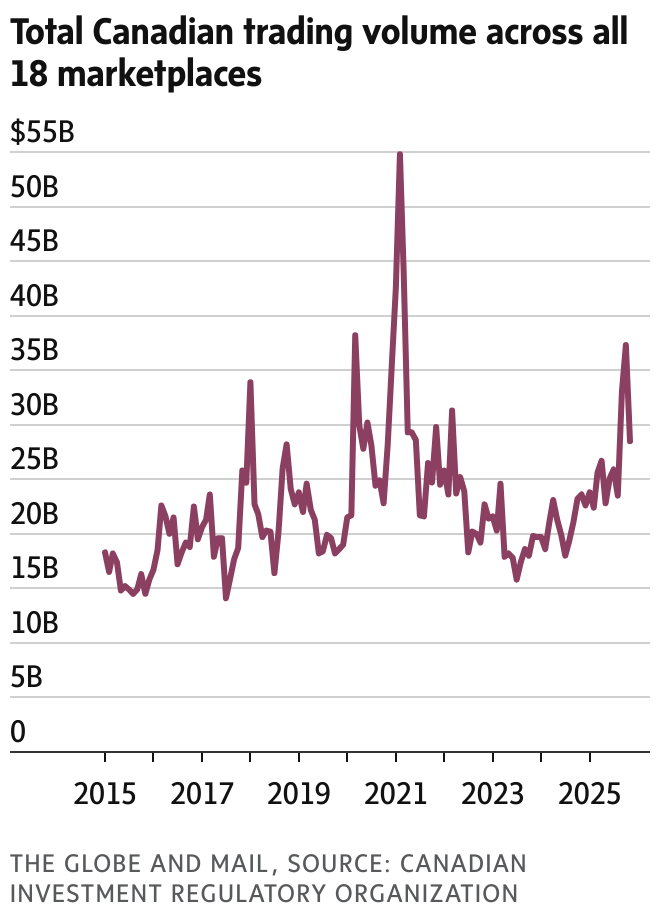
The vast majority of Canadian equities are listed on the TSX or TSX Venture Exchange, but there are a total of 18 different marketplaces owned by five separate companies where those securities can be traded. Now, a new alternative trading system is preparing to launch. CIX Trading Inc. will offer three trading venues, pushing the total number of equity marketplaces in Canada to 21. |
|
|
|
|
|
|
|
|
|
|
|
|
|
|
|
|
|
|