| | In this edition: Watching South Africa and DR Congo, Africa’s surging currencies, and longreads to l͏ ͏ ͏ ͏ ͏ ͏ |
| |  | Africa |  |
| |
|
 - The year in live journalism
- What we’re watching
- Africa’s surging currencies
- Striking number of 2025
- Persons of interest
- Longreads to linger on
 A book about the liberation of post-WWII colonial Africa. |
|
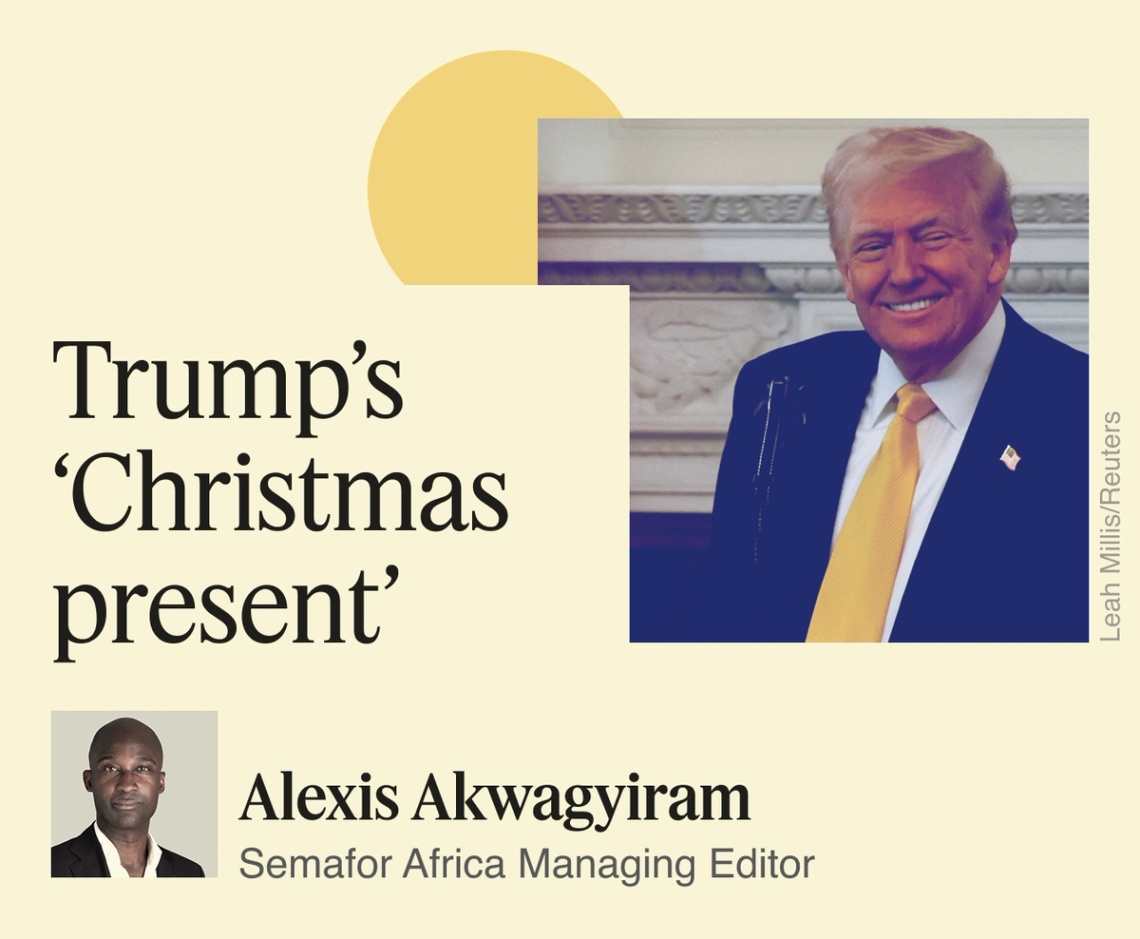 I hope you’re having a restful break over the holiday period. The news never stops, of course: Even as Semafor’s Africa team was looking back at the year, it poured in. As befits a year dominated by Donald Trump’s return to the White House, the biggest story of the past week was the US carrying out strikes against Islamic State-linked militants in northwest Nigeria on Dec. 25. I didn’t think Trump, who has previously shown a reluctance to commit to potentially messy military interventions, would have the chutzpah to follow up on his threat to go into Africa’s most populous country “gun’s-a-blazing” in order to protect Christians allegedly being persecuted. And yet his so-called “Christmas present” sums up a topsy-turvy year in which claims that Afrikaners and Christians are being oppressed in South Africa and Nigeria — fringe theories that have been doing the rounds for years — now dictate Washington’s relationship with sub-Saharan Africa’s biggest economies. The strikes may yet deepen security problems in northern Nigeria by driving polarization, as some commentators have suggested. I have no doubt that we’ll get into that in the new year. But first, we hope you enjoy looking back at the top stories that kept me, Yinka, and the rest of the Africa team busy in 2025. |
|
The year in live journalism |
 Massad Boulos (right), Washington’s senior Africa adviser. Dave Kotinsky/Getty Images for Semafor. Massad Boulos (right), Washington’s senior Africa adviser. Dave Kotinsky/Getty Images for Semafor.Washington was shifting focus to building a new relationship with Africa based on trade, the US State Department’s senior Africa adviser told Semafor at the Next 3 Billion event in New York. Massad Boulos — who said the Trump administration’s approach to the continent was grounded in peace, partnership, and prosperity — was just one of the many Africa-focused political and business figures we interviewed on stage this year. World Trade Organization Director-General Ngozi Okonjo-Iweala, at the same event, said African policymakers need to solve the logistical and payment issues that make cross-border trade expensive on the continent. We also took our events on tour. In Johannesburg, in the run-up to the G20 summit, South Africa’s special envoy said the country should diversify its commercial ties to protect itself amid the “weaponization of trade.” Nigeria’s deputy finance minister, speaking at our event in Abuja, said his government’s push to bring all citizens into the financial system has expanded the country’s capacity to mobilize domestic capital to fund projects. And, this month in Abu Dhabi, PayPal’s Africa chief revealed the company was in talks with African fintech players as part of plans to launch a global digital wallet on the continent in 2026. |
|
 Kevin Lamarque/File Photo/Reuters Kevin Lamarque/File Photo/ReutersSemafor’s Senior Editor Prashant Rao asked journalists across the newsroom two questions about the year ahead. 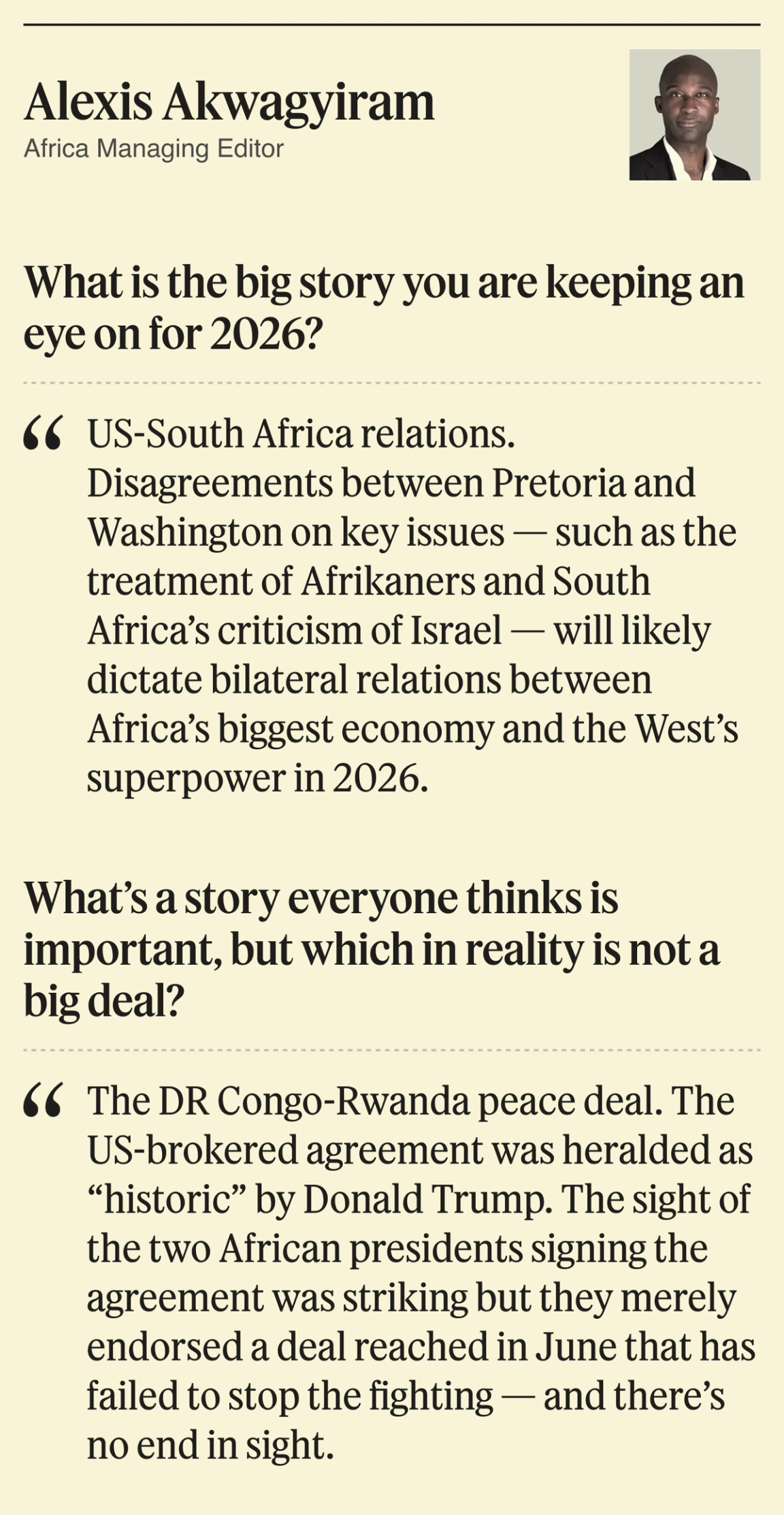 |
|
Africa’s top-performing currencies |
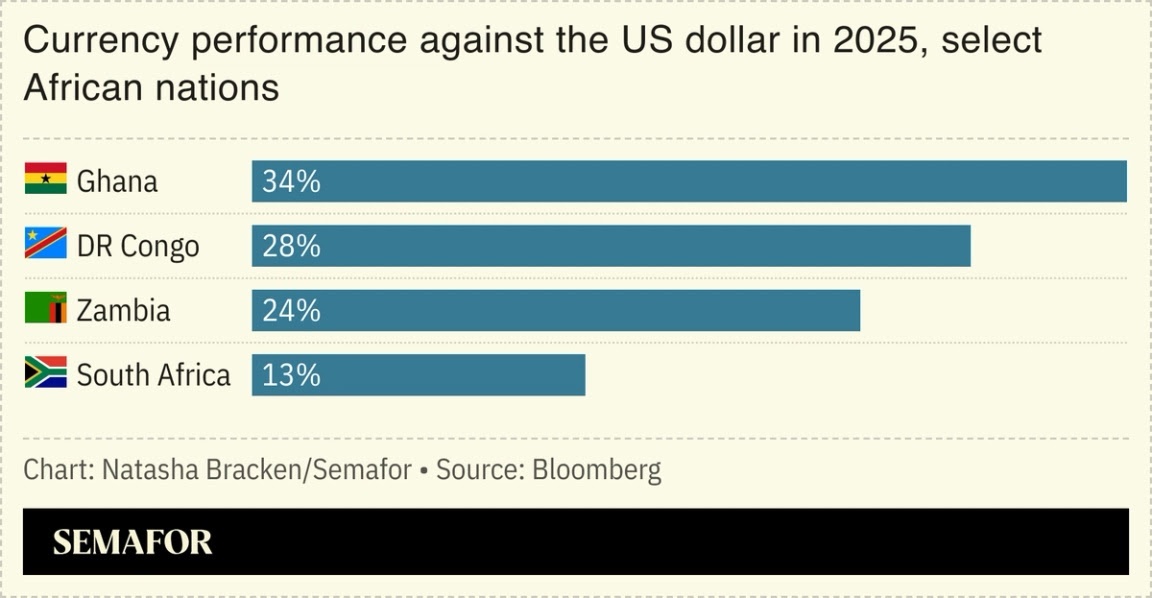 African currencies were among the world’s best performing in 2025, driven by soaring commodity prices and rising economic stability. South Africa’s rand is on track for its biggest annual jump in 16 years, as policy reforms, combined with a weakening dollar, drew investors to Africa’s most industrialized economy. Meanwhile, soaring metal prices — which saw gold, silver, and copper all hit record highs this year — have boosted the currencies of DR Congo, Ghana, Zambia, and other major African metal producers. The commodities boom has in turn boosted sub-Saharan African growth prospects, as benefits spill over to the broader economy, while likely easing the fiscal strain on increasingly debt-burdened nations. A version of this item first appeared in Flagship, Semafor’s daily global affairs briefing. Subscribe here. → |
|
|
 Semafor will be on the ground in Davos next month for the World Economic Forum, the annual gathering where the world’s most powerful come together to strike deals, tout their good deeds, and navigate the snow — sometimes getting stuck long enough to share a scoop or two with us. We’ll deliver exclusives on the high-stakes conversations shaping the world. Expect original reporting, scoops, and insights on all the deal-making, gossip, and lofty ambitions — with a touch of the pretentious grandeur Davos is famous for. Get the big ideas and small talk from the global village — subscribe to Semafor Davos. |
|
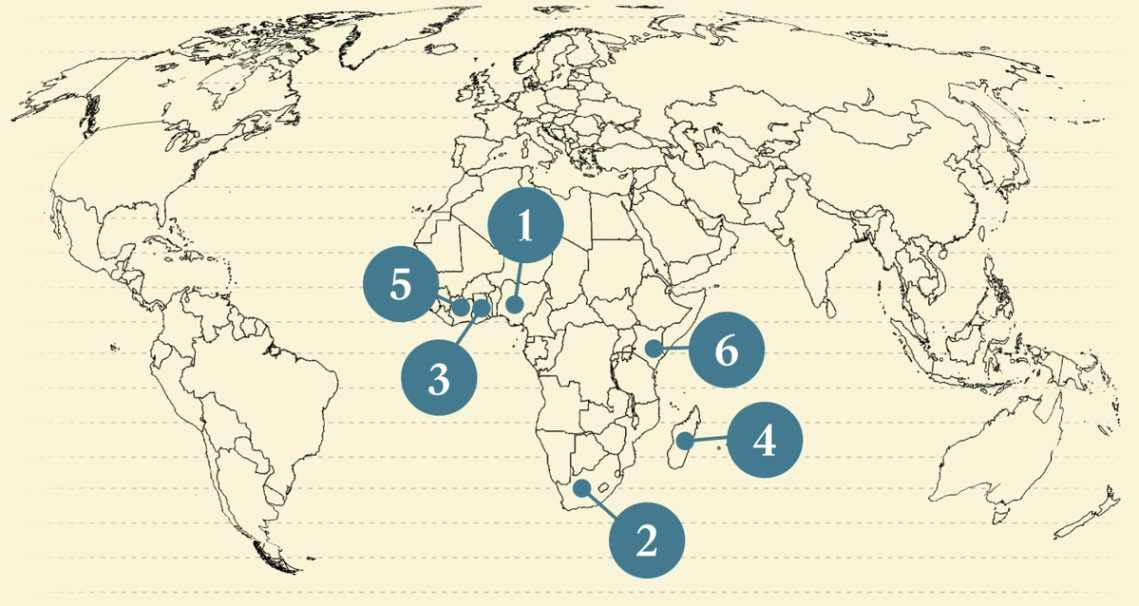
 The number of coups — successful and failed — in Africa in 2025. A massive uprising by Gen-Z protesters led to the military seizing power in the Indian Ocean island of Madagascar in October, followed a month later by a successful coup in Guinea-Bisseau. In the latter case, the timing of the apparent putsch, days after a presidential election and just ahead of official results, raised doubts over whether the coup was genuine. Most recently, military officers in Benin who attempted to seize the West African nation in early December were foiled by government forces. The coups are part of a regional trend: Since 2020, there have been 11 successful military takeovers in Africa, starting with Mali. Benin’s thwarted military coup was the fifth failed effort in the same period. A new study that explored whether coups, like pathogens, could be contagious, argued that “would-be plotters do indeed pay close attention when contemporaries seize power.” It found that coupmakers are bolstered by growing domestic support for military takeovers and the limited international consequences for those that take power. |
|
Persons of Interest in 2025 |
 Beatrice Chebet. Patrick Smith/Getty Images. Beatrice Chebet. Patrick Smith/Getty Images.South African President Cyril Ramaphosa played a crucial role in the continent’s biggest stories this year. At a tense Oval House meeting in Washington he calmly rebutted US President Donald Trump’s widely discredited claims of a white Afrikaner genocide, and at home held together a coalition government riven by long-standing divisions. He also oversaw a revival in Africa’s biggest economy that saw the country secure its first credit rating upgrade in 20 years. Former Credit Suisse chief Tidjane Thiam became emblematic of opposition figures who were undone by authorities that used “lawfare” to entrench political power. Thiam was barred from participating in Côte d’Ivoire’s presidential election after a judge ruled he lost his Ivorian nationality when he became a French citizen. President Alassane Ouattara, 83, went on to win a fourth term in October’s election. Kenyan long-distance runner Beatrice Chebet secured an historic double at the World Athletics Championship in Tokyo, winning the 10,000 meter and 5,000 meter races. Chebet, also a double gold medalist at the 2024 Olympic Games, became only the third woman to achieve the double over those distances at the World Championships. |
|
2025 longread recommendations |
 - In a series of stories during 2025, The New York Times reveals the scale of abuse faced by Kenyan maids in Saudi Arabia. It details cases of murder, rape, and beatings in an exploitative industry where reporters find that Kenyan government officials “personally profit” through financial interests in staffing agencies. Remittances from overseas workers play a major role in Kenya’s economy and President William Ruto has advocated for Kenyans to work in low-paid jobs in Gulf nations where they have few protections. Ruto’s own wife and daughter are the largest shareholders of the staffing industry’s major insurance company, the Times reports, citing records.
- Pan-African weekly magazine The Continent responds to the framing of an Atlantic feature about the Sudan war — where the front cover is headlined “The War About Nothing” — with an issued headlined “The war about everything in Sudan.” The opening editorial says it offers the perspective of five Sudanese writers as a “corrective” to the American lens, to give readers on-the-ground coverage of the country’s brutal civil war. The writers explore foreign economic interests, how gold funds the conflict, and an account of the siege of Khartoum, the first day of the war in March 2023.
- A year-long investigation found that the World Bank’s private investment arm deepened inequality by backing for-profit hospitals in Kenya and Uganda. Reporters from the International Consortium of Journalists conducted more than 70 interviews and unearthed court records and internal documents to reveal how the International Finance Corporation partnered with private equity firms to make the health care investments. They showed how “pressures to improve returns for investors” contributed to increased treatment costs that left some patients with crushing debt.
- And from Semafor, Alexis Akwagyiram and Kelsey Warner reveal how a $1 billion geothermal-powered data center project in Kenya’s Great Rift Valley has stalled. The first phase of the center — a collaboration between the Kenyan government, UAE AI firm G42, and Microsoft — was expected to be operational by around May 2026, but it still has not broken ground. Instead of helping Washington loosen Beijing’s grip on digital infrastructure in Africa, the stymied project has slipped out of the US’ priorities. It has been “undone by the challenge of creating a financial logic for geopolitically driven deals in emerging market battlegrounds between the US and China,” they write.
|
|
|


