|
 |
How the Legacy of Iraq Is Shaping the Dem Response to Venezuela
Members of a younger generation of elected officials—including combat veterans—have the last war on their mind.
|

| |||||||||||||||


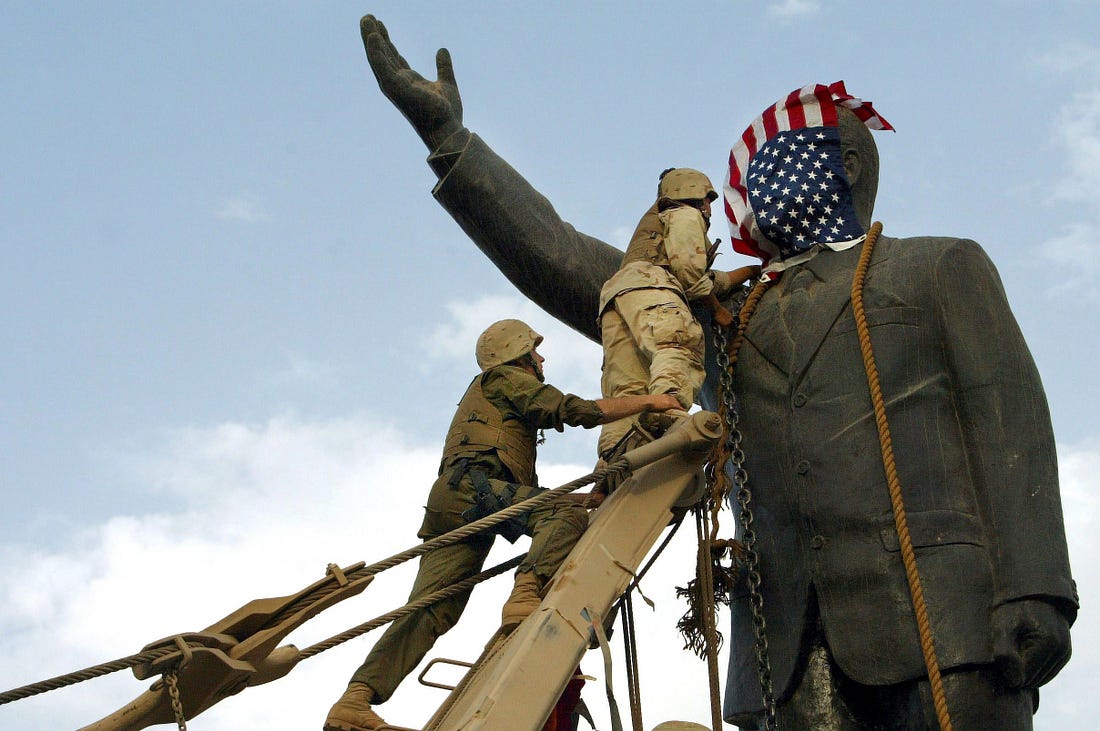 |
IN 2002, WHEN PRESIDENT GEORGE W. BUSH asked Congress to give him the authority to invade Iraq, the Democratic party, with few exceptions, acquiesced. Many, including all leadership, voted for the war resolution, wary of cementing the party’s image as being weak on national security, especially in light of the attack on 9/11.¹
More than two decades later, the party is facing another foreign policy challenge in President Donald Trump’s unauthorized invasion of Venezuela. And while its scope and breadth is obviously different from the Iraq War, there are clear parallels as well. The Trump administration’s use of the term “weapons of mass destruction” to exaggerate the threat of drugs supposedly coming from Venezuela² echo Bush’s false claims of Iraq’s secret biological weapons program. Oil appears to be a significant motivating factor for intervention. Both invasions were wars of choice, each with tremendous uncertainty about what would come after the initial military triumph.
But unlike in the early 2000s, Democratic leaders aren’t enthusiastically cowing to the Republican president’s war lust. Many, in fact, are aggressively pushing back. And it’s happening in a way that says a lot about the changing composition of the Democratic party.
If you’ve been following the political response to the Caracas operation, you may have noticed that the majority of voices in opposition to it are young—at least by congressional standards. Lawmakers like Massachusetts Rep. Seth Moulton, New York Rep. Pat Ryan, and Arizona Sen. Ruben Gallego have been criticizing both the specific operation and Trump’s newfound appetite for American imperialism more broadly.
In interviews, some of these lawmakers say they see the current moment as a chance to position Democrats as the anti-war party. But they also argue that another factor is at play: They came of age politically during U.S. interventions in the Middle East.
“A big reason I ran for Congress in the first place was to not see our country, which I love, make these same mistakes again,” New York Rep. Pat Ryan, a West Point graduate who served two combat tours in Iraq, told me. “We have an opportunity and an obligation to strongly assert ourselves as the anti-war, anti-intervention, anti-regime change party.”
Such rhetoric would have been unfathomable not so long ago. During the post-Jimmy Carter era, Democrats became terrified of being portrayed as the hippies on college campuses unwilling to go to war to protect Americans. And when the Iraq War authorization was being debated, any Democrat with an eye on running in the 2004 election concluded it would have been political suicidal to vote against the measure.
But as the situation in Iraq worsened, with close to 4,000 U.S. casualties by 2007, and tens of thousands of Iraqi civilian deaths, the party began to reassess. Barack Obama ran for the party nomination in 2007 on his opposition to the war. Donald Trump did the same in 2016 when campaigning against Hillary Clinton.³ Many Democrats who had authorized the war came to regret their votes.
Now, the generation that served in Iraq is filling the ranks of elected officials. They watched their friends die in combat and have dealt with their own PTSD since returning home, all for a war that they largely felt was pointless. They aren’t reluctant to come out in opposition to the use of military force abroad because they’ve lived it.
“Democrats finally are understanding that the American public is not pro-war and we’re not afraid to push back on this administration. I think that’s where this all comes from. And I think we’re seeing the results of also a lot more younger—and I say younger, people around my age, involved in politics and elected officials that grew up during the Afghan and Iraq war,” said Arizona Sen. Ruben Gallego, who served as a marine in Iraq, in an interview with The Bulwark.
“The people that were voting in 2001 were all the men and women that were dealing with the blowback from Democrats being considered soft on Communists from the Vietnam War,” Gallego added. “They were afraid to, I think, actually keep going down that line versus I think now, some of us younger veterans that are elected aren’t afraid to lead in the front when it comes to this kind of issue.”
That last line, in particular, stood out to me. During the run-up to Iraq, there were a handful of Democrats who did oppose the war (21 in the Senate). But they largely deferred to committee chairs and party leadership to set the messaging. In the immediate aftermath of Trump’s Venezuela operation, it’s been different: The younger generation