Video may have killed the radio star, but AI is starting to dance on its grave. Morgan Stanley’s annual survey of audio habits revealed that younger Americans are listening to an amount of AI-generated music each week that’s roughly on par with the run time of “Avatar.” And it’s not counting those sneaky songs on Spotify that hide they’re AI-made — the youth were talking about AI music they willingly consumed.
The S&P 500 closed flat on Thursday as investors were in a risk-off mood ahead of today’s jobs report. Tech was the worst-performing sector, sending the Nasdaq 100 lower. Small-caps rallied and the Russell 2000 jumped 1.1%. |
|
|
Yesterday, Google announced what could be its biggest change yet to Gmail, the world’s largest email service.
The company is adding an optional AI-powered inbox that prioritizes important messages, summarizes long threads, and lets users ask questions of their email the way they would Google’s Gemini chatbot — now built directly into Gmail.
|
- The idea is to turn email into something closer to a living to-do list. By drawing on information from users’ emails and calendars, Gmail will suggest actions, draft responses, and surface what it thinks matters most.
-
Do people want their email to be a living to-do list? Such questions are immaterial. Google wants Gemini to succeed, so congratulations! Your email will be a living to-do list.
-
Of course, companies like Apple have promised similar AI integration before and failed, so the features will actually have to work for them to be successful.
|
Google is giving access to the AI inbox first to “trusted testers” in the US and will make it available to consumers more broadly in the “coming months.” |
|
|
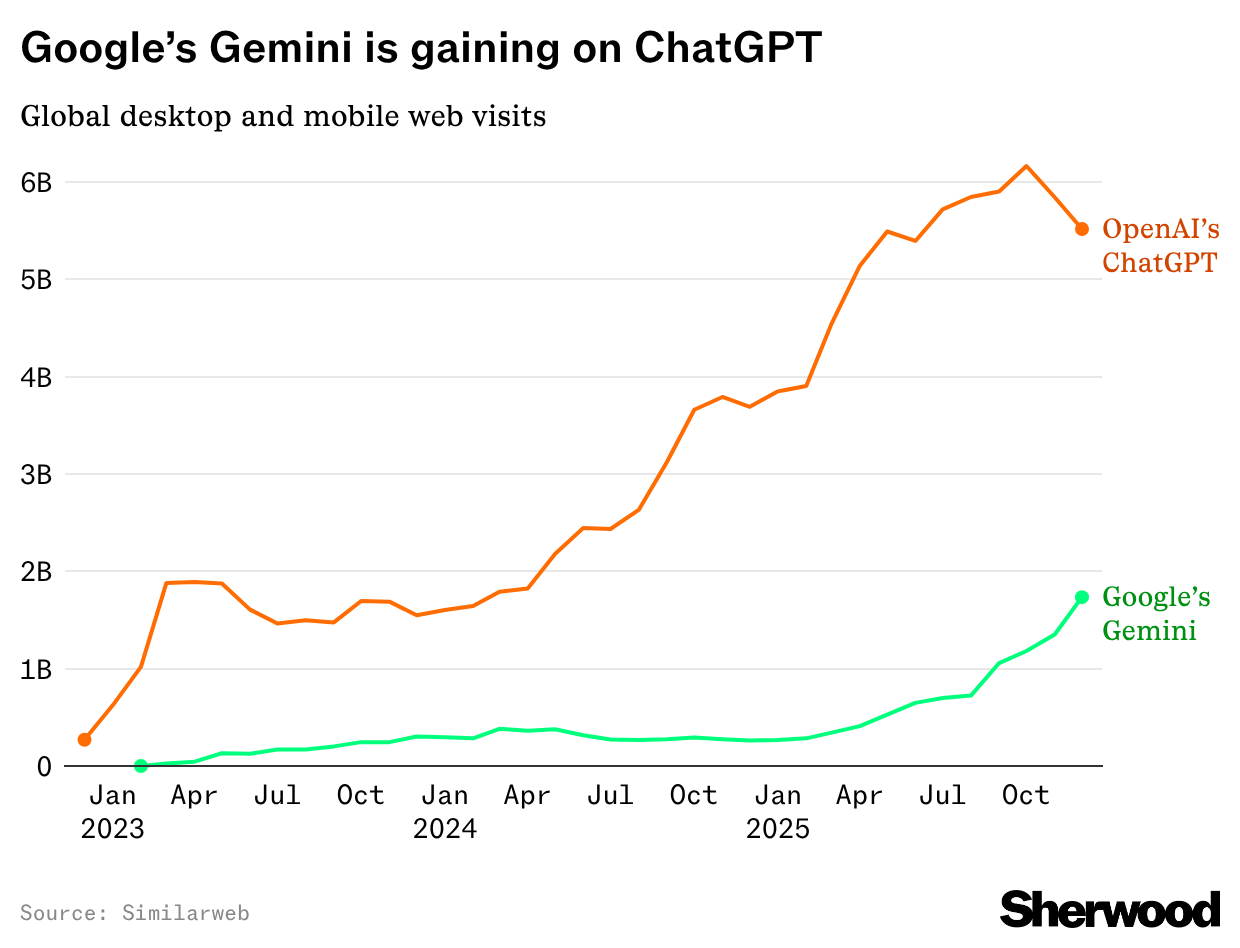
So far, Google’s AI efforts seem to be paying off. Traffic to Gemini’s website increased 28% in the last month, according to Similarweb, while ChatGPT’s shrank nearly 6%, though on an absolute basis ChatGPT is still well ahead. |
|
|
At the Consumer Electronics Show Wednesday, Google subsidiary Waymo announced the name of its latest self-driving vehicle, a Zeekr-made van called Ojai. It’s pronounced cutely as “oh-hi,” like the town in California it’s named after, and slated to roll out across Waymo’s planned 20-plus markets this year, but its real innovation is the price: roughly $125,000, which is way cheaper than previous iterations. That doesn’t sound cheap, but consider:
|
-
The vehicle itself is made exclusively for Waymo, but a similar build retails for around $38,000, and adding the sixth-generation driverless upgrades Morgan Stanley estimates cost an additional $85,000.
-
That’s a lot less than the current fifth-generation Waymo, which has twice as many cameras and costs about $120,000 to $130,000 to produce on top of its more expensive Jaguar I-Pace base, which goes for around $75,000.
-
Another lower-cost option may be coming, too: Waymo is also currently testing its sixth-gen software on the $35,000 Hyundai Ioniq 5.
|
Meanwhile, Ford is entering the autonomous race as well, announcing its plans to introduce “Level 3” eyes-off systems to vehicles being built on its new production platform in Louisville by 2028. The first vehicle planned for the platform is a $30,000 midsize EV truck, expected to come out in 2027. But in an interview with Reuters, Ford Chief EV and Design Officer Doug Field said the tech would not come at the $30,000 price point and would cost extra.
The elephant in the room is Tesla, which has pinned its future on making its existing lineup of cars driverless with software upgrades. Morgan Stanley estimates that Tesla Robotaxis cost just a fraction of what a Waymo does, at around $36,000, and expects Cybercabs to be an even cheaper $25,000. |
|
|
It’s not just about the cost of the driverless fleets, Morgan Stanley analysts wrote in a separate note responding to Nvidia’s rollout of autonomous tech. Analyst Andrew Percoco argued that while Nvidia’s tech stack offers a “capital efficient on ramp to advanced autonomy,” that still leaves automakers stuck in a “faster follower strategy… Tesla is years ahead of competitors when it comes to autonomy with a clear data and scale advantage.”
Tesla CEO Elon Musk said much the same thing, posting on X, “This is maybe a competitive pressure on Tesla in 5 or 6 years, but probably longer.” Go Deeper: Tesla vs. Google: Who has the wheel? |
|
|
Is this the finale? It seems that this multi-chapter saga in the battle to buy Warner Bros. Discovery is nearly over, as Paramount declared it will not up its $30-per-share bid, which has already been rejected twice. But would the Trump administration challenge the deal on regulatory grounds? Stranger things have happened.
|
|
|
|