A fresh take on culture, fashion, cities and the way we live – from the desks of Monocle’s editors and bureaux chiefs.
|
Saturday 10/1/26
|

|
|
London
Paris
Zürich
Milan
Bangkok
Tokyo
Toronto
|
|
|
|

Out and about
The year is off to a flying start and Monocle’s editors and correspondents are taking full advantage. We go in search of the original Panama hat (hint: it’s not in Panama), the Concierge shows us the best spots in Rome to do as the Romans do and we take umbrage at airport curfews. Then: we highlight the art exhibitions not to miss in 2026 and talk shop with the CEO of hotel-management company Marugal. Getting the wheels in motion is our editor in chief, Andrew Tuck.
|
|
Tread carefully: Why tyre trouble in the French countryside doesn’t mean the wheels have to come off
By Andrew Tuck
|

|
There’s an unspoken agreement on our epic Christmas drives from London to Palma. Wait, what am I on about, it’s very spoken. The other half makes it clear that he wants to do most of the driving and for me to manage the snacks, the dog and the music. He claims that it’s because he’s a bad passenger. What he means is that my driving strikes the fear of God into him: lane drift, looking at the passing landscape, not knowing what any of the buttons do. He’s harsh. But just before Christmas, as we came to the final stretch of day one, he admitted to needing a break and suggested that I do the non-motorway section to get us to our hotel in the town of Montluçon.
The town has, it transpires, used many road-design devices to slow down its urban traffic, including a system of chicanes featuring high-kerbed traffic islands. I know this because I hit one. With ambition. The car swerved but somehow no harsh words were said. A night at the Château Saint-Jean hotel was enjoyed. The following morning, a valet returned our car and we were off, with me not even pretending that I was getting anywhere near the steering wheel.
We pulled on to the motorway. “There’s a funny sound; can you hear it?” asked owl ears. I couldn’t but I needed to restock the snacks (it’s vital work) and the dog said that she wanted a croissant, so we pulled into the next service station and I did a car check. Oh dear. There was a blister on the tyre that had kissed the kerb. Don’t imagine a diddy thing on your toe, think plague-like bulla, a gargantuan pustule the size of an on-heat baboon’s radiant bottom.
We did some Googling (“your tyre might blow and you might die”). There was a call to our expensive breakdown cover provider (“bad luck, you must phone the police if you are on a French motorway. Bye.”). There was a family debate. It was a Sunday, just before Christmas but we were not far from the city of Clermont-Ferrand, home of Michelin, so surely we could drive slowly and find a tyre shop? It seemed that there was one which, via Whatsapp, we ascertained would be able to replace our warty ring of rubber. We limped along, lazy hedgehogs undertaking us on the hard shoulder.
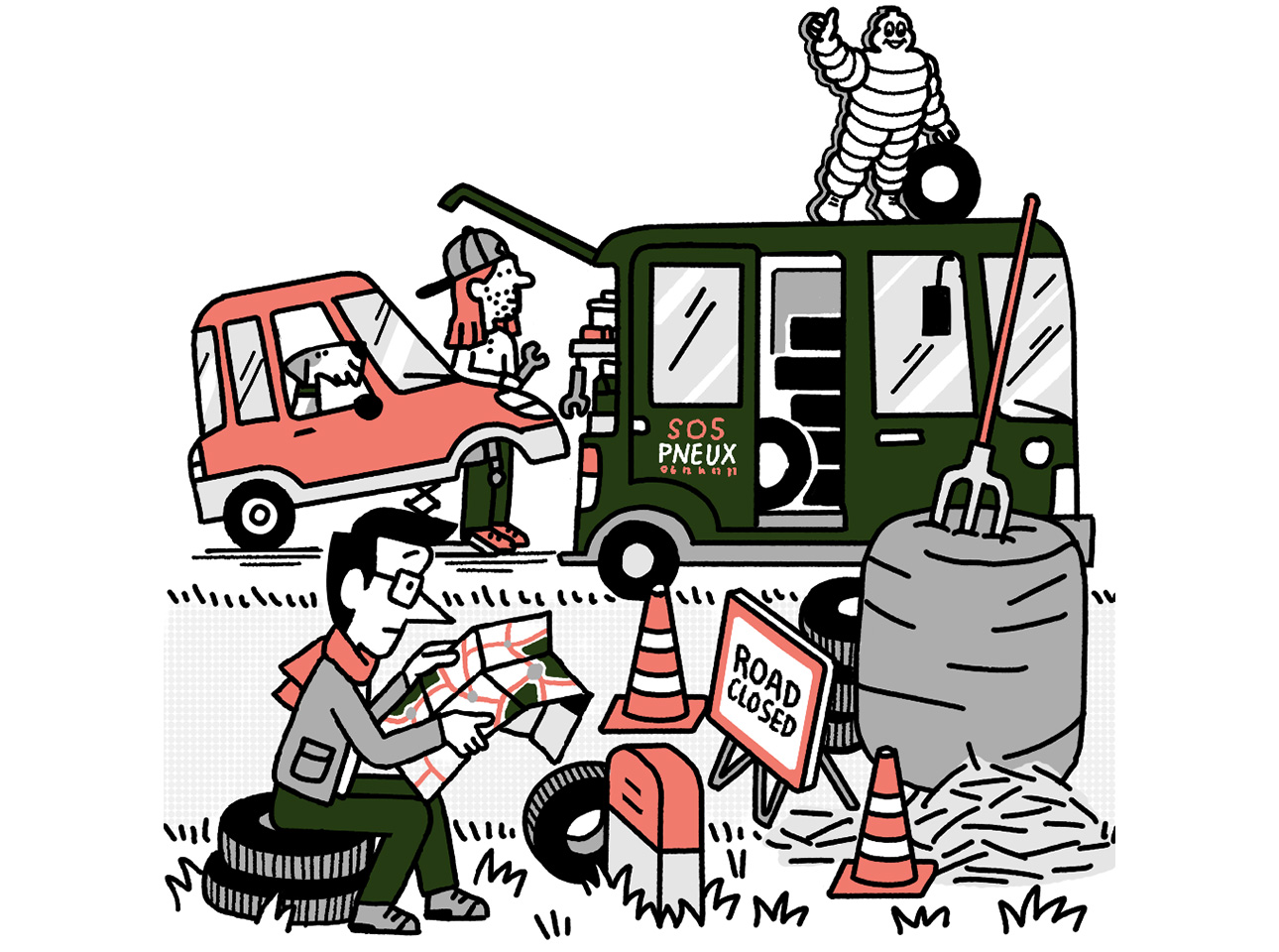
The tyre “centre”, however, was a bit of a surprise. It was a van, with broken wing mirrors drooping like dislocated limbs, parked on a road in an industrial part of town. In the back of the vehicle was squeezed a contraption capable of removing tyres from their hubs, another for balancing wheels. Oh, and the tyre that we would be purchasing was second-hand. We had no choice. Some two-and-a-half hours later (there were others in the same predicament ahead of us in the queue), we were on our way again. Our old tyre added to a pile by the repair truck.
Now we had a hard deadline for completing this second day of driving – a place on a ferry departing from Barcelona that evening. But even with the lost time, we would still be at the port two hours before it departed. Except that, after a few kilometres on the motorway, we hit a diversion. All the traffic was being siphoned off to a road that, judging by the satnav, would take us cross country – and for some distance. Back to Google, “Protesting French farmers are blocking the highway.”
Over the next two hours, we eased along narrow tracks, drove convoy style through forests and saw villages that I dearly hope never to see again. Every time that it looked like we might be about to rejoin the highway, the slipway was barricaded by bags of manure and piles of old tyres (I have a suspicion of who might have been supplying the farmers). Though not a single person was defending the barriers – there wasn’t a rustic rebel bearing a muscular arm and a pitchfork in sight.
Finally, there was a tyre-free motorway access point but by now the satnav said that we would arrive in Barcelona port only 35 minutes before the ship left and our ticket said that you needed to be there 90 minutes ahead of schedule. “We can do this,” said the other half bravely, before adding, “but no coffee stops, no loo breaks”. I looked at the dog. We crossed our legs.
And so, we drove. We wove. We began to make up time. We crossed the border into Spain. Signs for the port appeared. The dog’s and my legs were clenched like nut crackers. And, suddenly, there we were on a winter night in Barcelona joining the back of a line of cars snaking into the belly of a ferry. In the cabin we opened a bottle of champagne.
To read more columns by Andrew Tuck, click here.
|
|
URUGUAY  MONOCLE MONOCLE
|
|
THE LOOK: Panama hats
If you’re looking for an authentic Panama hat, head to Ecuador
International disputes about who invented what generally don’t come to blows (writes Gregory Scruggs). Chile and Peru skirmish over the right to trademark pisco in export markets. Greeks continue to pretend that their preferred coffee is anything but Turkish, while Estonian sauna entrepreneurs begrudgingly slap the Finnish label on their products if they want them to sell abroad.
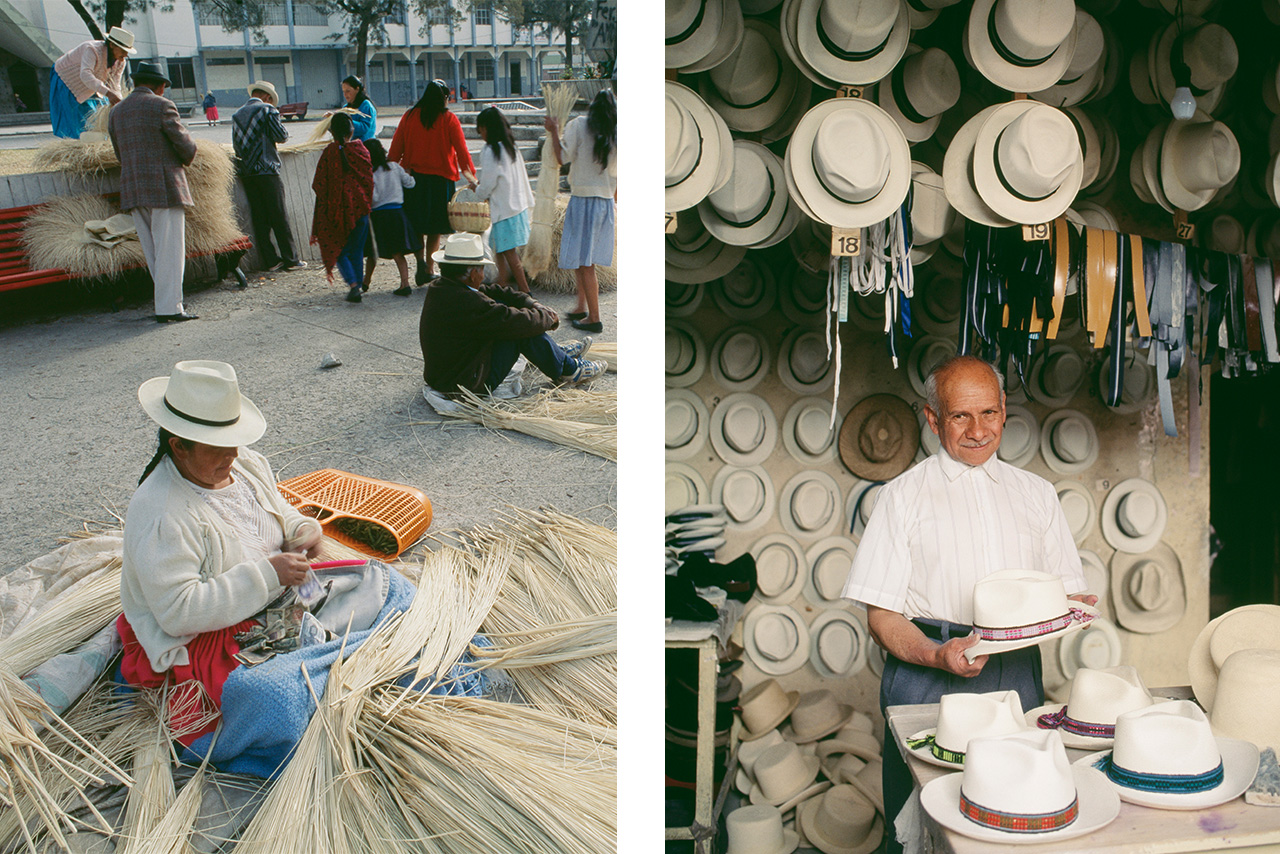
The same congeniality applies to a sartorial misnomer, one you might trot out on a tropical getaway in search of some winter sun. When donning a true Panama hat, look under the brim for the Ecuadorian flag. Spanish conquistadors encountered Incas wearing straw hats made from toquilla palm leaves in the 1500s, a painstaking handicraft that was commercialised in the 19th century. Panama became the head covering’s distribution hub and a 1906 photo of Teddy Roosevelt overseeing canal construction, with a wide-brimmed hat protecting his pasty visage, cemented the nomenclature.
The best quality hats come from the towns of Montecristi and Cuenca – I purchased mine from hatmaker Barranco – and discerning eyes will know. No less an authority than former Ecuadorian president Rafael Correa complimented mine at a press conference, before reminding me pointedly that Panama hats are, in fact, Ecuadorian.
Want to know what other world leaders are wearing this winter? Click here.
|
|
THE MONOCLE CONCIERGE: Rome
All roads lead to our handy Rome City Guide
Rome is a baffling and contradictory combination: breathtaking beauty and illustrious cultural heritage on one hand; a tradition of political mismanagement, unchecked tourism and creaking infrastructure on the other. The city was recently spruced up for the Catholic Church’s Jubilee year and the changeover of popes happened so gracefully that the Eternal City’s marvels enthused more than usual.
Perhaps you’re heading there to see it all scrubbed and polished or maybe you’re stopping off before heading north to the slopes. Here’s one suggestion from our Rome City Guide – a must read and handily downloadable before your trip.
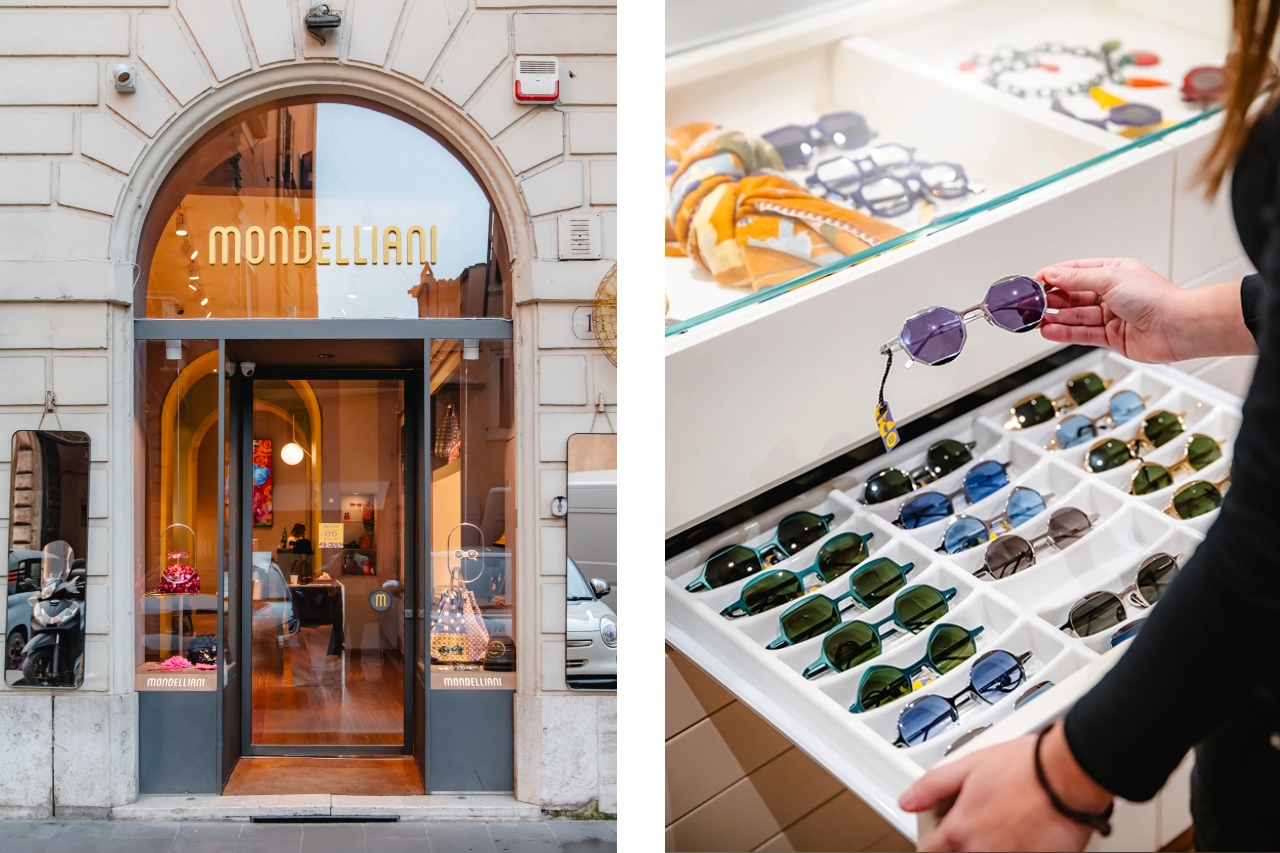
Mondelliani, Campo de’ Fiori (Centro)
This boutique is as much a design space as it is an eyewear shop. Now run by Federico Mondello, who took over from his father, Giancarlo, the space is known for its curated selection of independent brands and meticulous lens craftsmanship. Whether you’re after statement sunglasses or timeless optical frames, Mondelliani is just the place to find something truly special.
|
|
how we live: Airport curfews
Want a good night’s sleep in the German capital? Live by the airport
The captain’s voice crackled over the intercom as the last passengers took their seats (writes Blake Matich). “Ladies and gentlemen, please settle in as quickly as possible,” he said. “Berlin airport [BER] has a curfew and we’re against the clock.”
Having only just boarded after an already lengthy delay, I assumed that the airline had done the maths. I should’ve known better. Sure enough, the intercom soon blared back to life. “Sorry folks,” the captain said in a defeated tone, “but we’ve been informed that the curfew is now in effect and we’ll be unable to take off.” Dejected, the whirring engines wound down and a collective lament groaned through the cabin.
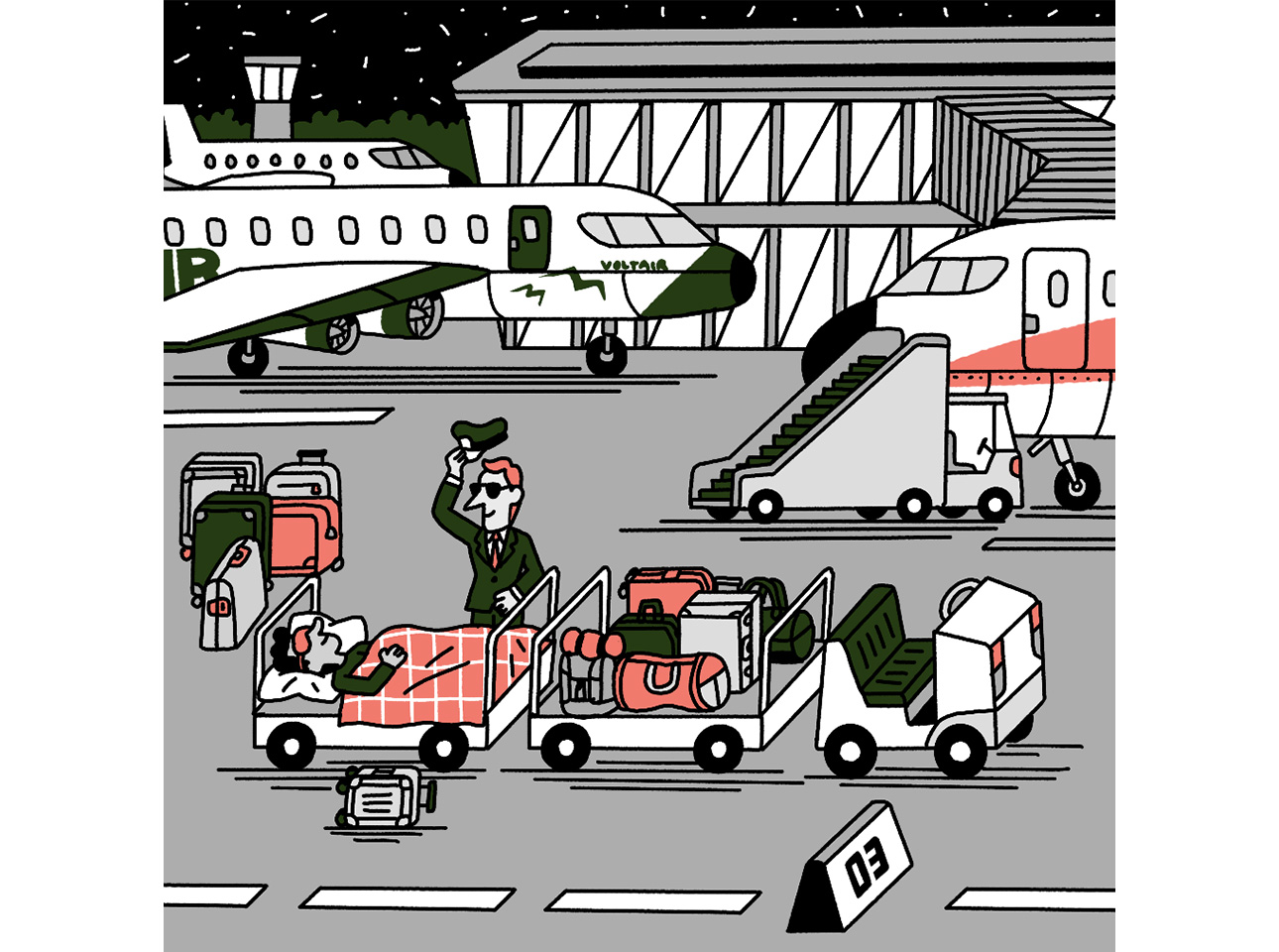
Cue the reverse procession: back through passport control with a planeload of happy campers, then a trudge through a snowstorm to the last available hotel room, a few sleepless hours and the same slog back in a pale, shivering dawn. The rescheduled flight? Delayed another six hours thanks to the pile-up of other planes grounded by the curfew.
I get it. Air traffic isn’t subtle and people need to sleep. But it’s not the fault of airports that urban sprawl has swallowed up once-outlying runways and left them smack bang in misophonic suburbia. Saying that, BER was opened in 2020 so it has no excuse.
And here comes the hypocrisy. While the curfew rigorously protects Berlin’s airport-adjacent residents from noise pollution, the same authoritarian enthusiasm is absent from the inner districts – where my neighbours blast industrial-strength techno all night and the Polizei do precisely nothing. Again, I should’ve known better. It was only after living in Berlin that I learned that techno doesn’t stand for “technically not music”.
As ever, Germany’s devotion to delusional exactitudes creates more problems than it solves. Despite Immanuel Kant’s best efforts to convince his compatriots that most rules are mere maxims rather than categorical imperatives, asking German authorities to treat rules as anything other than sacrosanct is like asking a dolphin for a haircut. A full flight already on the runway should be allowed to leave and a plane seconds from landing should be allowed to do so. Curfews should limit disruption, not amplify it across a continent.
Heading to the German capital? Heed our advice: avoid red-eye flights and check out our Berlin City Guide.
|
|
culture cuts: Art to see in 2026
Mark your calendars with these must-see art showcases for the year ahead
We have only just embarked on a new year but 2026 already promises much for those in search of a culture fix (writes Steve Pill). Here are a few exhibitions to put in your diary for the year ahead.
‘Raphael: Sublime Poetry’
The Metropolitan Museum of Art, New York
The US’s largest-ever Raffaello di Giovanni Santi exhibition has arrived more than 500 years after his death, aged just 37. Carmen Bambach, curator of the Met’s landmark 2017 Michelangelo show, has secured more than 200 pieces, from tapestries and sketches to the Louvre’s captivating “Portrait of Baldassare Castiglione”.
metmuseum.org
‘Sublime Poetry’ runs from 29 March to 28 June 2026
‘The 90s’
Tate Britain, London
Stylist and magazine editor Edward Enninful curates this fond examination of a decade that feels both increasingly distant and back in focus. Freewheeling optimism and a wilful disregard for previous hierarchies coursed through 1990s music, fashion, photography and YBA-led art, defining an era and setting the stage for 21st-century pluralism.
tate.org.uk
‘The 90s’ runs from 8 October 2026 to 14 February 2027

‘Mariko Mori’
Mori Art Museum, Tokyo
A homecoming of sorts, the Tokyo-born artist presents her first Japanese exhibition in 24 years at the Roppongi Hills museum founded by her uncle. Family ties aside, it will be fascinating to see how her increasingly spiritual sculptures and installations take shape across the 53rd-floor gallery space. A playful sense of transcendence awaits.
mori.art.museum
‘Mariko Mori’ runs from 31 October 2 | | | | |


