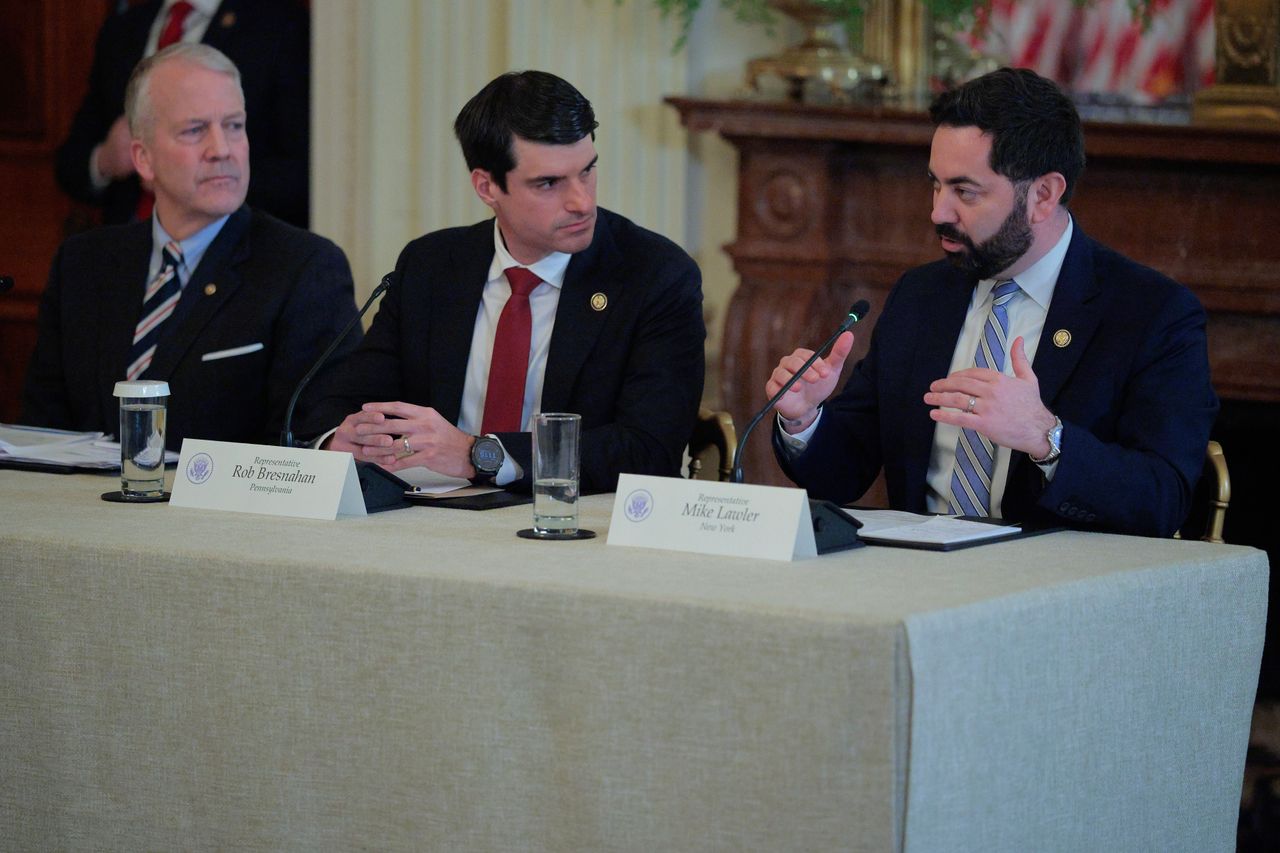
| |  | The Lead Brief | President Donald Trump, who wants to make health care a Republican-led issue in the 2026 midterm elections, on Thursday gave policymakers a blueprint to follow. On Friday morning, he followed that up with a White House briefing to tout the GOP’s Rural Health Transformation Program, which recently began distributing its first round of grants to states. The event featured Republicans in competitive races — Reps. Michael Lawler (New York) and Rob Bresnahan (Pennsylvania) and Sen. Dan Sullivan (Alaska), all of whom praised the president’s health policy proposals. Sullivan told Trump of his one-page outline of a health plan: “I bet every member of Congress votes for that.” (However, the reality is that it will likely be an uphill battle to not just turn Trump’s policies into comprehensive legislative text, but also to get it through both chambers of Congress.) Dan Diamond in The Washington Post newsroom has more on the White House’s roundtable this morning and the focus on rural health as an election-year issue. ‘IT SHOULD BE OUR ISSUE’ Last week, Trump told House Republicans that the party should make health care a top priority, as it provides an opportunity to connect with Americans during an election year on an issue that steadily ranks among voters’ main concerns. “It’s never been our issue. It should be our issue,” Trump said. → Meanwhile, Democrats are also likely to seize on Republicans’ cuts to health care programs in an effort to win back control of the House and Senate. My Washington Post colleagues Theodoric Meyer, Colby Itkowitz and Nick Mourtoupalas have a general overview of Senate races to watch as Democrats pursue a narrow path to Senate control. I’ve pulled out three competitive Senate contests where candidates are likely to center health care on the campaign trail. Alaska In addition to applauding Trump’s health care plan, Sullivan has promoted the more than $272 million in rural health funding Alaska was awarded from the new program, which was established by Republicans’ signature tax-and-domestic-policy law to offset massive cuts to Medicaid. Alaska received the second-highest amount from the Rural Health Transformation Program, following Texas’s $281 million. “This is the biggest investment in rural health care in American history, and certainly the largest investment in Alaska’s health care system from the federal government in our state’s history,” Sullivan said. Sullivan had been one of the few Republicans to vote to extend the now-expired enhanced Affordable Care Act premium subsidies, arguing that premiums would skyrocket following the expiration. Mary Peltola, a former House Democrat who lost her seat by just 2.4 points in 2024, jumped into the Senate race against Sullivan earlier this week. Alaska voters favored her 48 percent — compared to Sullivan’s 46 percent — in recent polling conducted before Peltola entered the race. In her campaign launch video, she previewed the looming campaign-trail battle on health care, pointing to the GOP law enacted last year that cut Medicaid and food assistance programs. “When [politicians] actually work together on something, it’s usually to help themselves,” Peltola said in the video. During the voice-over, a headline declaring the GOP law “Will Take Coverage Away From Millions of People and Raise Families’ Costs” flashed on the screen. Ohio Republican Sen. Jon Husted, who has been working to find a compromise on the Obamacare subsidies, is facing off against former Democratic Sen. Sherrod Brown. Brown lost his seat in 2024. Husted has blamed Brown for the health care cost issues faced by people with ACA plans, arguing that — while still a senator — Brown “created the failed Obamacare program” and voted for legislation that sunsetted the enhanced subsidies. “I’ve talked to people in Ohio, throughout Ohio, who are struggling to pay the premiums that Obamacare has created, the failed system that has created for them,” Husted said last month. Brown, meanwhile, has been holding forums on health care while on the campaign trail to hear from voters and small business owners. Asked about Husted’s criticisms, Brown told reporters: “He’s there to fix it. He hasn’t fixed it.” “The system is rigged and it’s only gotten worse since my opponent took office,” Brown wrote in a social media post last year. “Prices are increasing, 490,000 Ohioans will lose their health care, rural hospitals could close — all while Washington voted to give billionaires the largest tax cut in history. I’m ready to fix it.” Last month, the Democratic National Committee released Ohio-targeted digital ads slamming Husted on the premium subsidies. Georgia Democratic Sen. Jon Ossoff is protecting his seat from a Republican challenger to be decided in May. Ossoff has been vocal about protecting the ACA premium subsidies, something he’s made central to his campaign. “All of Sen. Ossoff’s GOP opponents in the Senate race have repeatedly refused to support extending the ACA tax credits, which 1.4 million Georgians rely on,” his campaign said in a statement Thursday that touted his $25 million election-year war chest. Those battling it out for the Republican nomination include Reps. Buddy Carter and Mike Collins, who are pitching themselves as strong Trump allies. Carter, a pharmacist, sits on the House Energy and Commerce Committee and has been passionate about moving legislative reforms to pharmacy benefit managers, a target in Trump’s new health care plan. Former University of Tennessee football coach Derek Dooley has the backing of Brian Kemp, the state’s popular governor. | 

_tstmp_1756933376-1920-1080.png)