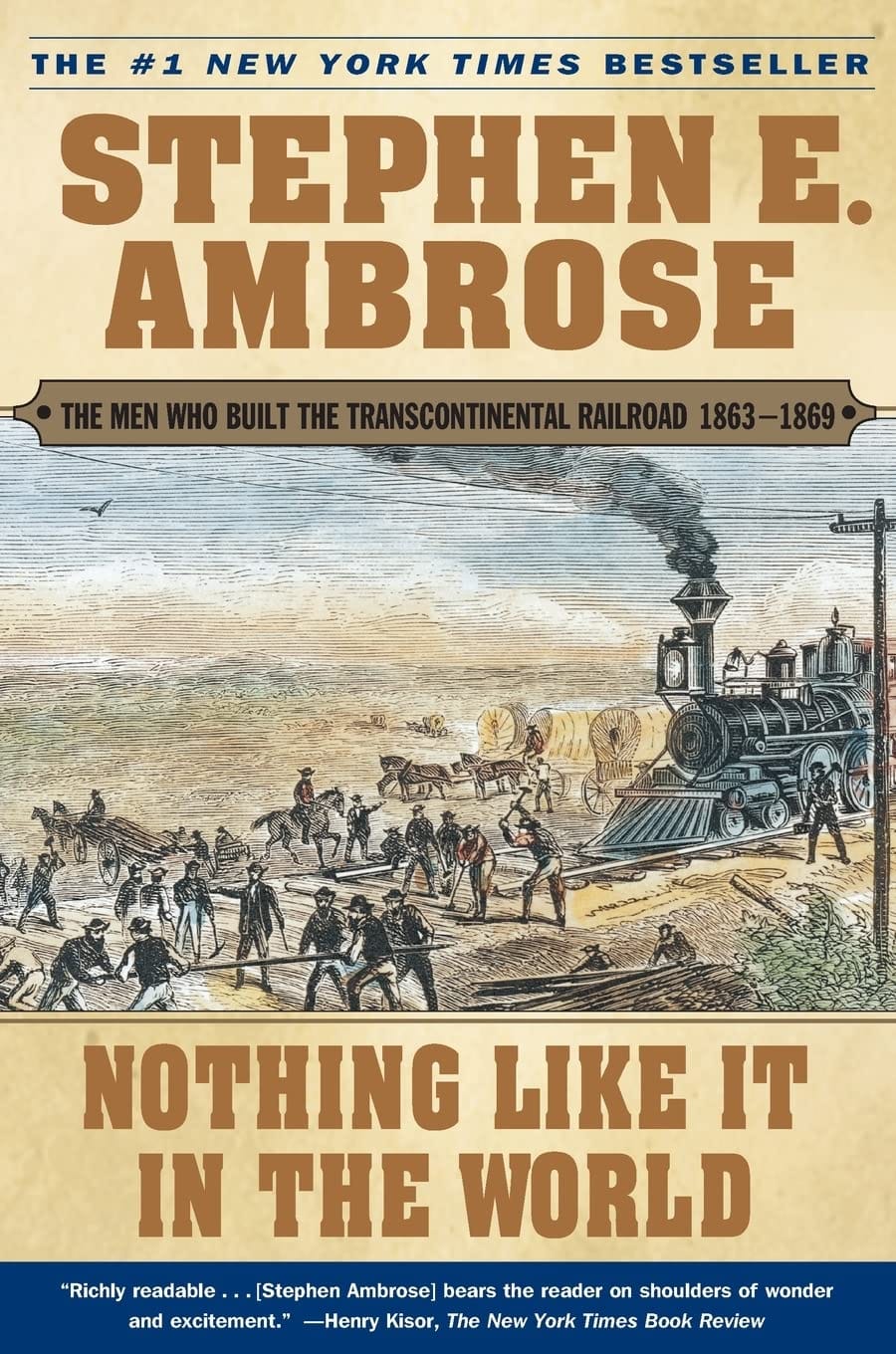
|
Nothing Like It In the World: The Men Who Built the Transcontinental Railroad 1863-1869
by Stephen E. Ambrose
Simon & Schuster
November 2001
432 pages The late historian Stephen Ambrose wrote more than two dozen books, many of them about presidents and other leading American historical figures. Perhaps his best-known book now is Band of Brothers, about the men in Easy Company in the 101st Airborne Division in Europe during World War II, because it was turned into the superb HBO series by the same name. Nothing Like It In the World is completely different. It is neither a biography nor an account of a famous battle. It is the story of the building of the Transcontinental Railway, which took place towards the end of the American Civil War and the years following it. The so-called “golden spike,” celebrating the completion of the railway, was driven into the rail on May 10, 1869 in Promontory Summit, Utah Territory. The spike was used to connect the two railroad companies building the Transcontinental Railway — the Union Pacific, building from east to west, and the Central Pacific, building from west to east, starting from Sacramento. I was encouraged to read the book by a Mormon friend — a former colleague at Citibank, who now lives in Utah and who was drawn to Nothing Like It in the World because Brigham Young and the Mormons played a major role in the railroad’s construction, as the two railway companies raced to complete the railway near Salt Lake City. Building the Transcontinental Railway was a spectacular feat of engineering, courage, and vision, and it was an important development in the ascent of America, both economically and culturally. Linking both ends of the country became important during the 19th century because of the isolation of its westernmost part. California was sparsely populated before the California Gold Rush, which began in 1848. Yet so many people poured in so quickly that Congress admitted California as the nation’s 31st state in 1850. (As part of the Compromise of 1850, California entered as a free state.) At the time, California was more than a thousand miles from the nearest state — and much of what was in between was wilderness. It was critical for Northerners (and, later, for Republicans) to maintain California as a free state and to bind it closely to the rest of the country — especially with the enormous numbers of pioneers heading west. But the only relatively safe means to travel from the eastern part of the United States to California in 1850 involved the lengthy passage around Cape Horn, or to Panama, or later Nicaragua, crossing the isthmus of Central America to the Pacific Ocean, and then boarding another ship for the voyage to California. President Abraham Lincoln was a key supporter of the Transcontinental Railroad and took action to initiate its construction. He signed the Pacific Railway Act on July 1, 1862, which chartered the Union Pacific and Central Pacific companies to build the line. The project was based on a basic American principle: competition. The Union Pacific and Central Pacific were in a race, because Congress created an incentive structure in its 1862 and 1864 railway acts awarding land and government funds based on the number of miles of track laid. The Pacific Railway Act provided for both government bonds (thus providing money) and major land grants for each mile of railway built. This encouraged the Union Pacific and Central Pacific to build the railway as quickly as possible, since the more they built, the more money and land they got. Congress didn’t explicitly define the meeting point of the two railways, leading to a fierce, competitive sprint. The most fascinating parts of Nothing Like It in the World are the people — the visionaries, the corporate executives, the supervisors on site, and the workers who built the Railway. It was not an easy task. The Union Pacific, coming from the east and building the Railway from Iowa to Utah, had to contend with the fierce Indian tribes (Sioux, Cheyenne, and Arapaho), who fought against the encroachment on their lands, attacking the crews of men, some of whom built with a shovel in one hand and a rifle in the other. A large proportion of the Union Pacific workers were ex-Union and Confederate soldiers. There were also thousands of Irish immigrants who were employed by the Union Pacific was well as newly arrived Germans and Italians. The Central Pacific, coming from the west, had to find a way for the Railway to make it through the Sierra Nevada mountain range. Ambrose goes into great detail about the tunnels that needed to be drilled through the Sierra mountains. The engineers and the workers had to bore through thousands of feet of granite. They used first dynamite and later nitro to blast their way through the mountains — often only progressing 10 or 15 feet a day. And who were the Central Pacific workers who did the lion’s share of this work, blasting the tunnels and enduring the fierce near-Arctic weather in the mountains? Chinese workers. These rugged Chinese men came to America because of the good wages, but often had to endure the fierce racial discrimination against the Chinese which existed at that time. Ambrose does an excellent job recounting the remarkable work ethic, courage, and perseverance of the Chinese working for the Central Pacific and how the Railway would not have been built without them. At the top were, of course, industrialists and corporate executives who guided the projects, and who built names for themselves while doing it. Just as the today’s culture knows all about Bill Gates, Steve Jobs, Elon Musk, and Mark Zuckerberg, there were the same type of larger-than-life figures in this 19th century narrative: With the Central Pacific, Leland Stanford (after whom Stanford University is named), Mark Hopkins (the San Francisco hotel), and Charles Crocker (the Crocker National Bank). Leading the Union Pacific, there were the Ames brothers (Oliver Ames Jr. and Oakes Ames from Boston), Grenville Dodge (a Union general during the Civil War), and Thomas Durant (head of operations and also president of the scandal-ridden Credit Mobilier construction company). It is a wonderful cast of characters. As the Railway neared completion, the American public took great interest in it. There was a sense of optimism about this great project — as one newspaper wrote, “American genius, industry, and perseverance can accomplish almost anything.” Robert H. Bradley is Chairman of Bradley, Foster & Sargent Inc., a $9.1 billion wealth management firm with offices in Hartford, Connecticut; Wellesley, Massachusetts; and four other locations. He is the founding chairman of the Massachusetts Family Institute and currently serves as its vice chairman. Read other articles by him here.
|