|
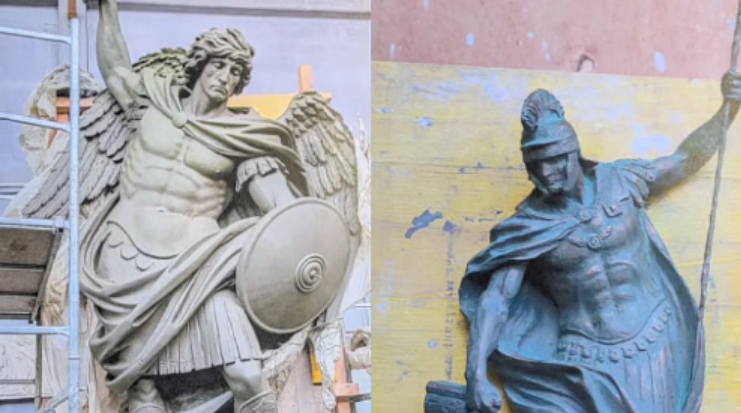
The Massachusetts Supreme Judicial Court has agreed to hear a legal challenge over the city of Quincy’s plan to install statues of St. Michael the Archangel and St. Florian on the exterior of its new public safety headquarters, putting a months-long local controversy on the state’s highest judicial stage. The case, Fitzmaurice v. City of Quincy, stems from a lawsuit filed by a group of Quincy residents seeking to block the installation of the statues, which Mayor Thomas Koch commissioned to honor police officers and firefighters. The plaintiffs argue the statues violate the Massachusetts Constitution by amounting to a government endorsement of Catholicism. Koch welcomed the high court’s decision to take the case and said the city will defend the project. “We look forward to defending Quincy’s plan to honor our brave first responders at the Massachusetts high court,” Koch said in a press release. “These statues will reflect the values our police officers and firefighters live out every day — courage, sacrifice, and service.” The planned statues are 10-foot-tall bronze depictions of St. Michael the Archangel and St. Florian, figures long associated with policing and firefighting. Police departments across the country have used St. Michael imagery as a symbol of protection against evil, while St. Florian has historical ties to firefighting and rescue. Fire departments commonly use the Florian cross as an emblem. Quincy commissioned the statues from the same artist who created the city's statues of John Adams and John Hancock. City officials have said the goal is to honor public servants using imagery already meaningful to the police and fire departments. The lawsuit was filed in Norfolk Superior Court in Dedham in May 2025 by residents who describe themselves as members of diverse faiths. The plaintiffs are backed by the American Civil Liberties Union of Massachusetts, Americans United for Separation of Church and State, and the Freedom From Religion Foundation. A Superior Court judge blocked the installation of the statues last fall, prompting the city to appeal. The Supreme Judicial Court’s decision to take the case clears the way for a statewide ruling on whether Quincy can proceed with the statues, which cost about $850,000. The city’s legal defense includes representation from its solicitor, James Timmins, and the nonprofit law firm Becket. Becket argues the statues fall within longstanding legal precedent allowing religiously rooted symbols in public spaces when they serve historical or commemorative purposes rather than religious worship. The U.S. Supreme Court has previously upheld such displays, including a World War I memorial featuring a cross. But the case before the state's highest court concerns only the Massachusetts Constitution. Supporters of the statues include Quincy Police Chief Mark Kennedy, who told city councilors earlier this year that he views the figures as symbols of duty, protection, and sacrifice rather than religious statements, as NewBostonPost previously reported. Not all city officials agree. Now-former City Councilor Dan Minton, a retired Quincy police officer, has said he thinks that common depictions of St. Michael could be interpreted as violent. The ACLU has also argued that imagery of St. Michael standing over a demon evokes themes of police brutality. The statues are planned for the city’s new $175 million public safety building on Sea Street, which will house police headquarters, fire administration, and emergency services. The building is scheduled to open in October 2025. Court filings show the city has already committed at least $850,000 to the statue project. The Supreme Judicial Court has not yet scheduled oral arguments. ACLU Massachusetts could not be reached for comment on Monday or Tuesday.
|