| | In today’s edition: The hunt for a new Federal Reserve chair draws to a close, and a deal to avert a͏ ͏ ͏ ͏ ͏ ͏ |
| |  | Washington, DC |  |
| |
|
 - Warsh set to be Fed pick
- Senate’s shutdown deal
- House faces tough week
- Homan’s moment
- Econ data risk
- Big Commerce departure
- Ukraine progress?
PDB: Omar attacker charged  Apple reports record-breaking quarter … NYT: Trump mulling new military options against Iran … Gold ⬇️ 8%, silver ⬇️ 15% |
|
Warsh expected to be Trump’s Fed pick |
 Brendan McDermid/File Photo/Reuters Brendan McDermid/File Photo/ReutersPresident Donald Trump is expected to nominate former Fed governor Kevin Warsh to helm the central bank, but his confirmation still faces political hurdles. Trump said he would announce his pick this morning, concluding a process that has spanned four months and nearly a dozen candidates — and which has sparked fears about the central bank’s independence, particularly after the Justice Department opened a criminal investigation into Chair Jerome Powell. Treasury yields rose on bets that Warsh would not maintain recent interest rate cuts, even after last year he aligned himself with Trump on the need for lower rates. Trump pivoted away from one finalist, adviser Kevin Hassett, amid skepticism that Hassett could distance himself from the White House. Yet whomever Trump picks has no current path to confirmation: Sen. Thom Tillis, R-N.C., is committed to blocking the nominee over the DOJ’s Powell probe. — Eleanor Mueller |
|
Schumer and Trump make breakthrough |
 Kent Nishimura/Reuters Kent Nishimura/ReutersSenate Democrats and Trump struck an agreement to fund most of the government through September — and the Department of Homeland Security for two weeks. The Senate is poised to approve a deal as soon as today that gives Democrats an opportunity to renegotiate immigration enforcement policy on a tight timeline. Republicans say Trump haggled directly with Senate Minority Leader Chuck Schumer to get the deal, which takes a shutdown that Trump really didn’t want off the table. That said, Senate conservatives don’t like it, and actually enacting a bipartisan DHS bill with the changes that Democrats want is going to be very difficult. “I don’t mind adding some things to DHS, to rein in ICE. Body cameras, no masks, ” Sen. Lindsey Graham, R-S.C., told Semafor. But, he added, “It has to include ending sanctuary cities, or it’s no deal.” And getting the funding bill through the House is not guaranteed. — Burgess Everett |
|
Inside the House’s spending deal Jenga |
 Aaron Schwartz/Reuters Aaron Schwartz/ReutersThe Senate may be having a tough week — but the House may well be about to have a tougher one. Lawmakers expect to return to Washington Monday with already lapsed government funding and a Senate-struck bipartisan deal, leaving them remarkably little margin of error to stave off a true shutdown. There are potential problems on both sides of the aisle: Many Democrats are wary of extending DHS funding, even temporarily, without any new restrictions. GOP hardliners don’t want to put off funding DHS for a full year — and especially not by funding it for just two weeks. And still others are treating their second bite at the package as a fresh opportunity to tack on their own priorities. That includes Rep. Anna Paulina Luna, R-Fla., who called Thursday for lawmakers to attach legislation that would require voters to provide proof of citizenship to “every single appropriations bill.” — Eleanor Mueller |
|
Homan tasked with Minnesota drawdown |
 Shannon Stapleton/Reuters Shannon Stapleton/ReutersThe Trump administration is leaning on border czar Tom Homan to defuse the situation in Minnesota after almost a week of nonstop media attention — and the decision to send one of Trump’s most trusted confidants to the state might be starting to pay off. On Thursday, Homan announced plans to “draw down” ICE and CBP operations in Minnesota and admitted that things can be improved. “He said at least twice he wasn’t there for a photo op, and he was there to de-escalate. That’s what happens when you put a professional law enforcement officer in the role versus people who have no experience,” said Sen. Thom Tillis, R-N.C.. The White House is hoping the changes will assuage some of the bipartisan concerns raised this week — but Democrats are still holding firm on their own demands regarding changes to DHS. — Shelby Talcott |
|
Funding lapse threatens economic data |
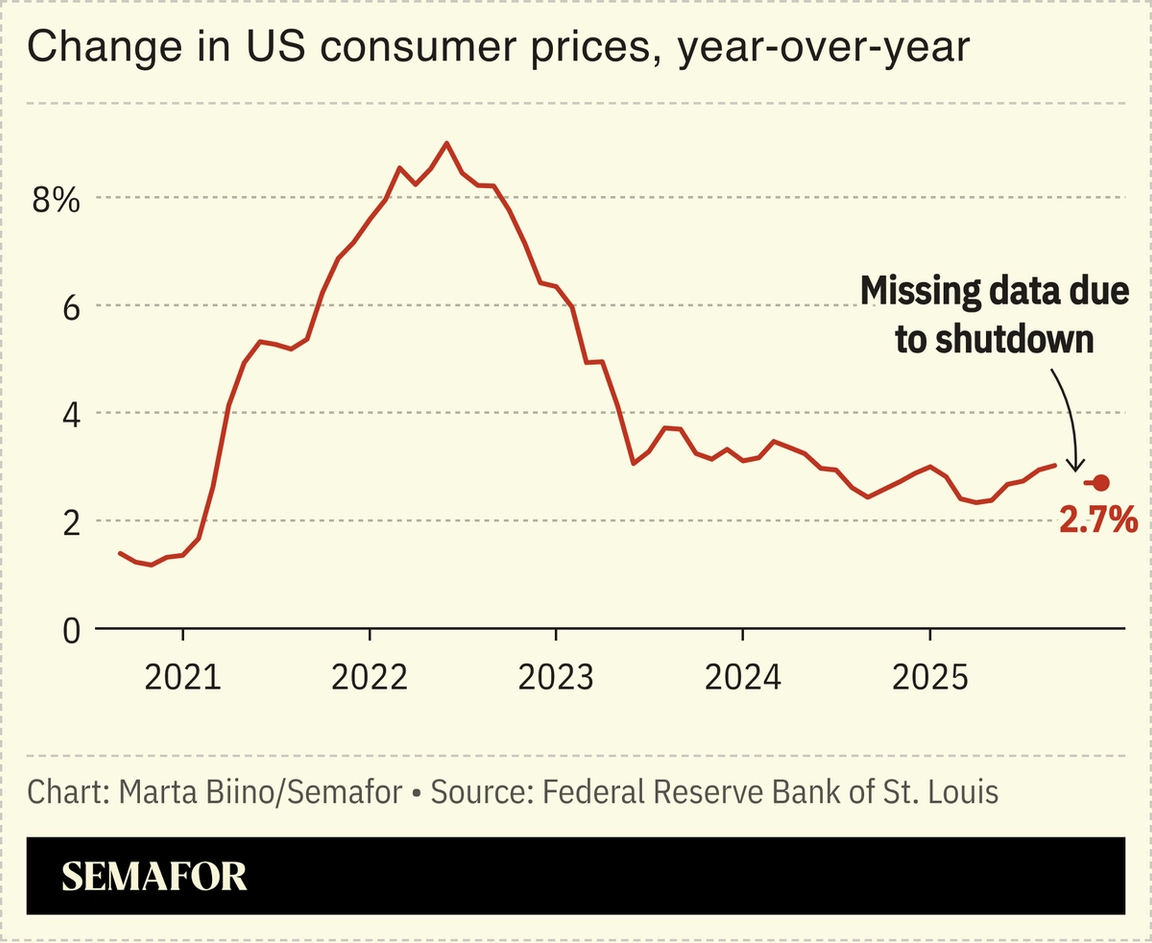 If Washington can’t enact appropriations legislation by early next week, there could be consequences for some economic data still recovering from the last government shutdown. Federal Reserve Chair Jerome Powell remarked Wednesday that the US is finally “getting through the distortions in the data” after federal agencies went dark for six weeks. Another funding lapse would set back the Labor Department’s widely relied-upon measure of inflation yet again. “CPI prices, during a normal month, are collected throughout the month, so even if the shutdown is brief, it would affect the quality of the CPI reading for February,” David Wilcox, an economist with Bloomberg Economics and the Peterson Institute for International Economics, told Semafor. He said a shutdown would not impact the jobs report unless it lasts more than two weeks. Also safe: data collected by the Commerce Department, which lawmakers funded through September. — Eleanor Mueller |
|
Power player Grimes exits Commerce |
 From left: Michael Grimes, Linda Yaccarino, former X CEO, and Claudio Madrazo. Leigh Vogel/Getty Images for Uber, X and The Free Press. From left: Michael Grimes, Linda Yaccarino, former X CEO, and Claudio Madrazo. Leigh Vogel/Getty Images for Uber, X and The Free Press.A central player in the Trump administration’s private-sector investment strategy is returning to Silicon Valley, Semafor’s Liz Hoffman scooped. Michael Grimes, a longtime adviser to Elon Musk, is leaving the Commerce Department where he ran the US venture arm, helping to direct the White House’s unprecedented investments in national security sectors. Commerce Secretary Howard Lutnick will take over the effort, Liz reports, a sign of him consolidating power at the agency. Lutnick has been recruiting from Wall Street banks and private-equity firms in recent weeks to scout projects. It’s not clear what’s next for Grimes, who took some of Silicon Valley’s biggest companies public during a 30-year career at Morgan Stanley, but he might be involved in the record-setting IPO of Musk’s SpaceX later this year. |
|
Trump points to Ukraine progress |
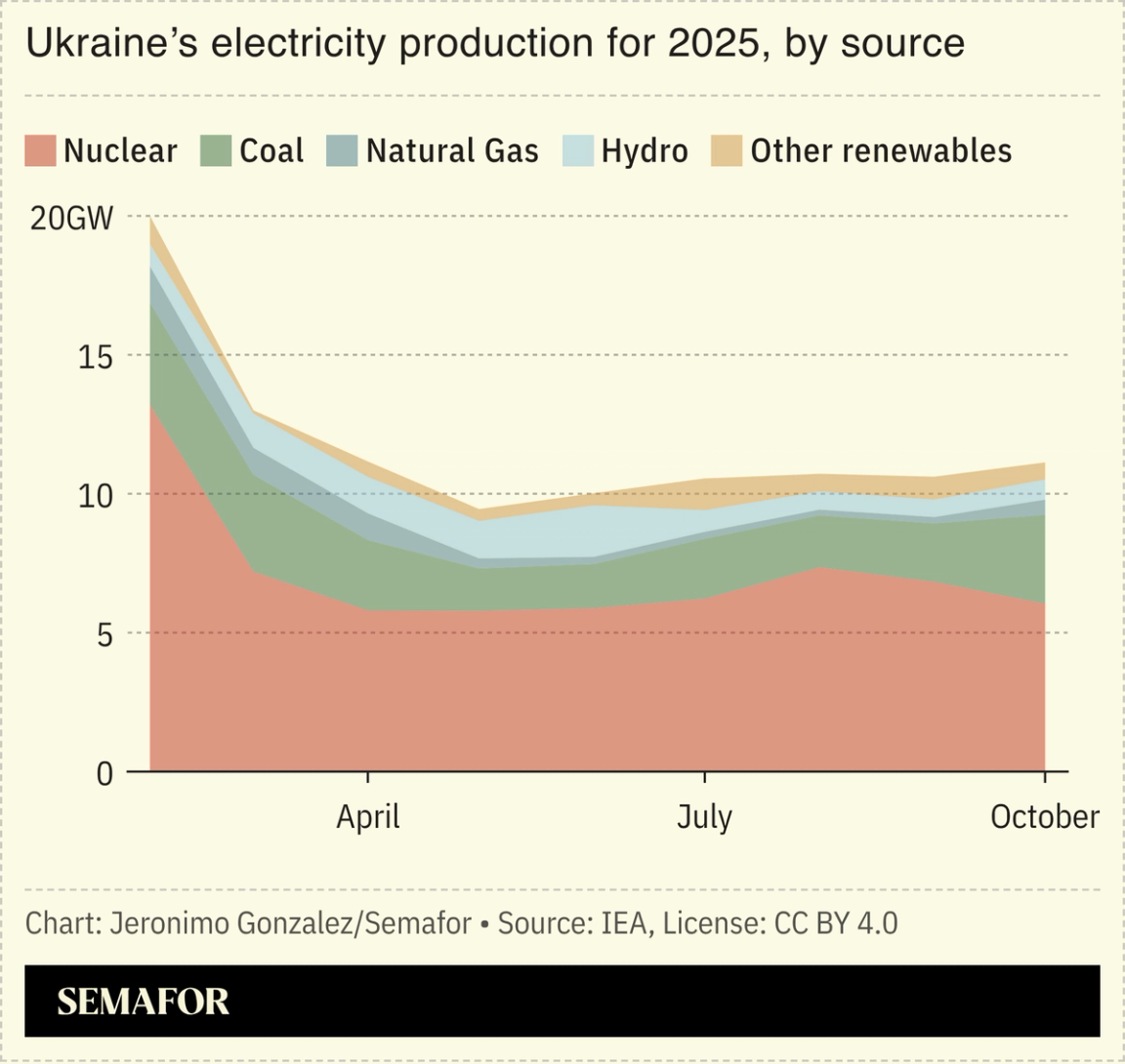 The White House is heading into a weekend of talks on the Ukraine war with an optimistic tone. Trump said he secured a pledge from Vladimir Putin not to bomb Kyiv for a week during the extreme cold, which would represent a notable commitment from the Russian leader. “If they are ready to talk about some kind of a ceasefire, even temporary, it is worth visiting,” a senior Ukrainian official told the Financial Times, which reported the idea was discussed during talks in the UAE. Russia has repeatedly targeted Ukrainian energy infrastructure with strikes, leading to power outages. And it remains to be seen whether Putin’s actions will match his words; he offers up “a lot of bullsh*t,” Trump said last July. Meanwhile, Russian Foreign Minister Sergei Lavrov rejected a key tenet of peace talks, fueling doubts about a breakthrough. |
|
Debatable: Trump’s national defense strategy |
 The new national defense strategy the Trump administration rolled out made headlines for deprioritizing China compared to past iterations. Deterring China’s aggression in the Pacific is still among its listed priorities, but the document focuses first on defending the US and the Western Hemisphere. While there is agreement in Washington on countering China, lawmakers and experts diverge on whether the new US strategy presents an adequate framework for doing that. Rep. John Moolenaar, R-Mich., who chairs the House select committee on China, commended Trump’s “peace through strength” approach to Beijing and said the strategy “wisely … recognizes our strength is built at home.” Rep. Ro Khanna, D-Calif., his Democratic counterpart on the committee, said Trump’s strategy “fails to recognize China’s increasingly aggressive behavior in the region.” |
|
 On this week’s Mixed Signals, Bell Media CEO Sean Cohan joins Ben and Max to unpack the success of Heated Rivalry and how the gay Canadian hockey romance became an overnight cultural sensation amid Hollywood’s heralded vibe shift, as major production companies in the US have increasingly catered to broader or more conservative tastes. Cohan also talks about Bell’s strategy of using licensing deals to reach new audiences, the enduring power of a well-told romance, and why Canadian storytelling is only getting started on the global stage. |
|
 Beltway NewslettersPunchbowl News: New polling from Republican Arkansas Sen. Tom Cotton’s PAC finds that while a plurality of Americans want ICE to scale back its tactics, most still back deportations. Playbook: Sen. Thom Tillis, R-N.C., on his efforts to obstruct President Trump’s nomination for Fed chair: “I grew up in a trailer park and I like a good scrap.” Axios: Gen Zers are surprisingly optimistic about their career prospects. WaPo: Virginia’s Democratic Gov. Abigail Spanberger faces a dilemma: play it safe on redistricting, or “gamble on a play that could give Democrats four more seats… and that might be disastrous for her party if it does not?” White HouseCongress |
|
|


