 |
|
Audit Buzz Newsletter
February 2026
|
Engagement and Office Updates
In this issue, we discuss the Office of Auditor General's (OAG) external peer review; provide the first article in the Coffee and Compliance Series; and offer a training opportunity.
Prior editions of Audit Buzz are archived here on OAG website.
As always, we appreciate the cooperation and courtesies extended to our staff by Fairfax County Public Schools (FCPS) management and staff during all past, current, and future audit engagements.
Here is a challenge to test your audit knowledge, before we begin this issue:
Say What You See
Hint: OAG professional standards are issued by this office.
OAG External Peer Review
Do you know that auditors can also be audited? At OAG, we follow the Generally Accepted Government Auditing Standards (GAGAS), where it requires OAG to be peer reviewed once every three years, by independent external reviewers. This peer review included an examination of our system of quality control (i.e. the infrastructure that we established to conduct audits) and audit engagements, and interviews with auditors. We are happy to report that we received the highest rating possible – pass with no management comments.
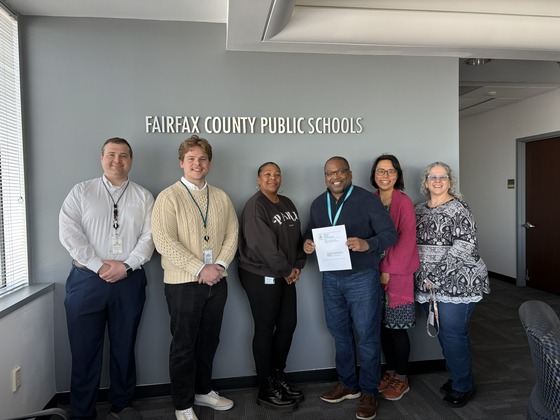 Picture with peer reviewer: Bruce Landrum, Audit Manager, Milwaukee County Office of the Comptroller
The review team, comprised of internal audit managers from the Milwaukee County and the City of Memphis, conducted detailed inquiries into fieldwork standards, supervision, and policy updates.
During the interview with our auditors, questions are usually asked around fieldwork standards, audit process, supervision review comments, training and policies and updates. All these questions revolve around the quality control procedures.
Key Takeaways:
- Greater appreciation for documentation and consistency
- Value of ongoing training and communication
- Importance of fieldwork standards
- Being intentional with documenting procedures
- Proactively seeking and addressing supervisory feedback
- Lastly, ensuring independence is obtained and documented
In conclusion, the experience highlighted the importance of strong quality control and continuous improvement in auditing.
Knowledge Hive
Coffee and Compliance Series: Changing the Narrative Around School Auditing
They say that behind every great school is a mountain of paperwork and behind that paperwork is a dedicated finance team fueled by coffee and commitment to getting it right. But let us be honest, when the word “compliance” is mentioned, most people do not think of a warm cup of coffee. We are changing that narrative.
Welcome to Coffee and Compliance, a new series designed to pull back the curtain on school audits. Our goal is to replace the “audit anxiety” with a sense of shared purpose. We believe that compliance is not just about following the rules; its about protecting the resources that our teachers and students rely on daily.
So, grab your favorite mug. Let us talk about how we can work together to keep our district’s integrity high, budgets healthy and our mission on track.
Our first topic will speak on how to approach a school audit.
Approaching a School Audit
The announcement of an upcoming audit usually triggers a specific kind of collective sigh in the finance office. Then the arrival of the auditors usually signals a shift in the atmosphere. The air gets a little thinner, the piles of backup documentation grow a little taller, and there is an unspoken feeling of being “under the microscope”. It is easy to view the auditor as a common enemy hunting for a “gotcha” moment, however that is not the case.
But if we pull back the curtain, a different reality emerges. The internal auditor is on the same team, with the same goal. We realize that the auditor is not there to find a victim and assign blame, they are there to provide a layer of protection for the entire district.
Five Tips for a Stress-Free School Audit
-
Adopt a “Year-Round” Mindset. The easiest audit is the one you prepare for every day. Ensure receipts are attached, signatures are captured, documents are filed easily ready to find. When auditors arrive, you are not “finding” documents; you are simply “handing them over”.
-
The “Story” of the transaction is known. Auditors look for the “who, what, where and why.” A receipt for $200 is just the paper; a receipt attached with a brief note explaining the purpose (which normally documented in a purchase order) is a story. If the transaction looks unusual, add a note to the file immediately so you do not have to rely on your memory months later.
-
Remember that auditors do not live in your filing cabinets every day. Label your physical binders. If you can find documents and all the supporting documents immediately, the process moves faster, and the “temperature” of the audit stays consistent.
-
Be Proactive. If you know a grant or donation, was difficult to manage or reimbursing was complicated, bring it up early in the audit. Disclosing a challenge upfront builds trust and brings a human layer. Remember, we are working together on a correction plan before the final report is even written.
-
Be Transparent. If you are uneasy or having anxiety about the results of the audit. Ask for a brief check in. Most “findings” are simply misunderstandings that can be cleared up with a two-minute conversation or one extra piece of back up documentation.
Ultimately, an audit is not a search for what is wrong; it is a celebration of what is right. When the final reports are signed and the auditors move to the next school, what remains is a reinforced foundation for our students.
"The auditor is the person who helps you tell your story with proof." -Tom Peters (Management Expert)
Did You Know?
OAG Outreach and Education: Continuing Professional Education (CPE) Opportunity - Audit as Ally: Strengthening District Culture through Ethical Core Competencies and Decision-Making
OAG aims at providing quarterly online training to all staff members, covering topics related to mitigating financial and process risks to FCPS. Scenarios will be provided during the training where staff members can take what they learn back to work. OAG is a certified National Association of State Boards of Accountancy (NASBA) Continuing Professional Education (CPE) provider, on behalf of FCPS. FCPS can award employees with CPE credits required to maintain professional certification status.
Course Details: This is a continuation of our training series, “if you want to go fast, go alone; if you want to go far, go together”. By the end of this session, participants will be able to internalize ethical core competencies, including transparency, integrity, and apply such competencies over decision-making in their everyday work.
Format and Date/Time: Synchronous online training via Zoom, on April 24, 2026 (Friday), from 9am to 12pm. Three CPE credits will be awarded for the entire training.
FCPS employees may sign-up here April 24, 2026 Training.
Upcoming Events
Next Audit Committee Meeting
The next Audit Committee meeting is scheduled for March 2, 2026 at 4:00 PM. Please refer to BoardDocs for meeting information once it becomes available.
Fraud, Waste & Abuse Hotline:
(571) 423-1333 (anonymous voicemail)
InternalAudit@fcps.edu (email is not anonymous)
Online Submission Form
[Answer: Government Accountability Office]
|