| | In today’s edition: Washington prepares for a partial shutdown, and senators take aim at Big Tech. ͏ ͏ ͏ ͏ ͏ ͏ |
| |  | Washington, DC |  |
| |
|
 - Bracing for shutdown
- Dems’ political calculus
- Trump’s latest brushfires
- Antitrust official out
- Rubio to Munich
- Dual-class stock scrutiny
- US at Africa mining summit
PDB: Goldman’s top lawyer resigns over Epstein ties  Trump delivers remarks at Fort Bragg … January inflation report set for release … Pentagon sends largest aircraft carrier to Middle East |
|
We’ll be off on Monday for Presidents’ Day, but back in your inbox on Tuesday. |
|
DC readies for a partial shutdown |
 Nathan Howard/Reuters Nathan Howard/ReutersThere won’t be any last-minute deal to keep the Department of Homeland Security and critical government services like TSA online — the Senate is gone and the department will shut down on Saturday. And Republicans aren’t quite sure whether the normal shutdown rules of politics still apply, Semafor’s Burgess Everett reports. Democrats “are really good at using stuff like this to be able to maneuver things to their political advantage. That’s what all this is about,” said Sen. Jim Justice, R-W.Va. The GOP thinks the Trump administration took great pains to make a short-term funding bill more palatable by removing federal immigration enforcement from Minnesota and sending an offer to Democrats. “It’s not enough at this point,” Sen. Elissa Slotkin, D-Mich., countered. “ICE will just do the same thing in another state, another city.” The Senate isn’t scheduled to return until Feb. 23. |
|
Democrats confident amid DHS shutdown |
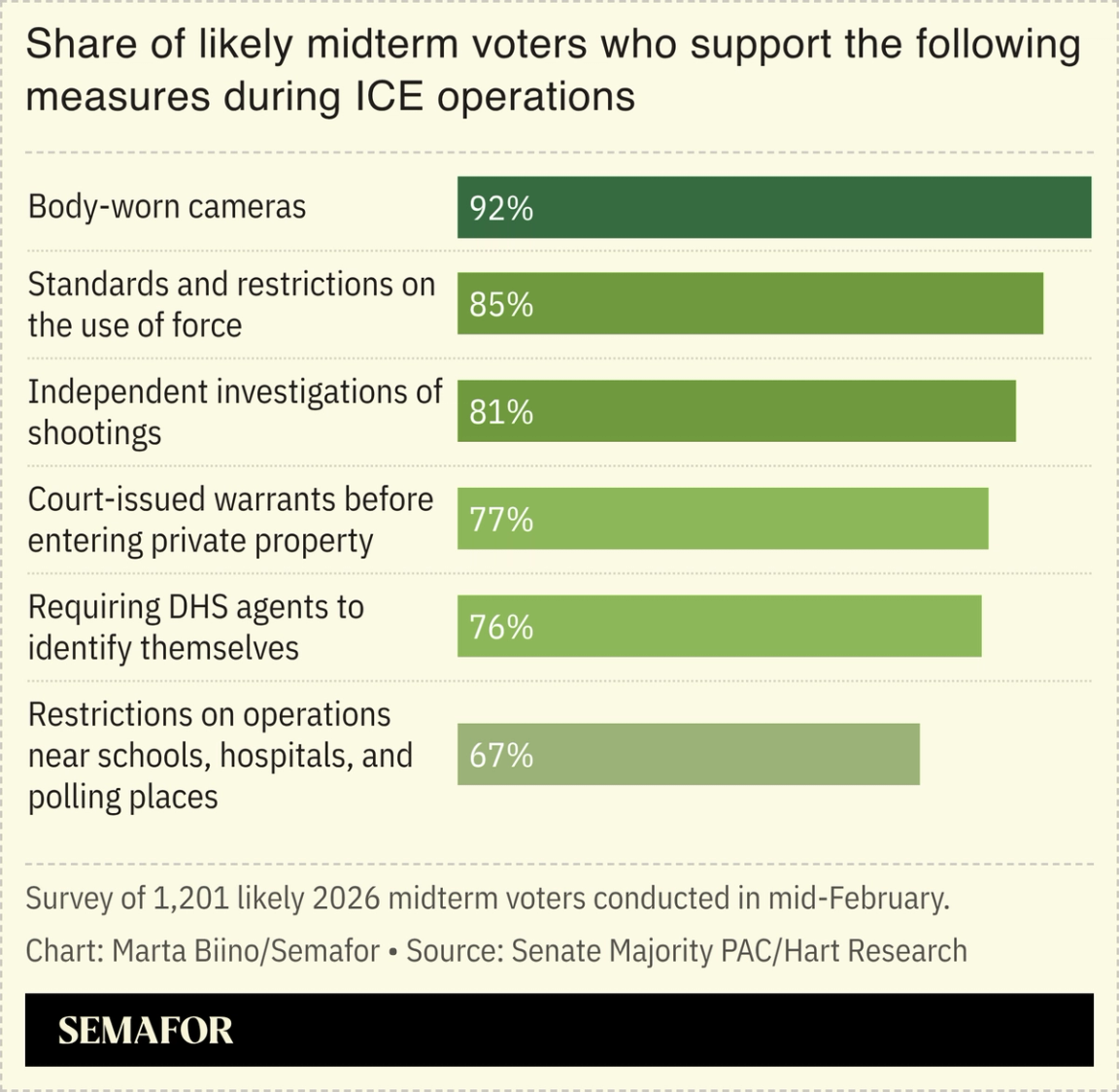 Democrats are feeling confident about their position headed into a partial DHS shutdown, armed with polling showing that voters back their approach. A new Hart Research poll commissioned by the Senate Democrat-aligned Senate Majority PAC found that 54% of likely midterm voters express support for Democrats demanding reforms to ICE and blocking DHS funding unless those reforms are adopted. And six in 10 view Republicans’ refusal to accept changes requested by Democrats negatively. The specifics of Democrats’ demands have overwhelming support, too: Nearly eight in 10 surveyed support requiring judicial warrants for agents to search private property, for instance. Meanwhile, 57% disapprove of President Donald Trump’s deportation policies and 60% hold an unfavorable view of ICE (including one-quarter of Republicans). The polling memo, which was shared first with Semafor, is being sent to Capitol Hill, donors, and Democratic operatives today. — Morgan Chalfant and Burgess Everett |
|
Trump ends a quieter-than-usual week |
 Jonathan Ernst/Reuters Jonathan Ernst/ReutersTrump is ending a notably quiet week when it comes to facing the press as his administration tries to extinguish a new round of political brushfires, from the closure of El Paso airspace to lawmakers’ bipartisan frustration over the DOJ monitoring their searches of the Epstein files. When Trump took live questions on Thursday for the first time in days (while he sat for one-on-one interviews), he largely avoided dicey topics, like his commerce secretary’s ties to Jeffrey Epstein. Trump did touch on domestic policies, like his promotion of coal and a new trade pact with Taiwan, but Republicans remain eager for more on that front — and less management of the backlash against Trump’s aggressive immigration enforcement. It “distracts us from the good work we’re doing on the economy,” one Republican lawmaker said. — Eleanor Mueller and Shelby Talcott |
|
Trump’s antitrust chief ousted |
 Mattie Neretin/CNP/Sipa USA Mattie Neretin/CNP/Sipa USAThe Justice Department’s antitrust chief is out, after weeks of mounting acrimony over the direction of the Trump administration’s antitrust policy. Gail Slater announced she was leaving her post on Thursday. She had recently clashed with the administration over ticket seller Live Nation’s efforts to settle its pending antitrust case, and Attorney General Pam Bondi overruled her last week on a personnel decision. But a source familiar with the situation told Semafor’s Shelby Talcott that there was no one incident that felled Slater, a more populist antitrust cop in a pro-business administration. Slater had her work credit cards cut off weeks ago amid the ongoing drama, the person said; the administration felt she had been moving too slowly in her enforcement efforts and was at odds with how Trump wanted things done. There were “other, more effective ways to fight and achieve” results, the source said. |
|
Europe anxious as Rubio in Munich |
 Alex Brandon/Pool via Reuters Alex Brandon/Pool via ReutersSecretary of State Marco Rubio is heading to the Munich Security Conference, and Europe is anxiously eyeing the trip. Expect him to defend a raft of Trump administration foreign policies, from widespread tariffs to the president’s push to acquire Greenland to his criticism over European defense spending. The speech, slated for Saturday, follows a report published by the conference’s organizers that described Trump as a world leader who has taken “the axe to existing rules and institutions.” The report also wondered “whether destruction is really clearing the ground for policies that will increase the security, prosperity, and freedom of the people.” Members of Congress from both parties will make appearances, too, despite the looming partial government shutdown. They include Rep. Alexandria Ocasio-Cortez, D-N.Y., who plans to offer a “working-class perspective” on US foreign policy, NBC reported. — Shelby Talcott |
|
Senators eye tech firms’ stock classes |
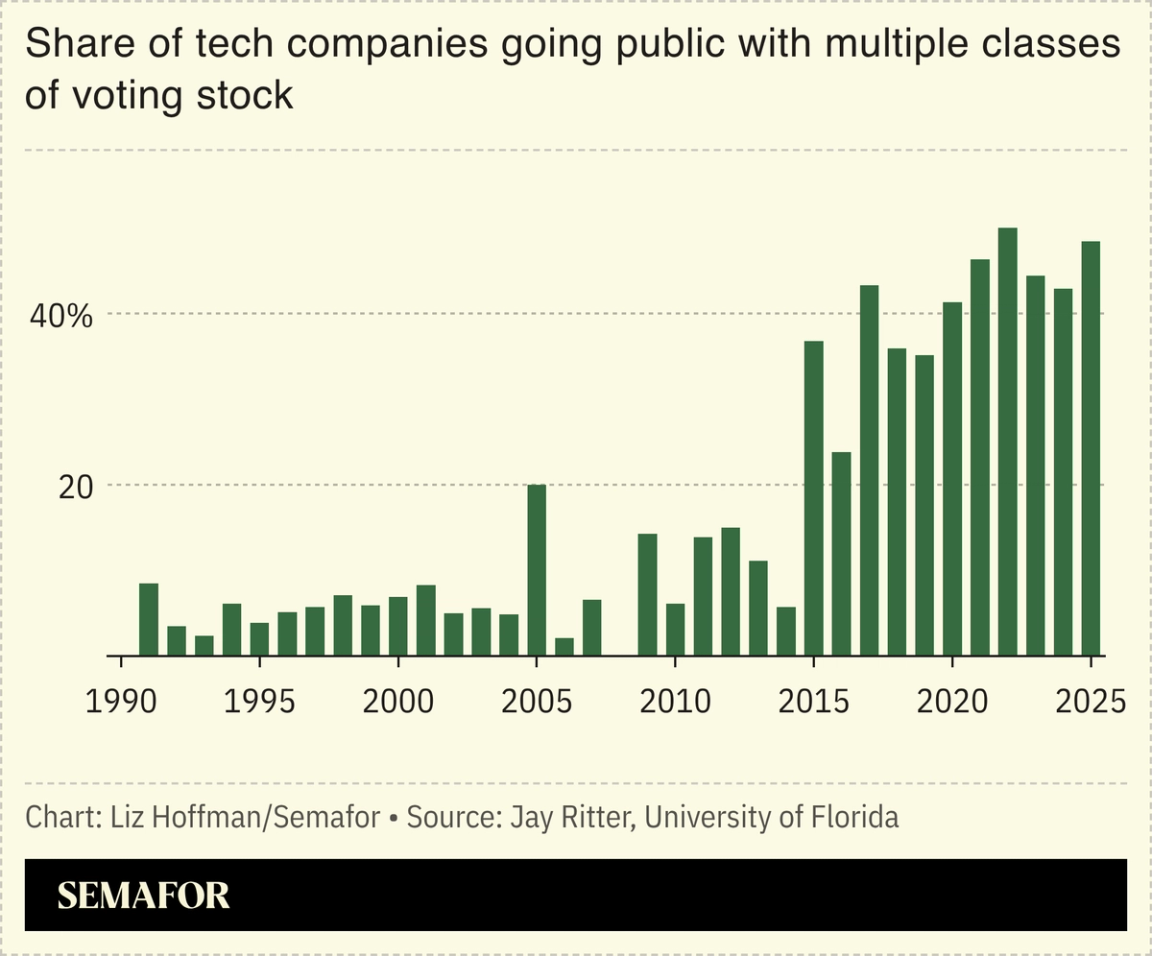 A bipartisan Senate bill is taking gentle aim at setups popular among tech companies that give insiders voting control, pouncing on the growing mistrust over how AI is being wielded, Semafor’s Liz Hoffman scoops. The bill from Sens. Ruben Gallego, D-Ariz., and Mike Rounds, R-S.D., would require companies to give shareholders more information about separate classes of stock that carry extra votes in corporate elections. A record 41% of companies that went public last year carried such dual-class setups, according to data compiled by Jay Ritter, a professor at the University of Florida. Though they aren’t legally required to (a loophole the Senate bill seeks to close), most big companies disclose the voting control of insiders, which can often be far higher than their economic ownership. Mark Zuckerberg, for example, controls 61% of Meta’s voting power despite owning 13% of its shares. |
|
Minerals in focus at Africa summit |
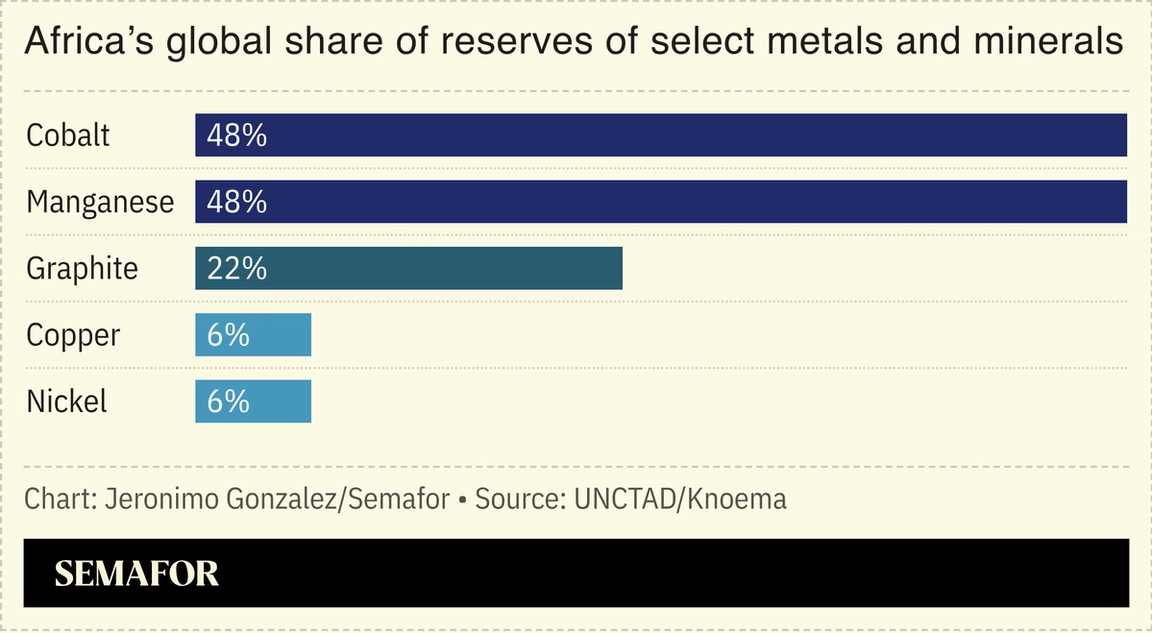 The Trump administration is following through with its pledge to make countering Chinese dominance of the global critical minerals supply a priority, sending the largest-ever US delegation of government officials to Africa’s biggest mining conference. Officials held talks with African governments and mining executives at the Mining Indaba in Cape Town, South Africa, this week — days after the US announced plans to create a trade zone for critical minerals needed for the manufacture of computer chips and EV batteries. The attendees weren’t all on the same page, however: South Africa, whose relationship with the US has deteriorated in the last year, was not among the 54 nations invited to last week’s meeting in Washington. Its mines minister, speaking at Mining Indaba, criticized DR Congo for signing a minerals deal with the US and urged African nations to work together on mineral policies. — Alexis Akwagyiram |
|
Debatable: Europe’s self-reliance |
 Russia’s war in Ukraine served as a wake-up call for Europe’s flagging defense industry, spurring European capitals to invest heavily in weapons production with an eye toward becoming less dependent on Washington, Semafor’s Morgan Chalfant writes. It’s part of a broader pivot toward what Europe refers to as “strategic autonomy,” or the continent’s ability to eliminate its military and economic dependence on other countries like the US. And experts increasingly see Europe achieving its goals in the coming years, as Trump fuels doubts within the NATO alliance about America’s reliability. “The question is no longer whether Europe will pursue strategic autonomy, but whether it has any alternative,” said Niklas Helwig of the Finnish Institute of International Affairs. But others, like the Atlantic Council’s Matthew Kroenig, think Europe will always be somewhat reliant on the US. |
|
 Gus Wenner, chairman of Rolling Stone and son of the magazine’s legendary founder, has spent years balancing the brand’s print heritage with its digital transformation. On this week’s Mixed Signals, Ben and Max talk with Wenner about his new holding company, Wenner Media Ventures, and why he thinks algorithms disrespect audiences. They also discuss the venture’s investment in the hit video series Track Star, his defense of Rolling Stone’s most provocative journalism, and his potential future media investments. Listen to the latest Mixed Signals now. |
|
 Beltway NewslettersPunchbowl News: A huge bipartisan bill to reauthorize highway, transit, and infrastructure programs is already looking in doubt, months out from its end-September deadline. |
|
|


