|
 |
Maps and models for Solo Chiefs navigating sole accountability in the age of AI.
The Snare of the Slopreneur
AI slop entrepreneurs have no moat, but someone has to explore the new tech
|

| |||||||||||||||


 |
AI slop creators have no time to think and no defensible moat. We need them anyway.
Slopreneurs flood your feed with AI slop and zero critical thinking. But they’re doing exploratory work the rest of us won’t. Here’s how to survive their content (and learn from it).
You probably know the type.
One day after Claude Cowork came out, they had a YouTube video called “How Claude Cowork Saves Me 10 Hours a Week” and a Substack post titled “If You’re Not Using Claude Cowork, You’re Already Behind.” Not a day goes by without them publishing LinkedIn posts such as, “7 New AI Tools That Feel Illegal To Use,” “Three Tools to Replace Your Entire Team,” and “Top 10 New Tools You’ll Wish You Found Sooner—Number Eight Will Make You Weep with Joy.” Not wanting to miss out on an opportunity, they’d already published an entire course called “Earn Six Figures with Clawdbot” before the tool was renamed to Moltbot and then OpenClaw—three days later.
I call them slopreneurs: entrepreneurs making a living off slop.
slopreneur /slɒprəˈnɜː/ noun informal, derogatory
A person who builds a business model around the rapid, high-volume production of low-quality, derivative content or products — typically leveraging generative AI and other automation shortcuts — prioritizing speed, scale, and short-term profit over originality, craft, or genuine value, without intent to build a sustainable enterprise.
The term slopreneur came to me as I completed my 10K run yesterday morning. Always a great time for creative ideas to ambush you between labored breaths. I thought the term was brilliant. Then it turned out the word was already suggested before. James Rendel beat me to it three months ago. (Such is the life of a Solo Chief. When you finally have a great idea, you’re probably not the first one. You’re rarely even the second.)
“Their posts fill your feed every day, promising the world in exchange for a comment, creating an avalanche of content optimised to be optimised, always with a distinct angle of self-promotion or quick profit. Emboldened by the latest in AI, it’s the work of a slopreneur. They don’t just inadvertently make slop (hey it’s ok to admit we’ve all inhaled at least once right), they’ve turned it into a whole business model and personality.” - James Rendel, “The Slopreneur”
I say we should pity, warn, and embrace the slopreneur.
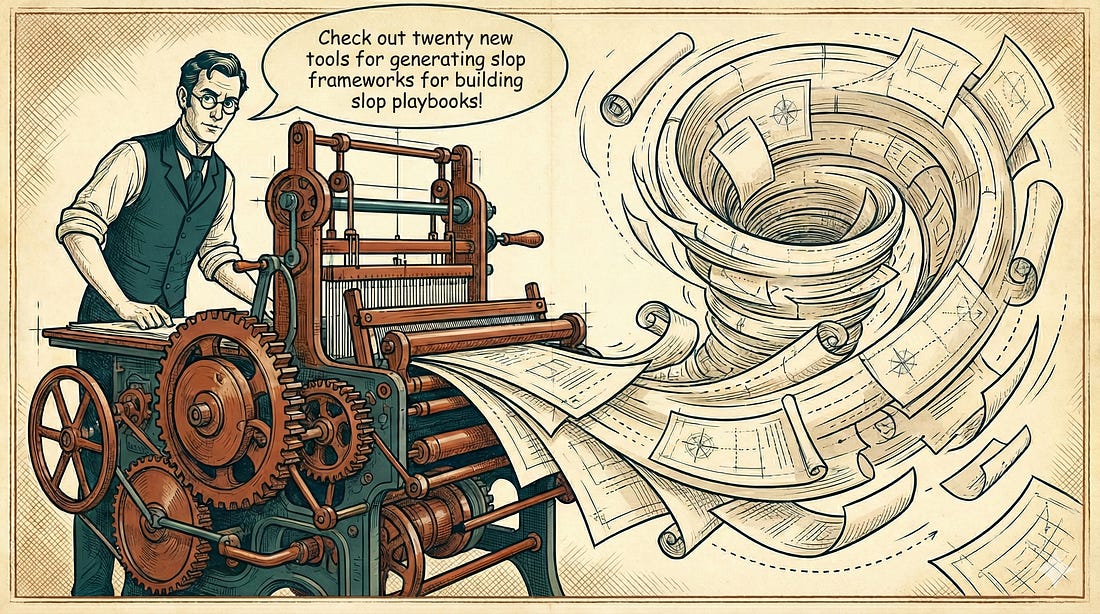 |
The Flaw of the Slopreneur: No Time for Critical Thinking
When your business model depends on being among the first to report on a trend or technology, the last thing you have time for is critical thinking.
That’s why slopreneurs breathlessly broadcast the news that McKinsey has “25,000 AI agents as employees,” completely ignoring that a headcount of AI agents makes no sense whatsoever. One might as well count the number of vibe-coded apps and call them your team of interns.
That’s why slopreneurs stumbled over each other in their haste to report that AI agents on Moltbook were inventing their own religion, completely overlooking the fact that those millions of bots on Moltbook were basically humans trolling the Internet by posing as agents.
That’s why slopreneurs uncritically parrot every press release about ‘AI co-founders,’ ‘algorithmic managers’ and ‘AI board members,’ never stopping to ask how a language model that can be turned off with a switch could possibly have fiduciary duties or legal liability. For Solo Chiefs who actually carry the single wringable neck, this isn’t just sloppy thinking—pun not intended—it’s an insult.
In their hurry to be the first to publish something clickworthy (and hopefully rake in millions of views), slopreneurs have little time for reflection. Almost no time to double-check if something really makes sense. Too litle time for the one thing that’s supposed to separate humans from the language models themselves: critical thinking.
The Risk of the Slopreneur: No Defensible Moat
As a Solo Chief advisor, there’s something else that bugs me. Most slopreneurs have no moat.
Sure, a small selection of influencers is able to attract millions of readers or viewers. They earn a good living with advertising and sponsoring, and maybe some additional revenues with books and courses. There’s no doubt about that.
But how defensible is that business when they have no proprietary data, no network effects, no unique infrastructure? How easily can they retain their views and followers when every competitor can literally offer exactly the same thing? How are they going to build a viable business when all the slop they make is, by definition, cheap perishable waste with a half-life shorter than Sam Altman’s reputation? Slopreneurs must publish their slop faster and faster just to stay in the game. It’s the Red Queen Effect with a content calendar.