|
 |
Rubio to Europe: We Hit You Because We Love You
But America’s allies aren’t interested in an abusive relationship.
|


| |||||||||||||||


Barack Obama kicked off a minor social media frenzy last week when he told the liberal podcaster Brian Tyler Cohen that aliens are real. “They’re real, but I haven’t seen them,” he said, adding that they’re certainly not “being kept” in “Area 51.”
On Sunday, Obama tried to clean his comments up: “Statistically, the universe is so vast that the odds are good there’s life out there,” he wrote on Instagram. But “I saw no evidence during my presidency that extraterrestrials have made contact with us. Really!” If you ask us, sounds someone’s alien handlers got to him. Happy Monday.
 |
Trump Shits on Europe. Rubio Applies Perfume.
by Andrew Egger
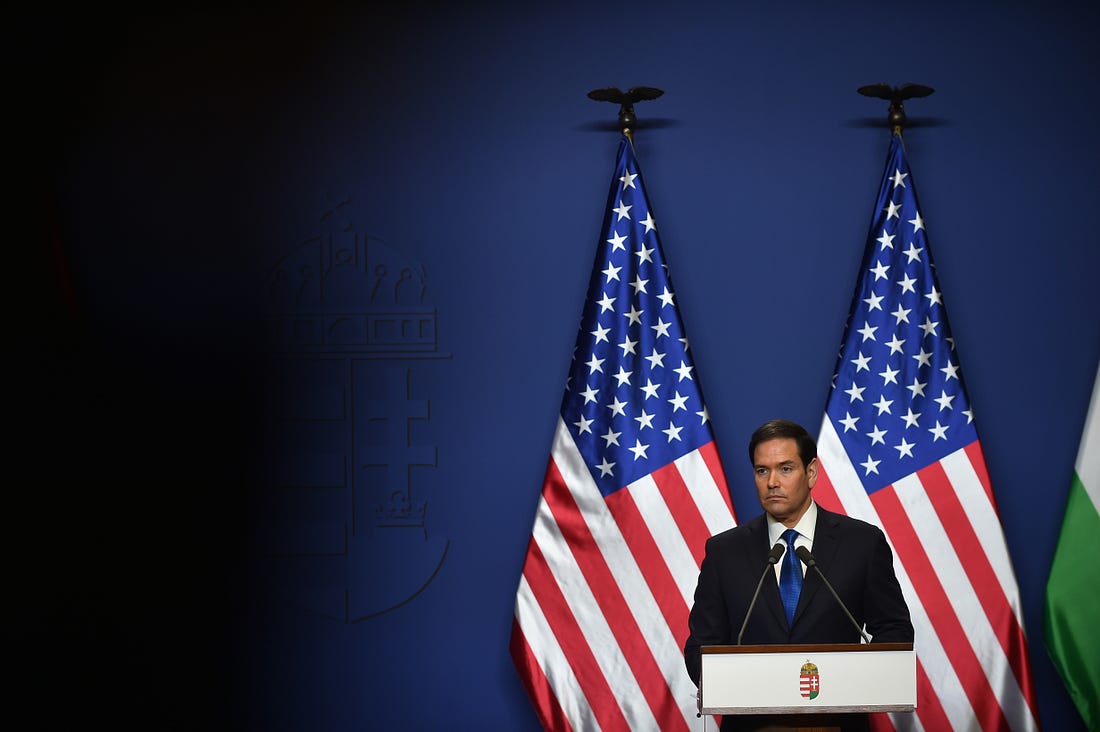
At least one top Trump administration official isn’t anxious to see the U.S.-led international order crumble overnight, and on Saturday he got his chance to say so. Secretary of State Marco Rubio took the stage at the Munich Security Conference in an attempt to strike a reassuring tone toward America’s European allies.
“We want Europe to be strong. We believe that Europe must survive,” Rubio said. “Because the two great wars of the last century serve for us as history’s constant reminder that ultimately our destiny is, and will always be, intertwined with yours.”
Rubio wasn’t without his critiques of Europe. But unlike Vice President JD Vance, whose hectoring there’s-a-new-sheriff-in-town speech at the same conference last year scandalized European allies, Rubio couched his critiques as a shared challenge for Europe and America both to overcome. Europe, he said, had at times lost its way in the same manner and for the same reasons that America had: because of a shared “dangerous delusion” that the world had entered “the end of history,” in which the lure of open markets and prosperity would inevitably charm the world’s despotic regimes into embracing liberal democracy.
“We made these mistakes together, and now together we owe it to our people to face those facts and to move forward to rebuild,” Rubio said. “This is why we Americans may sometimes come off as a little direct and urgent in our counsel. This is why President Trump demands seriousness and reciprocity from our friends here in Europe. The reason why, my friends, is because we care deeply. We care deeply about your future and ours.”
Whatever else he is, Rubio remains a talented politician; the whole thing was artfully done. In the world in which he operates—a world in which his boss, the president, opens up about three new lines of antagonism against U.S. allies a week—this was about the most promising rhetorical line available to him: America hits because America cares.
Europe, however, doesn’t appear to be buying it. Nowhere was this clearer than in a remarkable speech delivered the same day by German Chancellor Friedrich Merz, who opened his remarks with a riff on the theme of the conference: “Under destruction.”
“It probably means that the international order based on rights and rules is currently being destroyed,” Merz said. “But I’m afraid we have to put it in even harsher terms. This order, as flawed as it has been even in its heyday, no longer exists.” Europe, he said, had “just returned from a vacation from world history.”
The era of America as the sole world superpower, in which smaller democracies could bob along comfortably in her wake, is over. “If there had been a unipolar moment after the fall of the Berlin Wall, a unipolar moment in history, it has long passed,” Merz said. “The United States’ claim to leadership has been challenged and possibly lost.”
“We, the Europeans, too, are preparing for this new era,” Merz said. “And we reach different conclusions than, for example, the administration in Washington. Our prime task as Europeans, and, of course, as Germans too, is to accept this new reality today. It does not mean that we accept it as an inevitable fate. We are not at the mercy of the world.”
This isn’t idle talk. Politico Europe reported last week that negotiations are underway among Europe, Canada, Mexico, and a bloc of Indo-Pacific nations to form a new trade bloc, a move explicitly designed to tie the member countries closer together in an economic world now defined by Donald Trump’s harsh tariffs. It’s exactly the sort of middle-power solidarity in response to a world increasingly dominated by two hostile great powers, the United States and China, that Canadian Prime Minister Mark Carney argued for last month at the World Economic Forum.
Selfishly, as an American, I wish Europe would allow itself to be wooed by Rubio’s you-catch-more-flies-with-honey approach. A future in which America’s erstwhile allies are as willing to freeze us out as we have lately been to freeze them out is one in which America is perpetually lonelier, grimmer, poorer, and less safe. You can bet that Rubio knows this too. You can hope, at least, that it keeps him up at night.
But all the sweet talk in the world can’t change the fundamental truth. It isn’t just that everyone knows Rubio is only authorized to speak up to a point, and that ultimately it’s Trump who will call the relevant shots. In case there was any doubt, Rubio left Munich and immediately met with two of Europe’s most noxious right-wing populists, Hungary’s Victor Orbán and Slovakia’s Robert Fico. As Dalibor Rohac notes on the homepage today, what Rubio offered wasn’t a return to normal transatlantic relations but “Trumpism with a human face.”
Europe has finally learned the lesson that Trump is no aberration or blip, that America is the kind of place that ultimately cannot be trusted to elect reliable stewards for the free world, and that they’re all just going to have to plan accordingly.
Maybe Rubio deludes himself into thinking that he can put it all back together, if only he can find his way into the Oval Office in 2029. It’s plain by now that our allies aren’t waiting around for him.
America’s alliances aren’t just ratified by governments. They’re also built by cultural, economic, and ideological links among people. Share your ideas of what we can do now to rebuild our alliances from the bottom up.