Hi! Tomorrow marks the first day of the Year of the Horse as Lunar New Year celebrations kick off in earnest, with Draco Malfoy becoming an unlikely mascot for the holiday in China owing to the Mandarin translation of his name containing the words for “horse” and “fortune.” Today we’re exploring:
|
- Time is money: Americans are spending more time at home, and more time alone.
- Wheredy’s? Burger giant Wendy’s keeps shuttering stores in the face of falling sales.
-
Rivived: Rivian just had its best day ever on the stock market, after 4+ years of pain.
|
Americans are spending more time at home and alone, and money shapes who can opt out |
With the Covid lockdowns now a moderately foggy memory for most, the last few years have seen many habits that defined the pandemic era become more normalized: Peloton bikes now double as coat racks; Zoom’s share price is almost back to where it started; and Del Monte is stuck with mountains of unsold canned fruit.
But one lifestyle change has proven far more permanent than any fitness fad or panic-buying spree, and turns out to be part of a much larger phenomenon. Americans are spending more time at home, and alone… and not everyone has the means to break that trend. |
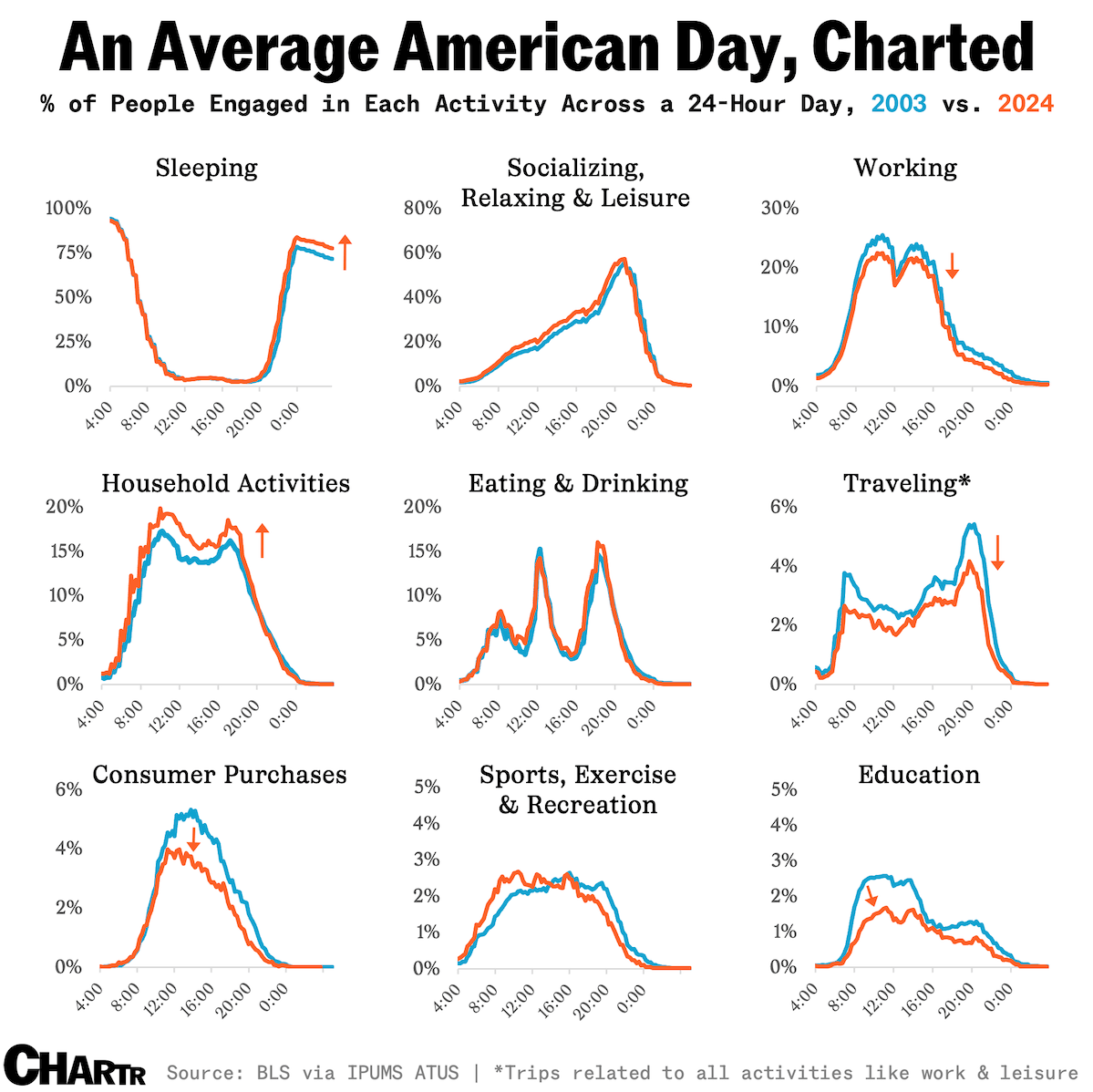
According to the annual American Time Use Survey, Americans now spend about 30 more minutes sleeping per day than they did two decades ago, as well as spending roughly 11 more minutes on household activities. On the flip side, we’re spending less time commuting, going shopping, and taking in-person classes — activities that usually have us interacting with others out in public.
In 2003, the average American spent 7.7 hours per day at home; by 2024, that figure had risen 18% to 9.1 hours, with the pandemic only accelerating the climb. Time spent alone has followed a similar trajectory: nearly 7 hours a day in 2024, up from 5.8 hours in 2010. |
But not everyone is experiencing the shift in the same way. As evidence for the K-shaped economy — where some groups thrive while others struggle — becomes harder to ignore, income is proving to be a big influence.
Indeed, households earning under $35,000 now spend about 10 hours a day at home, almost an hour and a half longer than those earning $150,000 or more. So, what’s keeping lower-income Americans indoors? |
Wendy’s sales got crushed during the pandemic — last quarter was even worse |
In 1984, Wendy’s launched what has to be one of the most successful advertising campaigns in the history of fast food, with its iconic “Where’s the beef?” slogan posed by 81-year-old Clara Peller going the 1980s-equivalent of viral, reportedly helping Wendy’s revenues soar by 31% year-on-year.
Now, more than 40 years later, American fans of the burger chain might be asking “Where’s the restaurant?,” as Wendy’s continues to shutter its square-burger-selling outposts around the country. The company plans to reduce its US footprint by 5-6% (about 300 locations) in the first half of 2026 as part of wider turnaround efforts, it revealed in its earnings call on Friday.
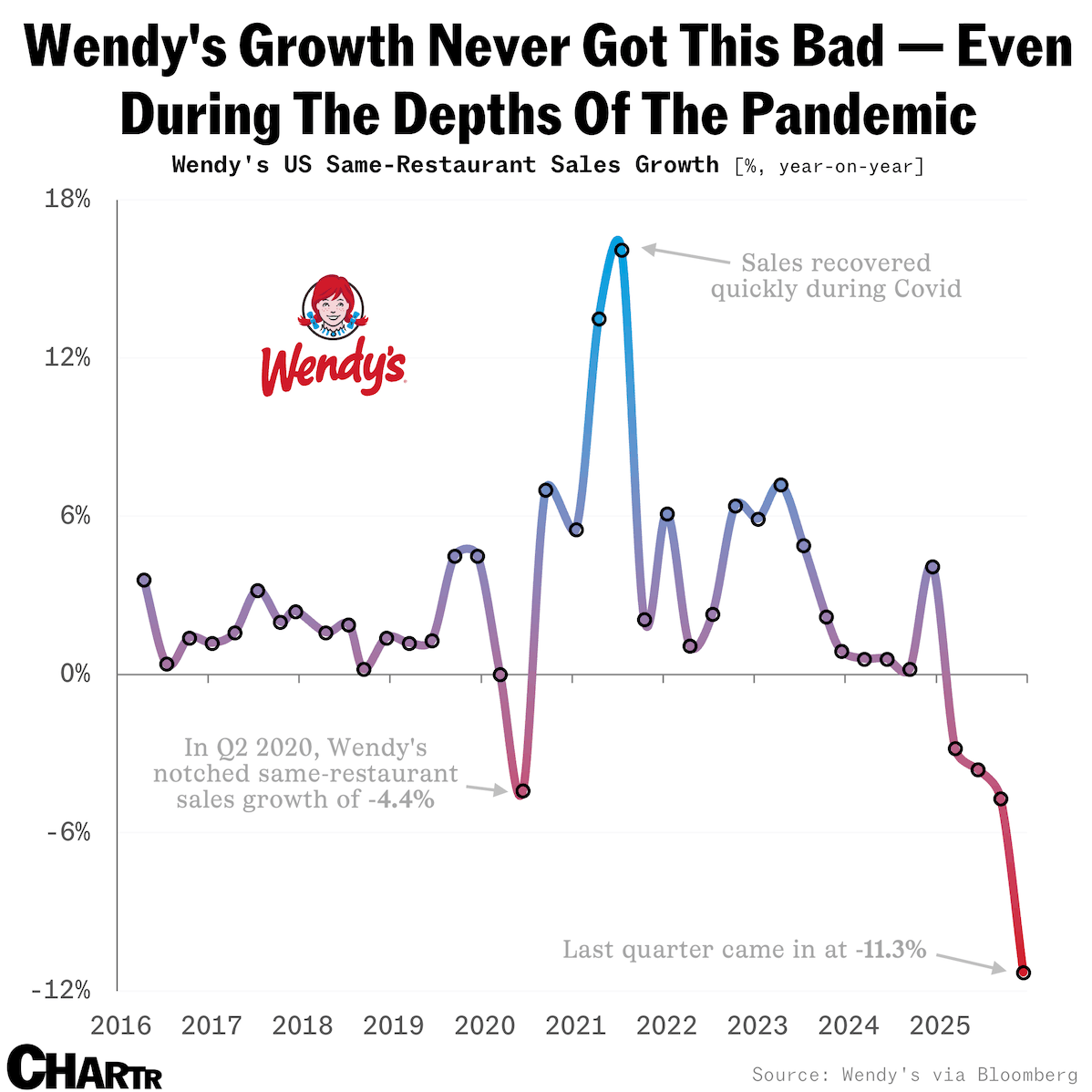
Wendy’s is closing “consistently underperforming restaurants,” per interim CEO Ken Cook, with US same-restaurant sales slipping 11.3% for the last quarter of 2025 and some 5.6% for the year all told. For context, same-restaurant sales only fell by 4.4% during the second quarter of 2020, when Wendy’s shut dining rooms across the states to focus on delivery and drive-thru services during Covid.
|
A strong “SpongeBob” collaboration in the same quarter of 2024 may have exacerbated how bad this Q4 looked, and Wendy’s chief accounting officer, Suzanne Thuerk, indicated that lower marketing spend could have contributed to the drop-off. But Thuerk conceded there is a much simpler issue at hand: people just aren’t showing up to Wendy’s restaurants, with traffic way down — a trend only “partially offset by a higher average check.”
Clearly, the restaurant’s attempt to get in on the chicken strip boom with its “Wendy’s Tendy’s” towards the end of last year was not enough to get more customers through the door… and investors still seem unconvinced by current turnaround efforts, with the stock down almost 10% so far this year. |
|
|
SGOV: A Place For Sidelined Cash. |
Your excess cash could do more for you. If you have cash parked on the sidelines, you could be missing out on potential yield — even if it’s in a savings account.
SGOV, the iShares® 0-3 Month Treasury Bond ETF, is the largest treasury ETF on the market ($70bn in AUM).1 The fund provides exposure to short-term US bonds that mature in 0-3 months, providing investors monthly income.
Could your excess cash be working harder for you? |
|
|
Rivian just had its best day ever on the stock market, after more than 4 years of pain |
It’s been a brutal start to the year for many EV producers.
With federal tax credits for new EVs abolished since the end of September, companies have been under pressure to cut prices to make up for lost subsidies. But, even with discounts, sales have slumped: data cited by the WSJ suggests that EV sales fell more than 30% in the fourth quarter of 2025, and January looks to be even worse.
Industry giants have had enough, announcing huge pullbacks in their electrification endeavors. Ford notched a $19.5 billion expense in December, while Jeep-owner Stellantis went further, announcing an eye-watering $26 billion worth of special charges over its EV pullback just ten days ago.
With that backdrop, it was a surprise when electric upstart Rivian had its best day on the stock market ever, jumping more than 25% on Friday. |
Rivian’s main business, selling cars, is still a cash incinerator. For every vehicle sold, the company is losing money — about $10,200 to be exact — but Rivian’s software business is proving to be something of a silver lining.
Last year, its software and services division made some $576 million in gross profit — seeing the company swing to a positive gross profit of $144 million, a whopping $1.34 billion improvement on 2024. That jump, plus Rivian forecasting that it will deliver between 62,000 and 67,000 vehicles in 2026, helped supercharge the stock. |
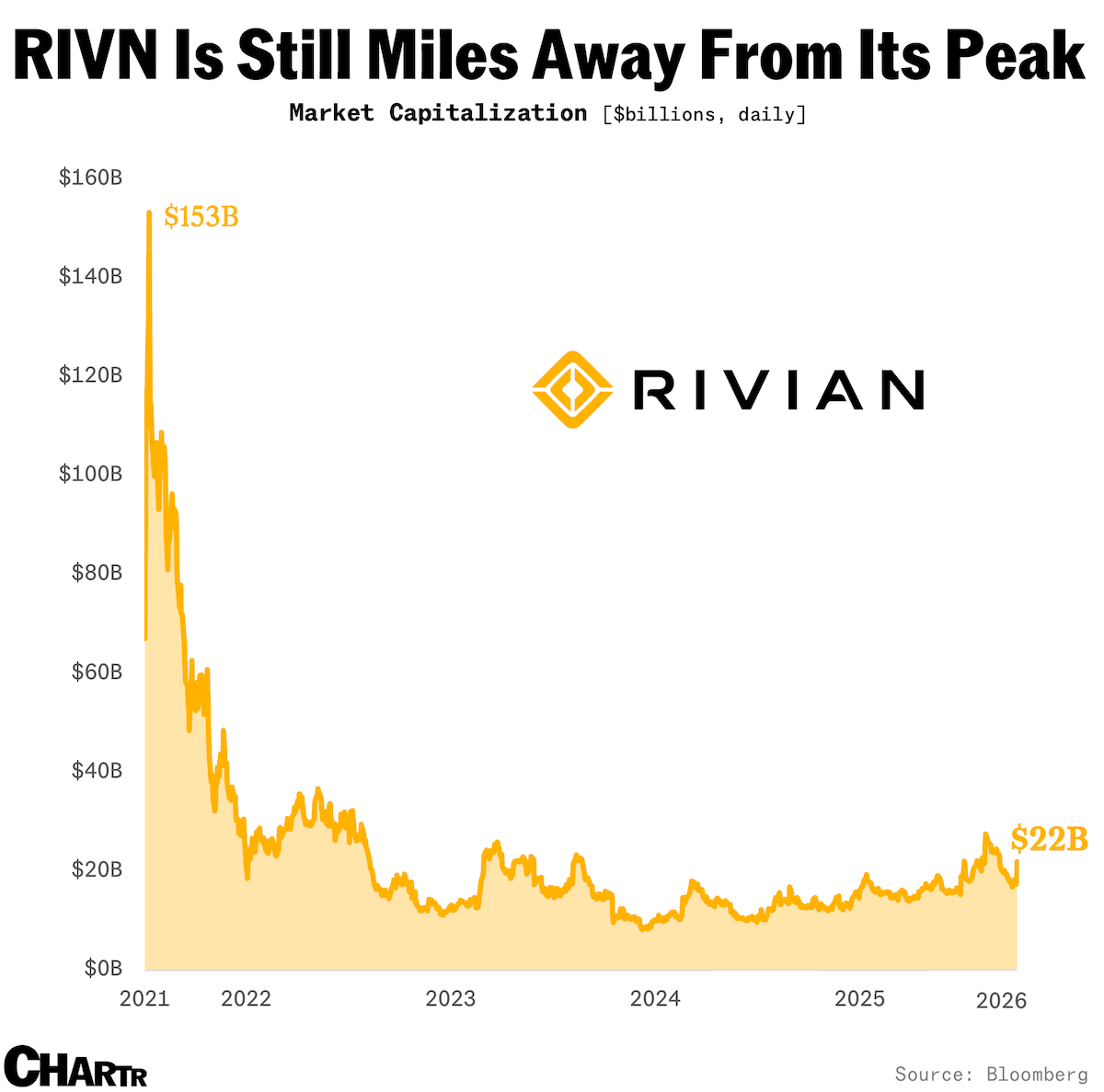
However, while adding more than a quarter of its value in a single day is still impressive, it’s nothing compared to what Rivian raced through at its peak. Even with Friday’s jump, the company’s market cap is roughly one-seventh of its peak value in 2021, notched shortly after its IPO — back in the days when the market believed that EVs would be the next big thing. |
|
|
-
To iPhinity and beyond: NASA astronauts are now able to take their smartphones into space, with Crew-12 becoming the first mission to leave Earth with mobiles onboard last Friday.
-
China’s government expects a record 9.5 billion passenger trips over the 40-day travel rush around the Lunar New Year.
-
TikTok usage in the US remains at around 95% of its late January level, despite a flurry of deletions after its new US joint venture ownership model was announced.
-
Singapore is paying athletes $792,000 for getting a gold medal at this year’s Winter Olympics — US top medallists, by comparison, will get just $38,000.
-
Brontësoars: “Wuthering Heights” just became the highest-grossing worldwide debut of 2026 so far, taking $82 million across its opening weekend.
|
|
|
Excess rainy-day funds stashed in a savings account? Your sidelined cash can do more for you. SGOV, the iShares 0-3 Month Treasury Bond ETF, provides investors monthly income and can provide higher potential yield. Explore SGOV. |
|
|
-
Time out: Pew Research Center explores where people around the world get more public holidays than others.
-
Charting the countries with the highest industrial robot-to-worker ratios.
|
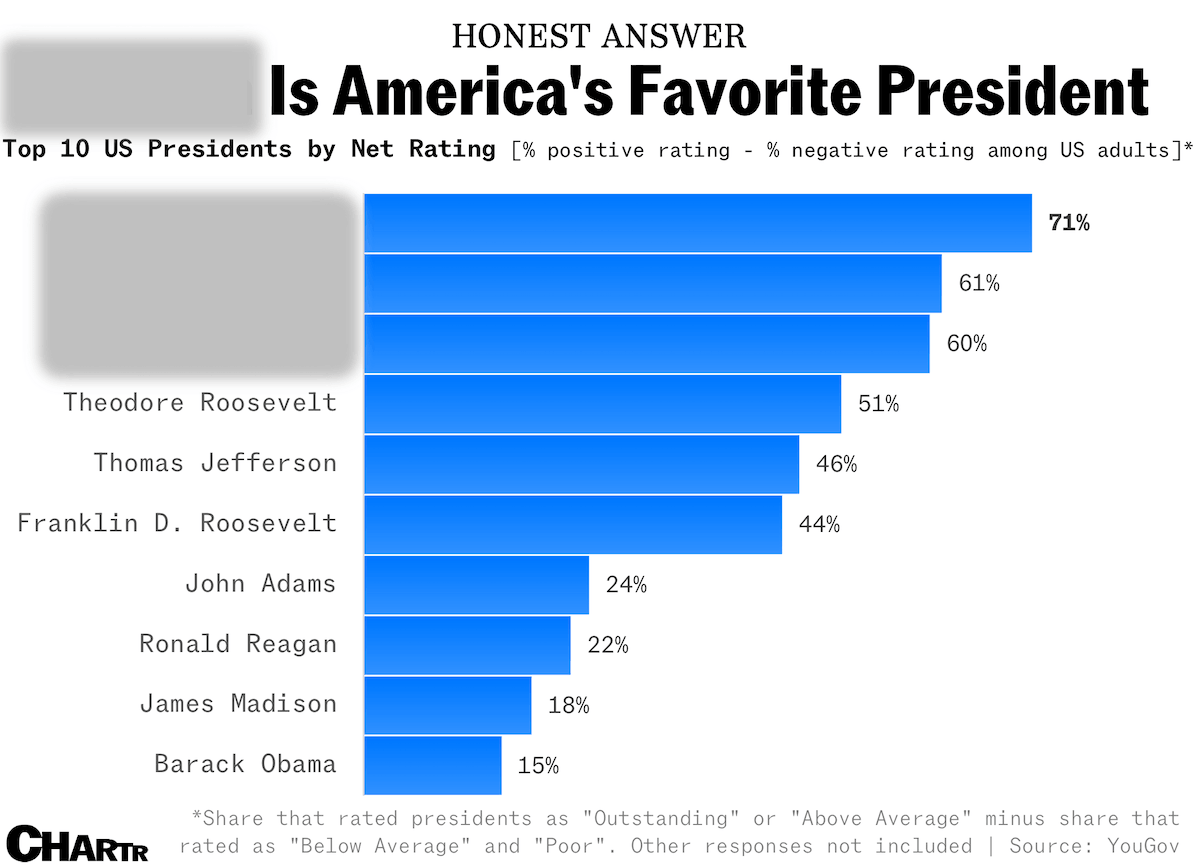
Off the charts: According to a recent YouGov survey ahead of Presidents’ Day today, who are America’s three favorite historical Commanders-in-Chief? [Answer below]. |
Not a subscriber? Sign up for free below. |
Advertiser’s disclosures: 1 Source: Morningstar as of 1/28/2026, based on assets under management.
Visit www.iShares.com to view a prospectus, which includes investment objectives, risks, fees, expenses and other information that you should read and consider carefully before investing. Investing involves risk, including possible loss of principal.
Fixed income risks include interest-rate and credit risk. Typically, when interest rates rise, there is a corresponding decline in the value of debt securities. Credit risk refers to the possibility that the debt issuer will not be able to make principal and interest payments.
An investment in the Fund is not insured or guaranteed by the Federal Deposit Insurance Corporation or any other government agency and its return and yield will fluctuate with market conditions. The Funds are distributed by BlackRock Investments, LLC (together with its affiliates, “BlackRock”).
BLACKROCK and iSHARES are trademarks of BlackRock, Inc. or its affiliates.All other trademarks are those of their respective owners. MKTG0226-5159775-EXP0227 |
|
|
|