| | In today’s edition: Saudi Arabia loosens some restrictions on daytime eating in Ramadan, and the UAE͏ ͏ ͏ ͏ ͏ ͏ |
| |  | Gulf |  |
| |
|
 - Saudi consulting growth
- Board of Peace meets
- Poll: Saudis OK with Israel?
- UAE extends Mars mission
- Looser Ramadan restrictions
 Qatari billionaires betting on Syria’s reconstruction and other weekend reads. |
|
Consultants still growing in Saudi |
 Mohammed Benmansour/File Photo/Reuters Mohammed Benmansour/File Photo/ReutersThe Saudi consulting market is still growing despite a wave of delays and cancellations to government-backed projects amid low oil prices. The industry’s revenues will expand by 13% this year, slower than the 25% rise in 2023 but still higher than the international average, ABGI reported, citing Source Global Research, which tracks the consultancy market. Advisers and consultancies in the kingdom have been saying for months that the market has shifted. The days of huge budgets for ill-defined projects with few tangible outcomes are over. Instead, consultants are dealing with lower rates, fee caps, and payments tied to performance. Until recently, Vision 2030, the kingdom’s economic diversification plan, had been a massive windfall for the likes of Boston Consulting Group, McKinsey, and the so-called Big Four. It also came with pitfalls, though: PwC was barred from working with the Public Investment Fund for 12 months after being accused of trying to poach a senior executive from a PIF-backed company. The ban ended a few weeks ago. — Matthew Martin |
|
Gulf pledges billions to Trump’s Gaza plan |
 Kevin Lamarque/Reuters Kevin Lamarque/ReutersPresident Donald Trump said the US would commit $10 billion to his Board of Peace initiative, with other countries adding $7 billion to rebuild Gaza. The UAE pledged $1.2 billion, with Kuwait, Qatar, and Saudi Arabia each promising $1 billion — initial plans include constructing around 100,000 homes. The total cost of reconstruction has been estimated at $70 billion. More than two dozen countries joined the board’s first meeting in Washington on Thursday. Troops from at least five nations, including Albania and Kazakhstan, are expected to form a peacekeeping force in the territory, even as Hamas tightens its hold on Gaza and resists pressure to disarm. While those US diplomatic efforts move forward, tensions with Tehran are escalating. Trump said he could decide within two weeks to strike Iran, as the US assembles its largest military force in the region since 2003. US Sen. Lindsey Graham, a Trump ally, told Abu Dhabi-based IMI’s Hadley Gamble that Gulf countries need to “suck it up” and seize the moment. “This region will never stabilize, will never move toward the lightness, away from the darkness until the Ayatollah is dispatched,” Graham said. |
|
Saudis’ mixed signals toward Israel |
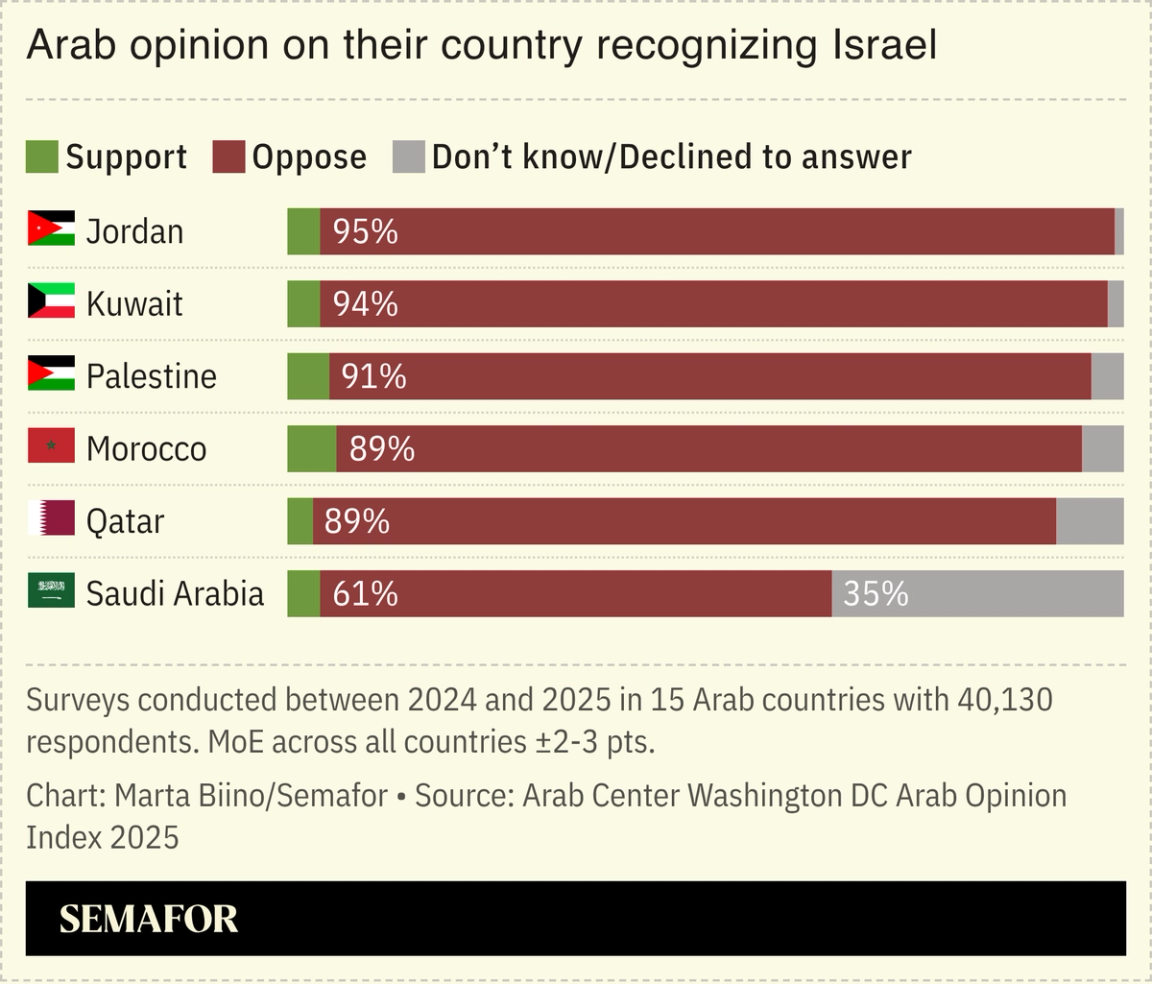 In a new survey of 15 Arab countries, Saudis appeared to be the least opposed to the idea of recognizing Israel. Some 61% of Saudis were against the idea — compared to a regional average of 87% — while 35% refused to answer or said “don’t know.” The latter response may just be a hedge against challenging the Saudi regime itself, which is widely seen to be interested in moving toward an agreement, albeit slowly, with Israel. The reality may be that most of the 35% actually side with the majority opinion and there is near total opposition to the Abraham Accords in the kingdom, “which I suspect [Crown Prince] Mohammed bin Salman recognizes as he makes his decisions,” wrote Marc Lynch, director at George Washington University’s Project on Middle East Political Science. The idea of normalizing relations with Israel is wildly unpopular among Arabs — 8 in 10 consider Palestine a collective Arab cause — according to the annual survey by the Arab Center in Doha, which involved 40,000 face-to-face interviews across the region. — Kelsey Warner |
|
UAE probe earns another Martian year |
 Courtesy of UAE Space Agency Courtesy of UAE Space AgencyAfter five years orbiting the Red Planet — and sending 10 terabytes of data back to Earth — the UAE is extending its Mars probe mission to 2028. Adding an additional Martian year, roughly two of ours, will allow the Emirates Mars Mission (EMM) to gather more data on seasonal changes. So far, the probe has delivered new insights into weather patterns, auroras, and the moon Deimos. Noora Alsaeed, principal investigator of the EMM, said one of the biggest surprises was that the planet’s atmosphere has proven to be far more complex than previously believed; the mission has uncovered secrets about what drives changes in its upper layers. The UAE is the only Arab country to have reached Mars, joining China, the European Space Agency, India, Russia, and the US in achieving the feat. — Mohammed Sergie |
|
Riyadh eases Ramadan restrictions |
 Restaurants in Riyadh on the first day of Ramadan. Manal Albarakati/Semafor. Restaurants in Riyadh on the first day of Ramadan. Manal Albarakati/Semafor.Riyadh residents are finding that eating out during daylight hours is getting slightly easier as the Muslim month of fasting begins, the latest sign of the city gradually loosening social restrictions to attract more foreign workers. A ride around the city on the first few days of Ramadan found that while most eateries have closed, a small number are staying open during the daylight fasting hours. That’s a step change from previous years, when Ramadan fasting was strictly enforced, but still far from the practice in Dubai where there are no restrictions on serving food or alcohol during the holy month. Riyadh has been slowly transforming under Crown Prince Mohammed bin Salman as the authorities look to improve quality of life in the city and attract an international workforce to help diversify the economy. Over the past few years the religious police have been stripped of powers, women have been allowed to drive, gender mixing has been permitted, and there’s even now a liquor store for diplomats and well-paid expats. — Matthew Martin and Manal Albarakati |
|
 On Tuesday, March 24, Semafor will convene with leaders in Nairobi to advance financial inclusion at the intersection of long-term capital, policy, and financial infrastructure. Bringing together investors, policymakers, and financial system leaders, the conversation will move beyond ecosystem-building toward action — mobilizing capital, strengthening infrastructure, and closing persistent access and affordability gaps. Join us as we dive into how coordinated public-private efforts can accelerate inclusive growth across East Africa and other emerging markets. March 24 | Nairobi | Request Invitation |
|
 Finance- Kuwait has been placed on the so-called grey list compiled by financial crime watchdog the Financial Action Task Force, which said the country needed to do more to address money laundering and terrorism financing. The UAE was removed from the grey list in 2024, after improving its systems for tackling financial crime.
- Qatar Investment Authority launched a $200 million equity fund with Franklin Templeton in a bid to boost foreign investment and liquidity on the local stock exchange. The fund is the third created by the QIA over the past two years, following similar agreements with Ashmore and Fiera Capital.
Energy- Saudi utility Acwa Power could join a consortium led by Vitol Group to develop a gas-to-power project in South Africa. The proposal aims to replace aging coal-fired power plants and could cost $3 billion. — Bloomberg
- The US is reportedly considering a civil nuclear pact with Saudi Arabia that doesn’t include non-proliferation measures to prevent the spread of nuclear weapons, according to a letter from the Trump administration to some congressional committees. — Reuters
Logistics- Dubai’s DP World sold a 37.5% stake in a Jeddah port to Dutch group APM Terminals. The agreement aims to help expand Jeddah Islamic Port’s role as a gateway to Saudi Arabia and as a trading hub on the Red Sea, connecting Asia, Africa, Europe, and the Middle East. DP World retains a 62.5% interest.
|
|
 - The narrative that Saudi Arabia is embracing Islamism and dabbling in antisemitism does not hold up to the facts: The kingdom remains on a long-term path toward moderation, write former US Ambassador to Saudi Arabia Michael Ratney and Princeton professor Bernard Haykel in The Times of Israel.
- Two Qatari brothers, originally from Syria, have seen their listed holding company more than double in value over the past year to more than $4 billion as it secured major reconstruction deals in Syria, Bloomberg reported.
- Saudi Arabia is recalibrating its cultural policy as foreign institutions and donors compete for influence, with the latest Diriyah Contemporary Art Biennale spotlighting artists from the Global South over Western heavyweights, Roxana Azimi writes in Le Monde.
|
|
|


