| | In this edition, Toyota’s deployment of humanoid workers at its Canada plant shows the dual tracks i͏ ͏ ͏ ͏ ͏ ͏ |
| |  | Technology |  |
| |
|
 - SCOTUS stops tariffs
- No hand-holding
- Making AI stick
- Zuck plays defense
- Waymo hits red light
 The two sides of the humanoid robots, and Microsoft says it’s found a solution to store data for more than 10,000 years. |
|
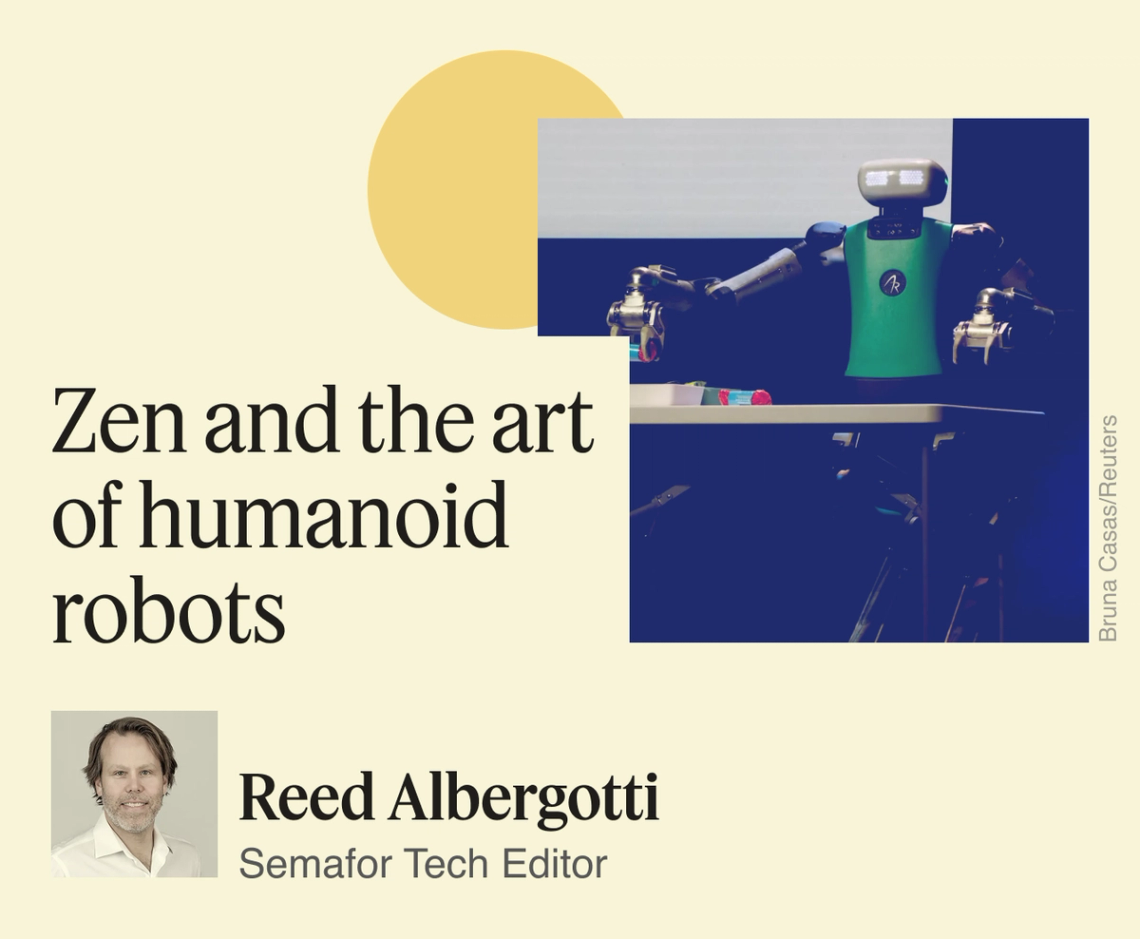 Rachyl Jones scooped yesterday that Agility Robotics will deploy its humanoid workers to Toyota’s Canada plant — a good reminder of the two-track robotics industry race happening right now. On one track, robotics companies are competing to generate the most hype, and consequently the most funding. On the other hand, they are desperately trying to get humanoids to do the simplest tasks in professional environments. In the case of the Agility–Toyota deal, the robots will move bins — for now. They won’t fundamentally change the manufacturing process — at least not overnight. It’s likely it would be cheaper to hire humans to do the same thing that Agility’s robots are doing. But you have to start somewhere. On the other side of the humanoid robot divide, you have my social media feed. Over the weekend, I was bombarded with videos of robots in China, dancing and doing martial arts as part of the Lunar New Year celebration. They are truly impressive to watch and meant to demonstrate China’s apparent dominance in robotics. But they told me nothing about the state of robotics today. There is not a very big market for dancing robots. And dancing does not necessarily translate into actually useful tasks, except perhaps raising venture capital. In the last couple of years, there have been great advances in robotics, both on the hardware and software sides. What that means is that demonstrations like the ones that dominated the Consumer Electronics Show last month are no longer meaningful. Deployment is what matters, even if those deployments are relatively mundane, like carrying a bin from point A to point B. |
|
Tariffs struck down, but no big changes for tech |
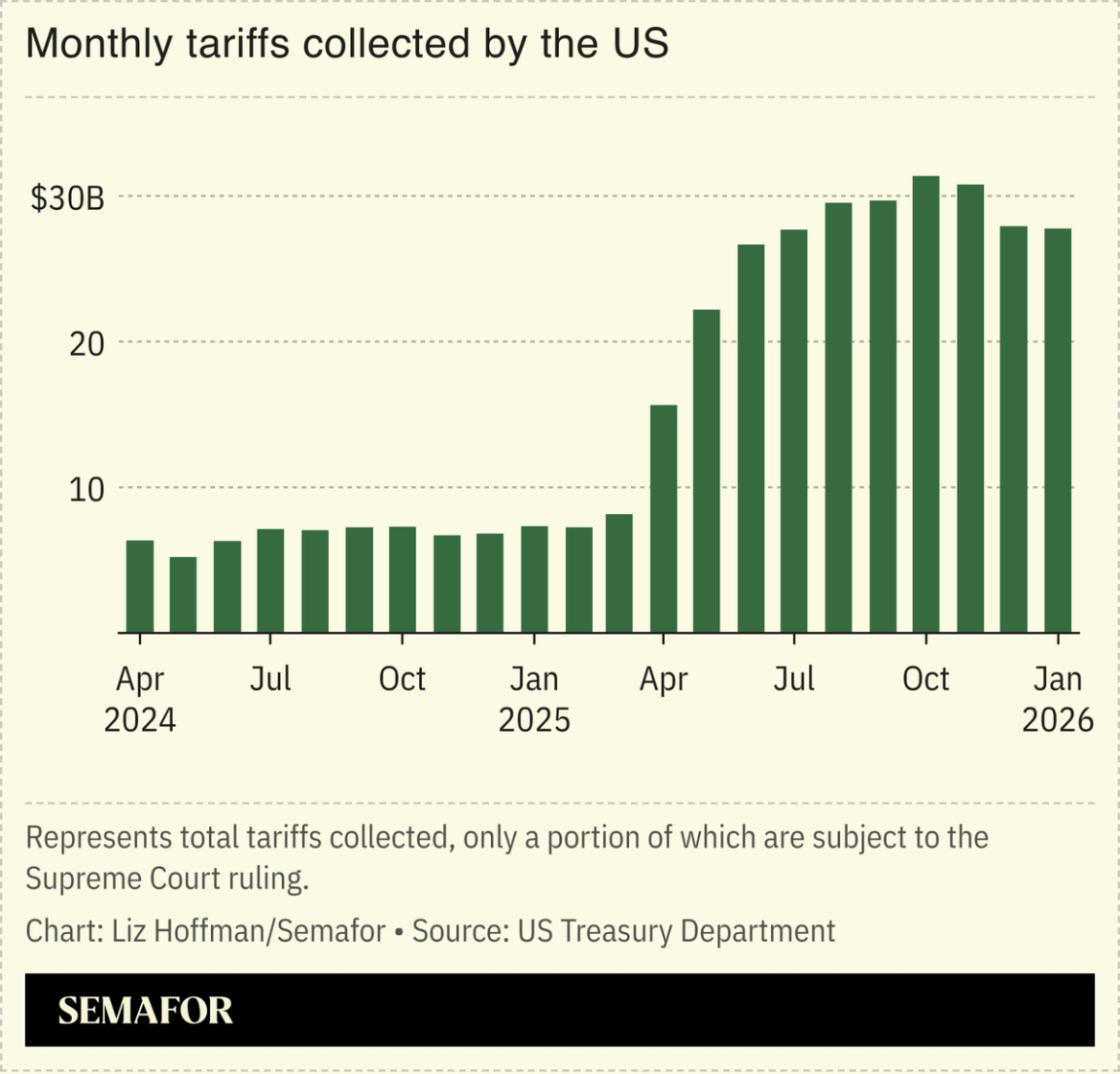 The Supreme Court struck down President Donald Trump’s sweeping tariffs Friday morning, but experts tell Semafor the move won’t change much for now, especially in tech. Electronic components and devices were already largely carved out of trade duties. Companies that were eating the tariffs will find a slight boost to the bottom line, which should help stock prices — the S&P 500 ticked up on the news. Consumers who were (or thought they were) swallowing the cost might shop a little more. “It will help consumer spending and corporate profits but won’t be huge,” economist Jason Furman said. What it does mean is more limbo: Waiting for the Trump administration to reintroduce some of the tariffs under different legal authority means “materially more trade uncertainty,” a Goldman Sachs analyst wrote. Companies are “back in a wait-and-see position again,” said Sam Tombs of research firm Pantheon Macroeconomics. “Nobody is going to make any big moves.” He said businesses had passed on about two-thirds of the tariff hit to consumers by January, a rate that might slow down, but “it’s a one-way ratchet when it comes to price rises.” |
|
Friends close, enemies farther |
 Ludovic Marin/AFP via Getty Ludovic Marin/AFP via GettyIt was an awkward moment that will live on in memes forever. At the Indian AI Summit, Prime Minister Narendra Modi led a photo-op with 13 leaders who all raised and held hands. All of them, except two: Sam Altman and Dario Amodei. There are plenty of reasons for the bitterness. OpenAI and Anthropic are in the midst of intense competition. Anthropic earlier this month launched an advertising campaign during the Super Bowl attacking OpenAI for its decision to seed advertising revenue. And, the original sin: Anthropic was founded as a revolt at OpenAI, with seven employees leaving to found the rival startup. Neither side has really gotten over that breakup. But it’s also a reminder that Silicon Valley is just so different from the rest of the business world. People take things personally and they aren’t always so great at communicating. Just look at Anthropic’s war with the Trump administration, which is driven as much by emotion as it is strategy. Maybe tech leaders should watch the Olympics, where even the most bitter rivals congratulate each other, in victory and in defeat. |
|
Behind Microsoft’s efforts to push AI adoption |
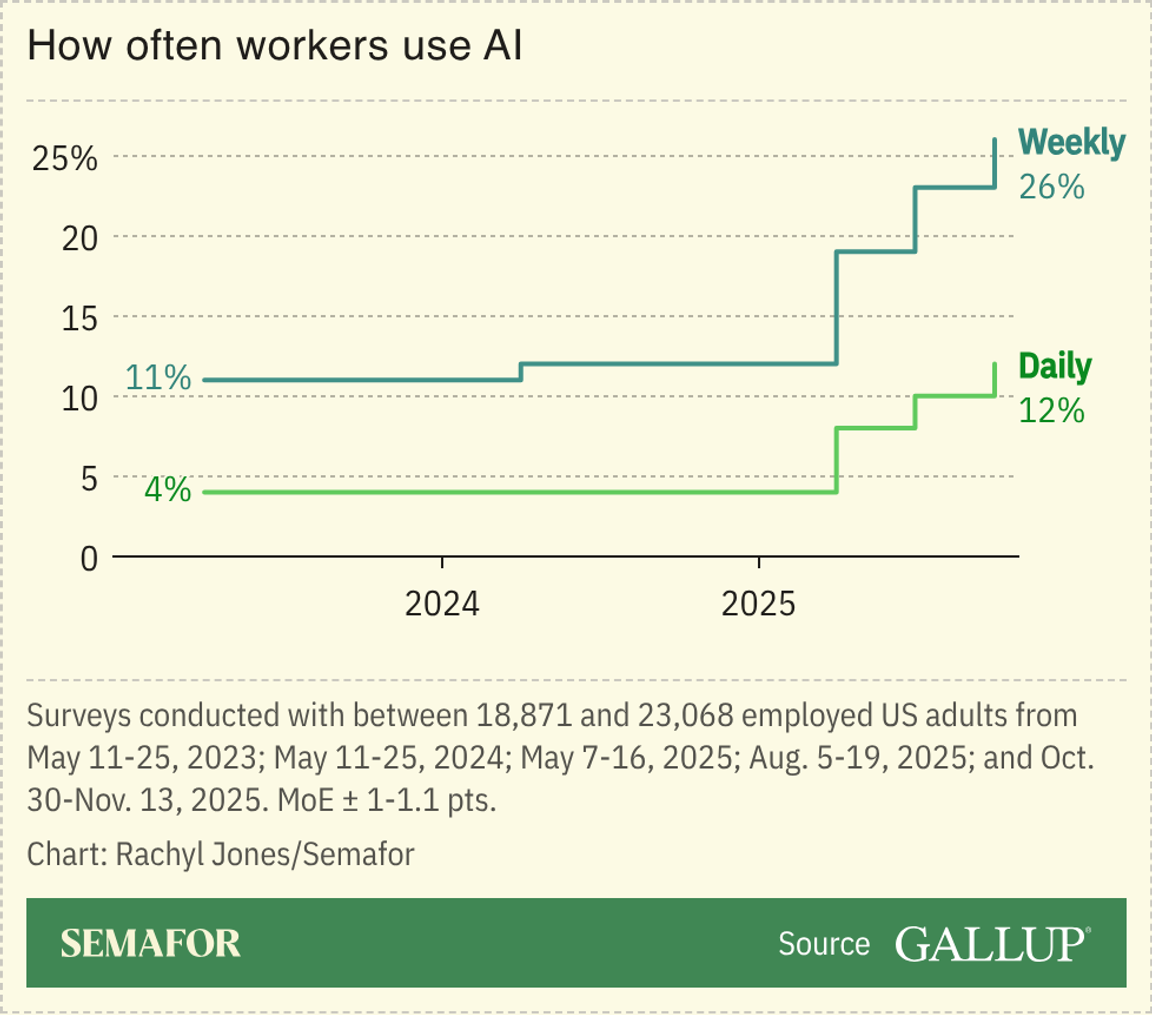 The low rate of AI adoption in the workplace may not be due to lack of trying, but lack of dedicated training, Semafor’s Rachyl Jones reports. Last June, roughly 70 Microsoft engineers stopped working for a week and gathered in person to discuss workflow, friction points, and what an AI-first team looks like. They even covered the professional identity crisis of developers, who once spent days writing code and now manage bots that do it for them. The engineers returned to their normal jobs but intentionally worked at a slower pace during the next two weeks, aiming to practice their AI learnings and form new habits in their work. Starting in January, Microsoft began expanding this initiative, called “Camp AIR,” first to human resources workers, with plans to implement it across the entire company. AI adoption is something many companies, even in tech, struggle with when there’s no clear roadmap for training workers, free time for employees to experiment with tools is limited, and many fear AI will eventually replace their jobs. The existence of a program at Microsoft indicates that even employees leading the AI charge need guidance on integrating it into the workplace and clarity about what AI-driven changes mean. It also suggests that overall business transformation promised by executives could take longer than expected. |
|
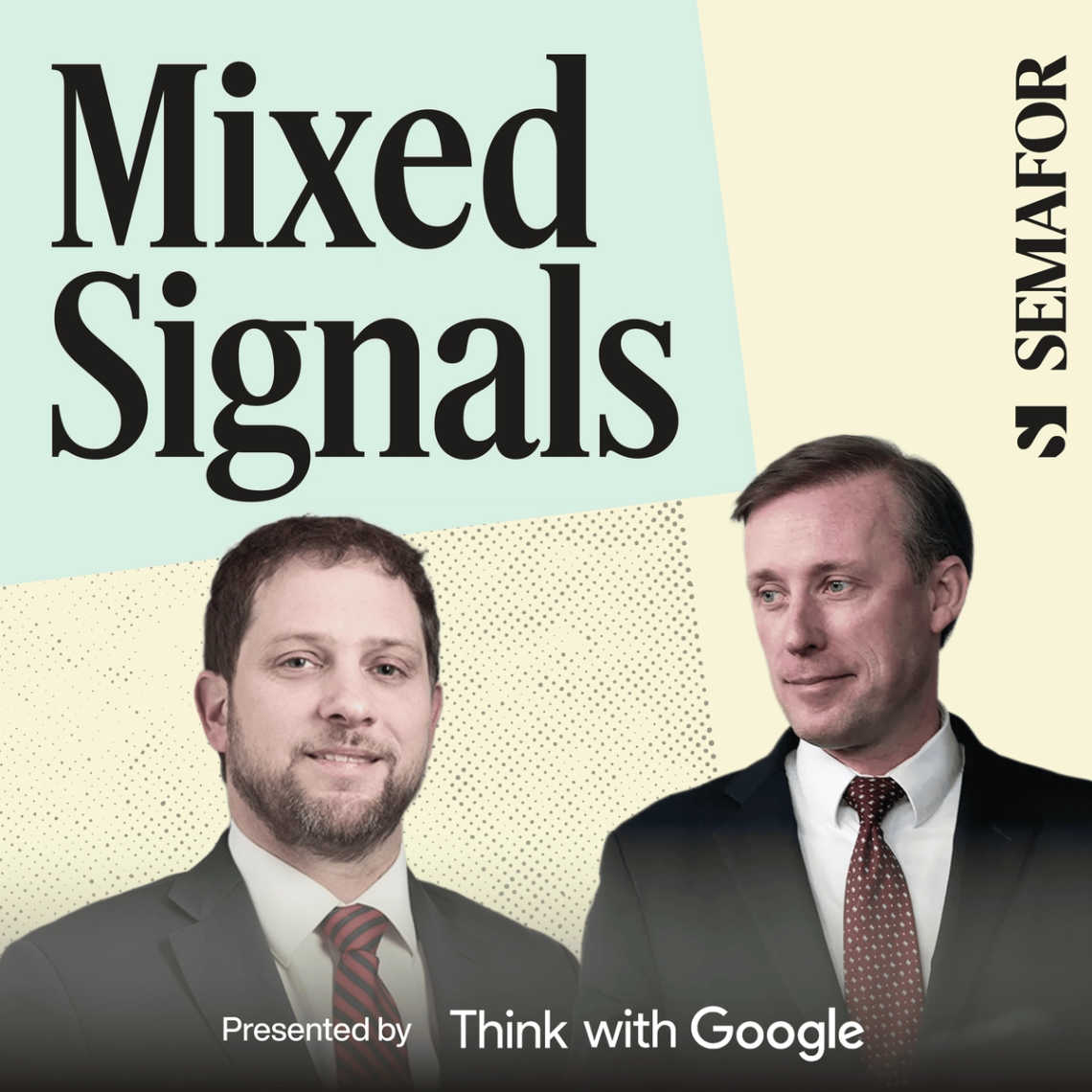 On this week’s episode of Mixed Signals, Ben and Max are joined by former National Security Advisor Jake Sullivan and Deputy National Security Advisor Jon Finer to discuss their leap from the Situation Room to the podcast studio. They talk about launching The Long Game, what they learned about media while shaping US foreign policy, and how the war in Ukraine became as much an information battle as a military one. Plus, they discuss AI-generated propaganda, reactions to the Munich Security Conference, and whether Democrats ever figured out how to explain foreign policy to the American middle class. Listen to the latest Mixed Signals now. |
|
 Zuckerberg leaving the court in LA. Mike Blake/Reuters. Zuckerberg leaving the court in LA. Mike Blake/Reuters.Mark Zuckerberg took the stand this week in a blockbuster trial that claims social media services like Facebook and Instagram are addictive and harmful to teens. Because of the nature of lawsuits, Zuckerberg was forced into some pretty silly stances — like arguing “time spent” isn’t an important business metric for them and the company doesn’t want teen users. Of course they do. It’s a business, and businesses want to make as much money as possible. Meta and other social media companies can’t say that on the stand. And they can’t say this: Social media certainly doesn’t make the lives of teens any better. It might make them a little worse. But ultimately, it can’t be blamed for all of our problems. We’ll see if banning social media solves the teen mental health crisis in Australia, which just banned social media for anyone under 16. European countries including Portugal and France have also passed bills to restrict teens. I’m guessing it won’t. The biggest danger of social media is that it might prevent us from confronting the real problems with society. — Reed Albergotti |
|
 Dennis Schneidler-Imagn Images/Reuters Dennis Schneidler-Imagn Images/ReutersWaymo just can’t seem to catch a … brake. The Google subsidiary took a strategic hit on Thursday when New York Gov. Kathy Hochul withdrew her proposal for robotaxi services in the areas surrounding New York City. The proposal drew pushback from transit workers and rideshare drivers, in an ironic moment reminiscent of the early days of Uber. The support just wasn’t there, according to the governor’s spokesperson. The news doesn’t affect testing in New York City, which is ongoing. But it’s an illustration of the mountainous problem facing robotaxi services in the US. Even when expansion approvals are greenlit by people in power — which has been difficult enough for Waymo — they can be rescinded when support in hyperlocal jurisdictions appears stunted. The effect, at scale, is the kind of fractured regulatory landscape tech companies spend big money fighting against. While New York City is still a big get for Waymo, it has perhaps the best supported public transportation infrastructure in the entire US, with rideshare cars also available in under five minutes, no matter where in the city you are. New York doesn’t need Waymo. Where it could have had a real impact is suburban places like Rochester, Buffalo, and Albany, which rely more heavily on road transport. |
|
 Kevin Lamarque/Reuters Kevin Lamarque/ReutersCan AI predict the State of the Union? Statt, a company that makes AI tools for policy and government workers, has predicted the verbatim transcript of Trump’s State of the Union address next week. The nearly 5,000-word generated speech, which includes applause breaks and Trump’s off-the-cuff remarks criticizing Democrats, was written using the startup’s speechwriting tools and an analysis of social media posts, previous addresses, think tank documents, and other sources. It forecasts Trump will begin by declaring the US in its “Golden Age,” then follow with remarks on the economy, trade, border security, and health care. Steve Glickman, Statt’s co-founder and CEO, says the goal is to hit all the overall points, not necessarily match every beat of the speech (though I’m not convinced you need AI to know Trump will discuss the economy and border). Trump’s rhetoric often looks a bit incoherent in print because he includes so much nonverbal signal. AI hasn’t reached the point where it knows us better than ourselves. (Remember the startup Aaru, that used AI agents to predict the election results?) But predictions like this can help give us a sense of the state of AI, if not the state of the union. — Reed Albergotti |
|
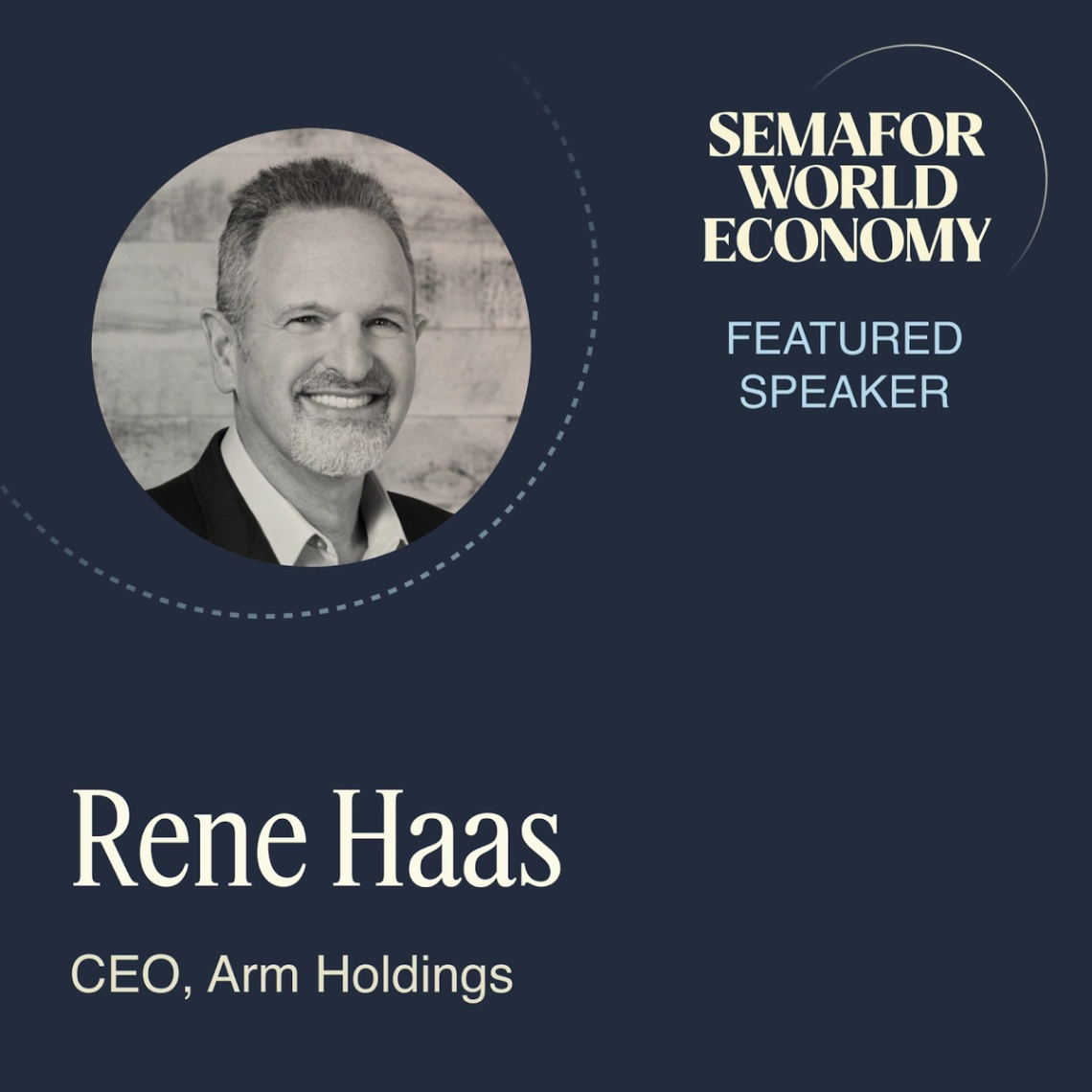 This April, Arm Holdings CEO, Rene Haas, will join global leaders at Semafor World Economy — the premier convening for the world’s top executives — to sit down with Semafor editors for conversations on the forces shaping global markets, emerging technologies, and geopolitics. See the first lineup of speakers here. |
|
|


