|



Don’t miss out: your free pass to Monster SCALE Summit is waiting! 50+ engineering talks on AI, databases, Rust, and more. (Sponsored)
Monster SCALE Summit is a new virtual conference all about extreme-scale engineering and data-intensive applications.
 |
Join us on March 11 and 12 to learn from engineers at Discord, Disney, LinkedIn, Uber, Pinterest, Rivian, ClickHouse, Redis, MongoDB, ScyllaDB and more. A few topics on the agenda:
What Engineering Leaders Get Wrong About Scale
How Discord Automates Database Operations at Scale
Lessons from Redesigning Uber’s Risk-as-a-Service Architecture
Scaling Relational Databases at Nextdoor
How LinkedIn Powers Recommendations to Billions of Users
Powering Real-Time Vehicle Intelligence at Rivian with Apache Flink and Kafka
The Data Architecture behind Pinterest’s Ads Reporting Services
Bonus: We have 500 free swag packs for attendees. And everyone gets 30-day access to the complete O’Reilly library & learning platform.
Uber’s infrastructure runs on thousands of microservices, each making authorization decisions millions of times per day. This includes every API call, database query, and message published to Kafka. To make matters more interesting, Uber needs these decisions to happen in microseconds to have the best possible user experience.
Traditional access control could not handle the complexity. For instance, you might say “service A can call service B” or “employees in the admin group can access this database.” While these rules work for small systems, they fall short when you need more control. For example, what if you need to restrict access based on the user’s location, the time of day, or relationships between different pieces of data?
Uber needed a better approach. They built an attribute-based access control system called Charter to evaluate complex conditions against attributes pulled from various sources at runtime.
In this article, we will look at how the Uber engineering team built Charter and the challenges they faced.
Disclaimer: This post is based on publicly shared details from the Uber Engineering Team. Please comment if you notice any inaccuracies.
Understanding the Authorization Request
Before diving into ABAC, you need to understand how Uber thinks about authorization. Every access request can be broken down into a simple question:
Can an Actor perform an Action on a Resource in a given Context?
Let’s understand each component of this statement:
Actor represents the entity making the request. At Uber, this could be an employee, a customer, or another microservice. Uber uses the SPIFFE format to identify actors. An employee might be identified as spiffe://personnel.upki.ca/eid/123456, where 123456 is their employee ID. A microservice running in production would be identified as spiffe://prod.upki.ca/workload/service-foo/production
Action describes what the actor wants to do. Common actions include create, read, update, and delete, often abbreviated as CRUD. Services can also define custom actions like invoke for API calls, subscribe for message queues, or publish for event streams.
A resource is the object being accessed. Uber represents resources using UON, which stands for Uber Object Name. This is a URI-style format that looks like uon://service-name/environment/resource-type/identifier. For example, a specific table in a database might be uon://orders.mysql.storage/production/table/orders.
The host portion of the UON is called the policy domain. This acts as a namespace for grouping related policies and configurations.
The Charter System
As mentioned, Uber built a centralized service called Charter to manage all authorization policies. Think of Charter as a policy repository where administrators define who can access what. This approach offers several advantages over having each service implement its own authorization logic.
See the diagram below:
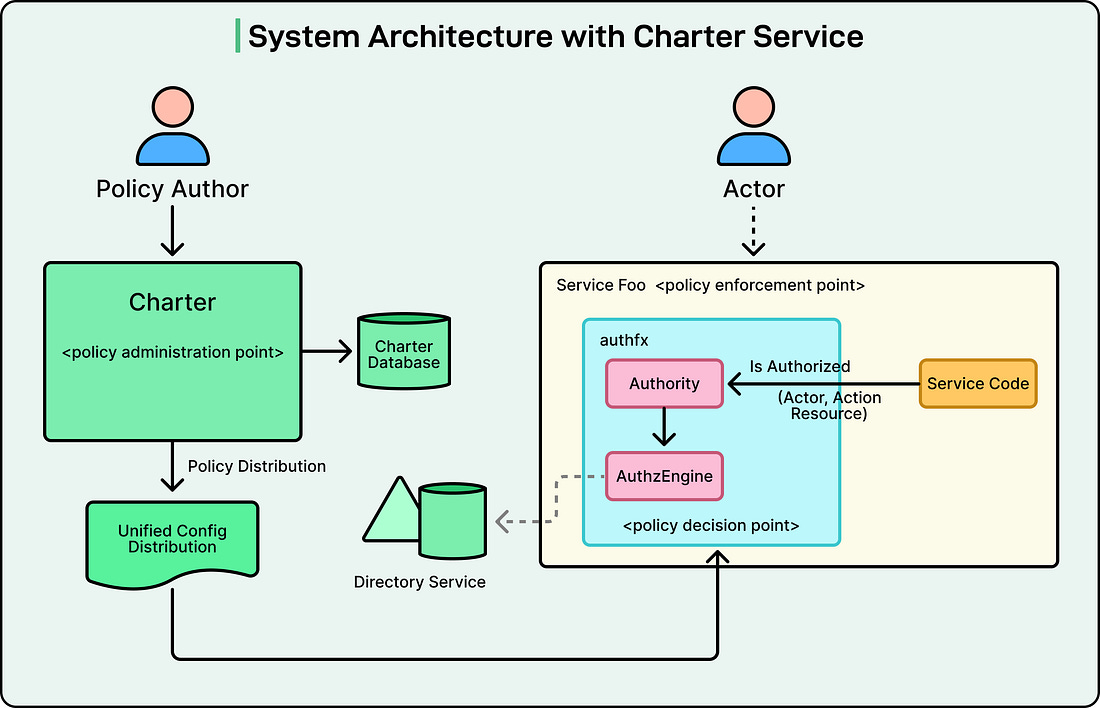 |
Policies stored in Charter are distributed to individual services. Each service includes a local library called authfx that evaluates these policies.
The architecture works as follows:
Policy authors create and update policies in Charter
Charter stores these policies in a database
A unified configuration distribution system pushes policy updates to all relevant services
Services use the authfx library to evaluate policies for incoming requests
Authorization decisions are made locally within each service