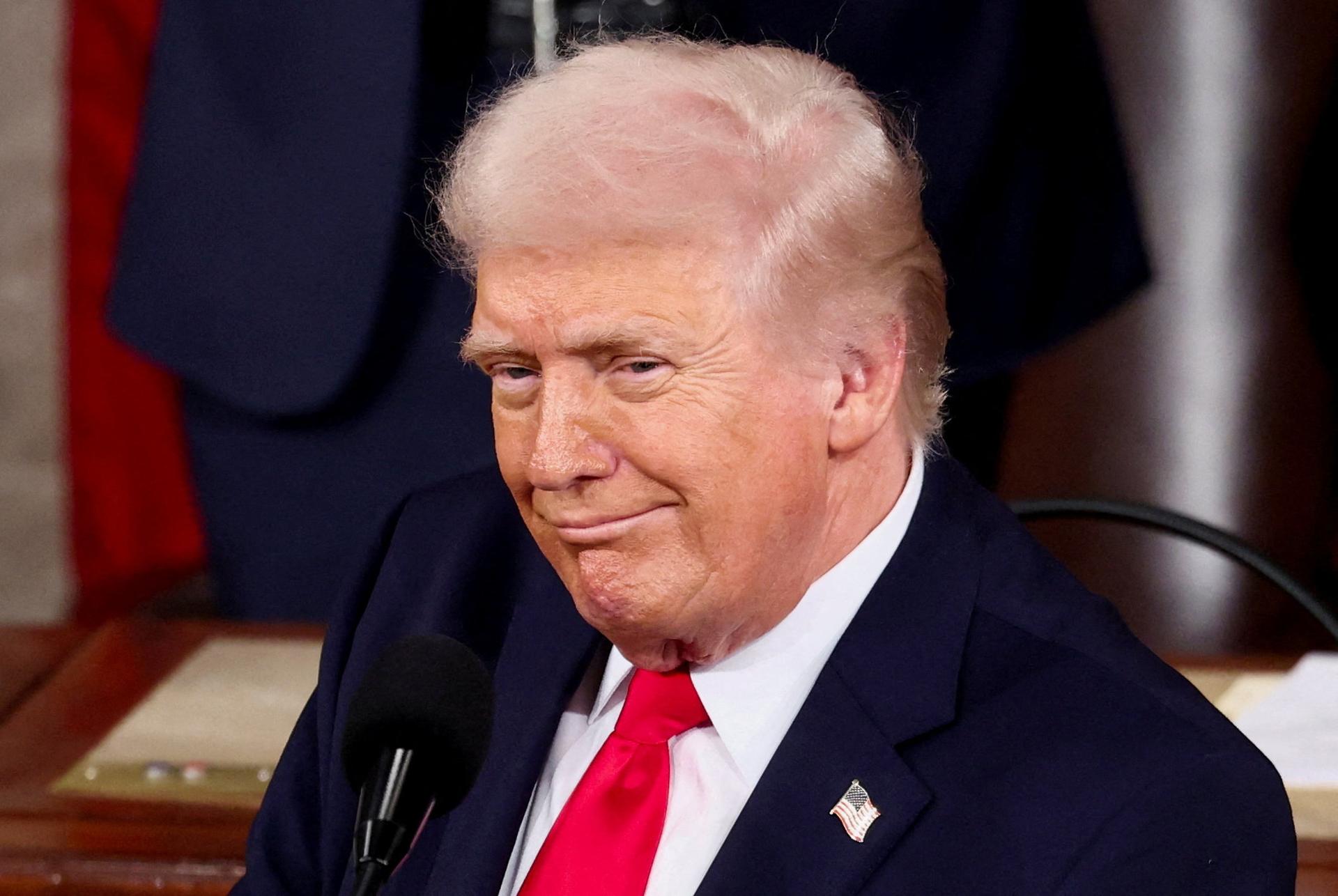
State of the Union speech came amid sagging approval ratings.

Add Reuters to Your Google Preferred Sources


Daily Briefing

Daily Briefing

By Kate Turton

Hello. In the US, Trump hails ‘golden age’ in State of the Union, businesses are unlikely to lower prices despite tariff relief, and a bipartisan majority of Americans believe vaccines are safe.

Elsewhere, Hungary's opposition party widens its lead ahead of Orban's Fidesz, and Nepal's rapper-mayor in pole position to become prime minister.

Today's Top News


Donald Trump delivers the State of the Union address in the House Chamber of the US Capitol in Washington, D.C. February 24, 2026. REUTERS/KEVIN LAMARQUE

United States

  • President Donald Trump boasted in his State of the Union address that he had ushered in "the golden age of America," seeking to project an aura of success despite sagging approval ratings and deepening voter frustration. These are the key takeaways from Trump's speech.
  • He briefly laid out his case for a possible attack on Iran in his speech, saying he would not allow the world's biggest sponsor of terrorism to have a nuclear weapon.
  • "At times in his speech he was almost like a ringmaster." Political Correspondent Bo Erickson talks us through Trump's record breaking State of the Union address on the Reuters World News podcast.
  • A bipartisan majority of Americans believe vaccines are safe and that children should receive them to attend school, according to a new Reuters/Ipsos poll, illustrating the challenges Trump's administration faces to win broad support for upending decades of health policy.

In other news

  • China and Germany want to deepen cooperation, German Chancellor Friedrich Merz and Chinese Premier Li Qiang said in Beijing, as Merz began a visit aimed at resetting ties amid a widening trade imbalance.
  • France appointed Christophe Leribault as the new head of the Louvre, bringing in the director of the Palace of Versailles to turn around the world's most-visited museum after a high-profile jewel heist and rolling strikes.
  • Nepal's historic youth-led uprising last September killed 77 people and forced then-Prime Minister K.P. Sharma Oli to resign. Now a 35-year-old rapper-turned-politician Balendra Shah is dominating the race to become Nepal's next prime minister.
  • Zimbabwe has suspended exports of all raw minerals and lithium concentrates with immediate effect, its mines ministry said in a statement, after the government alleged malpractices and leakages.
 

Business & Markets

 
  • Consumers expecting a drop in prices after the US Supreme Court struck down the White House's emergency tariffs are likely to be disappointed, as businesses plan to use any relief to offset elevated costs and gird themselves to chase refunds.
  • The prices importers can get from selling rights to potential government refunds have surged in the wake of the Supreme Court’s ruling that Trump’s emergency tariffs are illegal.
  • British luxury car maker Aston Martin will cut its workforce by up to 20%, it said, as it strives to recover from the impact of US import tariffs and weak demand in China.
  • Diageo's new boss Dave Lewis cut the company's annual sales forecast and dividend in his first results presentation, sending its shares down 6%. Lewis, nicknamed "Drastic Dave" for his history of cost-cutting reforms at Tesco and Unilever, took over as CEO at the Johnnie Walker whisky and Guinness beer maker in January.
  • Artificial intelligence lab Anthropic has no intention of easing its usage restrictions for military purposes, a person familiar with the matter said, adding talks continue after a meeting to discuss its future with the Pentagon.
  • Nvidia’s earnings could jolt global markets tonight. A 5% swing now means hundreds of billions in value. We break down why one chipmaker has become the market’s biggest macro indicator on Reuters Morning Bid.
 

US orders diplomats to fight data sovereignty initiatives


US Secretary of State Marco Rubio in Budapest, Hungary, February 16, 2026. REUTERS/Bernadett Szabo/File Photo

Trump's administration has ordered US diplomats to lobby against attempts to regulate US tech companies' handling of foreigners' data, saying in an internal diplomatic cable seen by Reuters that such efforts could interfere with artificial intelligence-related services.

Experts say the move signals the Trump administration is reverting to a more confrontational approach as some foreign countries seek limits around how Silicon Valley firms process and store their citizens' personal information - initiatives often described as "data sovereignty" or "data localization."

In the State Department cable signed by US Secretary of State Marco Rubio, the agency said such laws would "disrupt global data flows, increase costs and cybersecurity risks, limit Artificial Intelligence (AI) and cloud services, and expand government control in ways that can undermine civil liberties and enable censorship."

Read our exclusive
 

And Finally...

Anderson .Paak attends the MusiCares Person of the Year gala honoring Mariah Carey in Los Angeles, California. January 30, 2026. REUTERS/Mario Anzuoni

Grammy award-winning rapper and singer, Anderson .Paak, is exploring his Korean roots with his directorial debut film "K-Pops!", which is due for release in US theaters on Friday.

Rather than delving into his own emotional struggles with his dad, .Paak decided to do a heartwarming story about a father and a son reuniting during a K-Pop competition show.

Read more