| | Cuban forces kill four people on a US-registered boat, peace talks continue in Geneva over Iran and ͏ ͏ ͏ ͏ ͏ ͏ |
| |  | Flagship |  |
| |
|
The World Today | 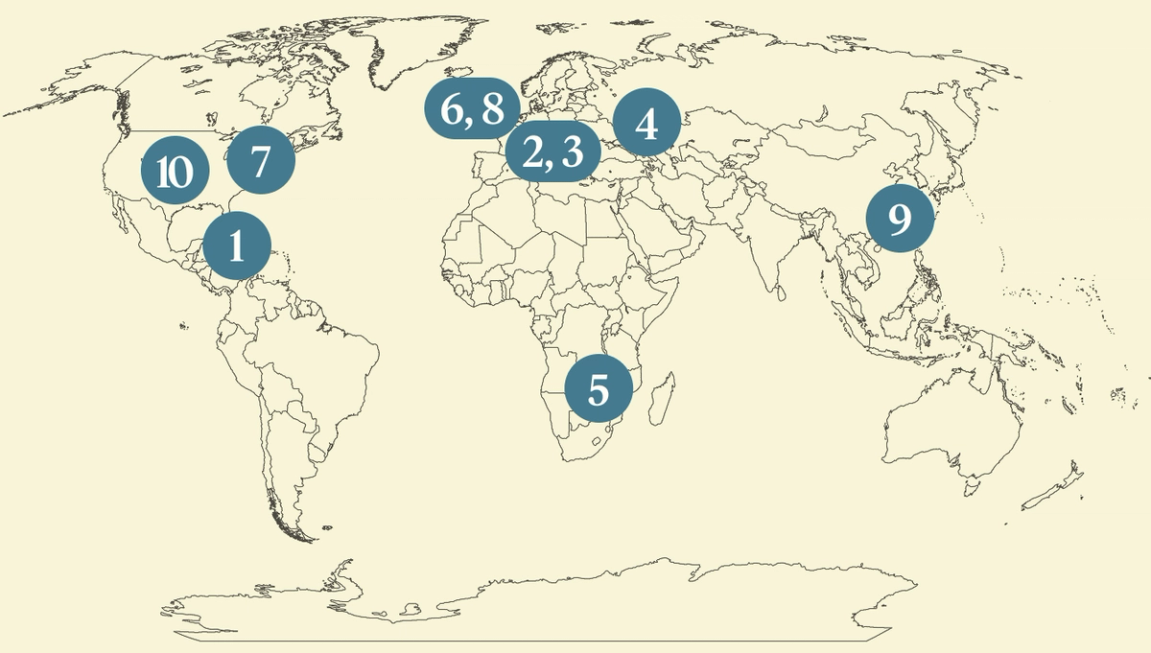 - Cuba hits US-owned boat
- Last-ditch US-Iran talks
- US-Ukraine postwar plans
- Russia’s African fighters
- Zimbabwe’s lithium plans…
- …and the UK’s
- US DoD’s Anthropic threat
- Ireland’s naval strategy
- Jimmy Lai wins appeal
- US citizens head abroad
 A new book from veteran science US writer Michael Pollan that delves into consciousness. |
|
Cuba kills four on US-registered boat |
 Norlys Perez/Reuters Norlys Perez/ReutersCuba said it had killed four people traveling on a US-registered speedboat, risking a heightening of tensions with Washington. Havana said those killed belonged to a group of Cuban nationals trying to “infiltrate” the island nation, with the US secretary of state promising to investigate the “highly unusual” incident. Washington has tightened its embargo on Cuba in recent weeks, sending the country’s economy into a tailspin, but said it would roll back some restrictions on firms reselling Venezuelan oil to Cuban private sector firms, a move that could ease Havana’s fuel crisis. Canada and Mexico, meanwhile, vowed to send aid to the island, which the United Nations warned faces a humanitarian “collapse.” |
|
US, Iran meet for last-ditch talks |
 @dparody/Instagram/via Reuters @dparody/Instagram/via ReutersIranian and US representatives met in a last-ditch bid to reach a nuclear deal and avert armed conflict. US President Donald Trump has moved huge military forces to the Middle East, and demanded Tehran pledge not to build a nuclear weapon. Iran’s foreign minister made such a pledge this week, but said it would continue its civilian program. There is skepticism over how civilian it really is: Iran is the only non-nuclear-armed state to have enriched uranium at near-weapons-grade level, the BBC noted. The two sides seem far apart. The US wants any deal to address Iran’s support for regional proxies, in addition to the development of ballistic missiles; Tehran denies supporting groups such as Hezbollah or building long-range weapons. |
|
US, Ukraine to discuss post-war plan |
 Jonathan Ernst/File photo/Reuters Jonathan Ernst/File photo/ReutersPresident Donald Trump spoke with his Ukrainian counterpart Volodymyr Zelenskyy as US and Ukrainian envoys prepared to discuss post-war reconstruction. Zelenskyy said the meeting today would focus on a recovery plan for Ukraine, as well as a prisoner swap with Russia, which continued its onslaught on Kyiv overnight. Though Zelenskyy has said the war is at the “beginning of the end,” many remain skeptical of a ceasefire being agreed to any time soon, even as Russia’s battlefield progress continues to stall and its personnel losses mount. Meanwhile, Ukraine’s recovery bill keeps rising: A recent estimate put the country’s recovery at almost $600 billion, around three times its pre-war GDP. |
|
Russia reportedly luring Africans |
 Rogan Ward/Reuters Rogan Ward/ReutersMore than 1,700 Africans are fighting for Russia in its war against Ukraine, Kyiv said, many lured with work offers from Moscow. Ukraine’s foreign minister said he was in discussions with African leaders to prevent their citizens from being drawn into such schemes: Reports of Africans going to Russia have become increasingly common as Moscow’s war losses pile up. Pretoria has in recent days moved to repatriate its nationals stranded in Russia, some of whom were allegedly duped by the daughter of a former South African president in exchange for payment. Those left in eastern Europe face harrowing conditions: “So long as you’ve stepped in the Russian military, you escape or you die,” a Kenyan recruit told CNN. |
|
Zimbabwe suspends lithium exports |
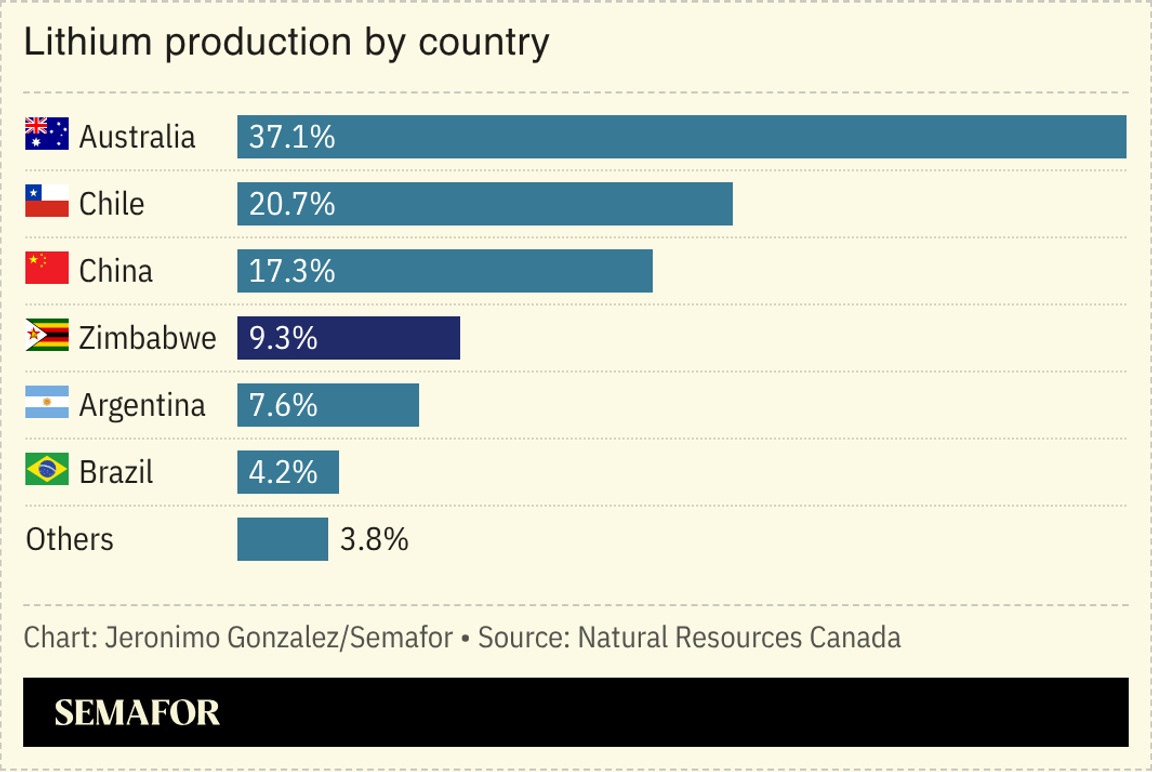 Zimbabwe suspended lithium exports in a bid to pressure firms to set up domestic processing facilities, sparking fears of supply chain disruptions and sending prices soaring. The move caused Chinese lithium futures to rise more than 9% on Thursday. Like other commodity-exporting African nations, Zimbabwe wants to capture more value across the supply chain, with at least 13 African countries imposing similar export restrictions since 2023. However, progress on setting up processing plants remains slow: The highly technical and capital-intensive requirements, as well as faltering intra-African integration, have hindered attempts to boost domestic upskilling, the Africa Center for Strategic Studies said. |
|
UK opens first lithium plant |
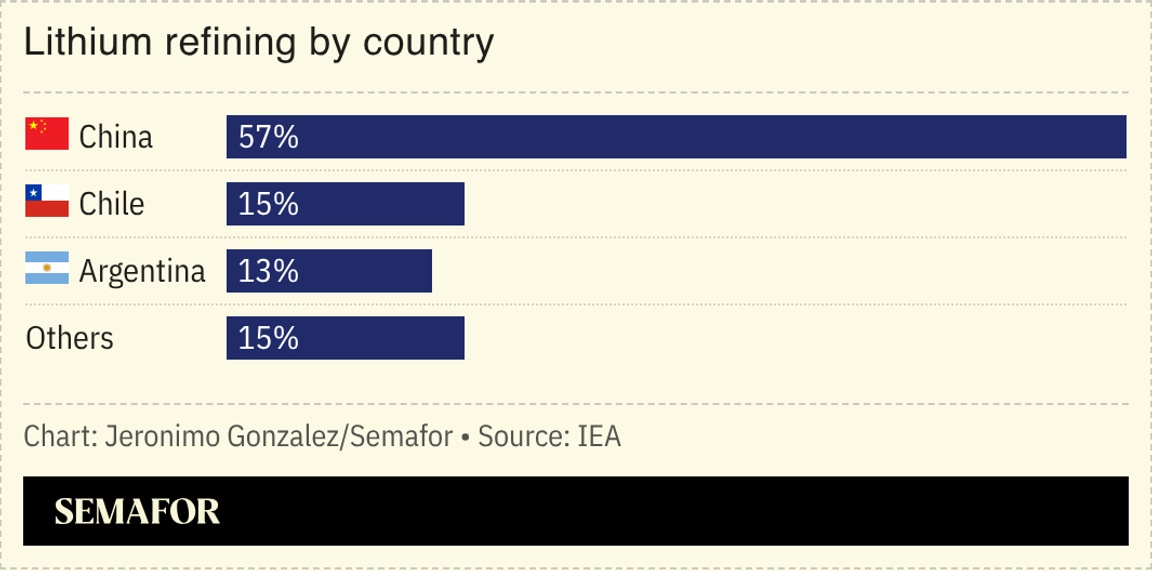 The UK’s first commercial lithium plant opened, as more nations race to secure domestic supplies of critical minerals. The mine will initially produce around 100 tons annually, enough for about 2,000 EVs, with plans to scale up to 18,000 tons within a decade. Lithium is just one of about 60 elements listed as economically crucial by the US Geological Survey, and demand is especially high in the energy, defense, and semiconductor industries. China refines around 60% of global lithium production and is similarly dominant in the supply of other minerals, from copper to rare earths. The US has begun stockpiling several key minerals and collaborating with allies such as Japan and Europe to develop alternative supply chains, the Financial Times reported. |
|
US seeks to blacklist Anthropic |
 Anthropic CEO Dario Amodei. Ludovic Marin/AFP via Getty Images. Anthropic CEO Dario Amodei. Ludovic Marin/AFP via Getty Images.The US government took steps towards blacklisting Anthropic, in a sharp escalation of its row with the AI giant. The US military uses Anthropic’s Claude chatbot extensively, including to plan its Venezuela operation last month. But the Pentagon also wants to use it for surveillance and human-unsupervised killing, and has threatened to designate Anthropic a “supply chain risk” if it refuses to comply. The Department of Defense asked Boeing and Lockheed Martin about their integration with Anthropic, Axios reported, a potential move towards such a designation. The blacklisting would be unprecedented for US companies: It is usually reserved for firms from adversarial countries, such as China’s Huawei. AI companies and academics have largely backed Anthropic, saying it should resist coercion. |
|
 This April, Patrice Louvet, President and CEO of Ralph Lauren, will join global leaders at Semafor World Economy — the premier gathering for the world’s top executives — to sit down with Semafor editors for conversations on the forces shaping global markets, emerging technologies, and geopolitics. See the first lineup of speakers here. |
|
Ireland seeks to boost military alliances |
 Clodagh Kilcoyne/File Photo/Reuters Clodagh Kilcoyne/File Photo/ReutersIreland said it would deepen its naval cooperation with Britain and France and step up protection of shipping and undersea infrastructure from potential Russian attacks. Dublin has been neutral since 1922: It is not a NATO member and did not fight in World War II, although it relies on British forces to protect its airspace. But growing concern over Russian hybrid warfare — notably cyberattacks and sabotage of submarine cables — led the country’s defense ministry to launch its first maritime security plans, potentially permitting NATO ships to patrol its waters. This is not the first time Moscow’s recent aggression has driven formerly neutral countries towards its adversaries. Finland and Sweden both joined NATO following the full-scale invasion of Ukraine. |
|
Hong Kong’s Jimmy Lai wins appeal |
 Tyrone Siu/File Photo/Reuters Tyrone Siu/File Photo/ReutersA Hong Kong court overturned a fraud conviction against Jimmy Lai, but the pro-democracy media tycoon remains in prison. Lai was jailed for fraud for five years in 2022; he has now won an appeal, but he was separately sentenced last month to 20 years for collusion with foreign forces. Activists say Lai’s detention shows how Hong Kong’s once robust civil liberties are shrinking, the BBC reported: The US and UK governments said Beijing-imposed national security laws are used to silence democracy campaigners. Lai, 78, is reportedly in poor health, and his daughter believes he will “die a martyr behind bars.” The conviction’s overturning is “nothing more than a PR move by the Hong Kong authorities,” Claire Lai told reporters. |
|
|


