|
 |
Editor’s note: Our coverage in The Bulwark of the attack on Iran began with a morning livestream—now available on Substack and YouTube—and continued with an important article by our Gen. Mark Hertling on the apparent gap between strategy and action: “Bombing Iran Is Easy. What Comes Next Is Not.” And below, please read our Ben Parker on some of the open questions surrounding the Iran campaign.
We’ve got more reporting and analysis coming in the days ahead. To make sure you don’t miss any of our articles, newsletters, shows, and livestreams, consider signing up for a Bulwark+ membership today:
Three Massive Questions Concerning Trump’s War in Iran
Through the fog of war, some things are dimly discernible.
|

| |||||||||||||||


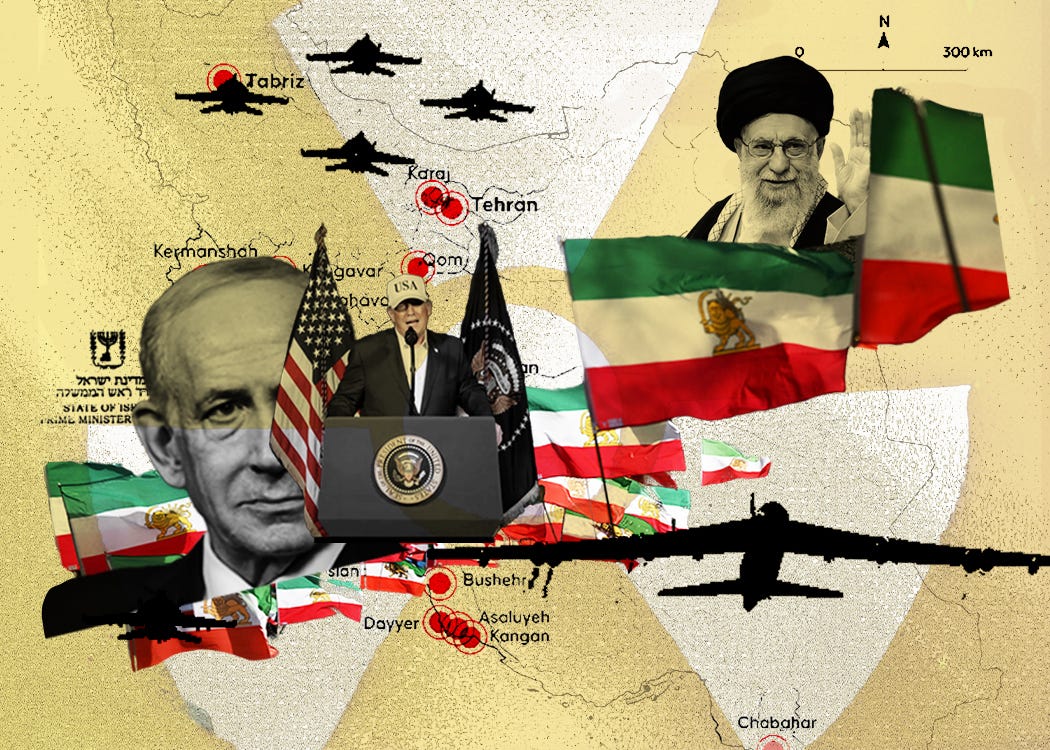 |
THE UNITED STATES, IN CONJUNCTION with Israel, initiated a series of air attacks against Iran Saturday. Early reports indicate that American forces attacked military targets throughout the country while Israeli forces targeted Iranian Supreme Leader Ali Khamenei, President Masoud Pazeskhian, and other high-level figures in the regime. The Israeli government and President Donald Trump both announced mid-day Saturday that Khamenei had been killed.
In response, Iran launched missiles at American bases throughout the Middle East and reportedly moved to halt shipping through the Strait of Hormuz.
As always, the earliest reports of combat are often confused, sometimes contradictory, and probably wrong, at least in some respects. But there are some questions that we can already answer, provisionally and partially, to gain some clarity on what’s going on.
1. Why now?
LET’S START WITH WHAT we don’t know: Was there some secret exigency that required a decision at this point? Donald Trump’s special envoy, Steve Witkoff, said within the last week that Iran was “probably a week away from having industrial-grade bombmaking material.” Witkoff isn’t an expert in nuclear weapons or international relations; there have been no other reports corroborating his statement; and it directly contradicts open-source intelligence about the state of the Iranian nuclear program, to say nothing of the Trump administration’s own claim that the air strikes U.S. forces conducted as part of last summer’s Operation Midnight Hammer “obliterated” Iran’s nuclear sites.
Then again, if Iran had made some secret breakthrough in its nuclear weapons program, the Trump administration would have had every reason not to announce it, given those claims of “obliteration” last year. It’s possible, but unlikely, that Witkoff slipped up and accidentally told the truth.
Then, too, the Canadian and Australian governments—both members of the Five Eyes intelligence partnership, along with the United States, the United Kingdom, and New Zealand—issued statements expressing support for the operation on the grounds that it would prevent Iran from obtaining a nuclear weapon. (The U.K. released a slightly more ambivalent statement about the strikes that nonetheless emphasized that Iran must be prevented from acquiring nukes.) Maybe our intelligence partners know something the American public doesn’t.
Trump has made clear, though, that unlike Midnight Hammer, these attacks are not designed just to incapacitate Iran’s nuclear program. He intends them to topple the regime. The optimal time to do that might have been mid-January, when the largest protests since the fall of the Shah in 1979 seemed to destabilize the regime—until it responded with massive violence, effectively quashing them. (The protests restarted this week, but not on the scale of last month.)