|
The disaster in Iran
With no plan for real regime change and no thoughtful strategy, Trump has thrown the Iranian people to the wolves.
| |||||||||||||||


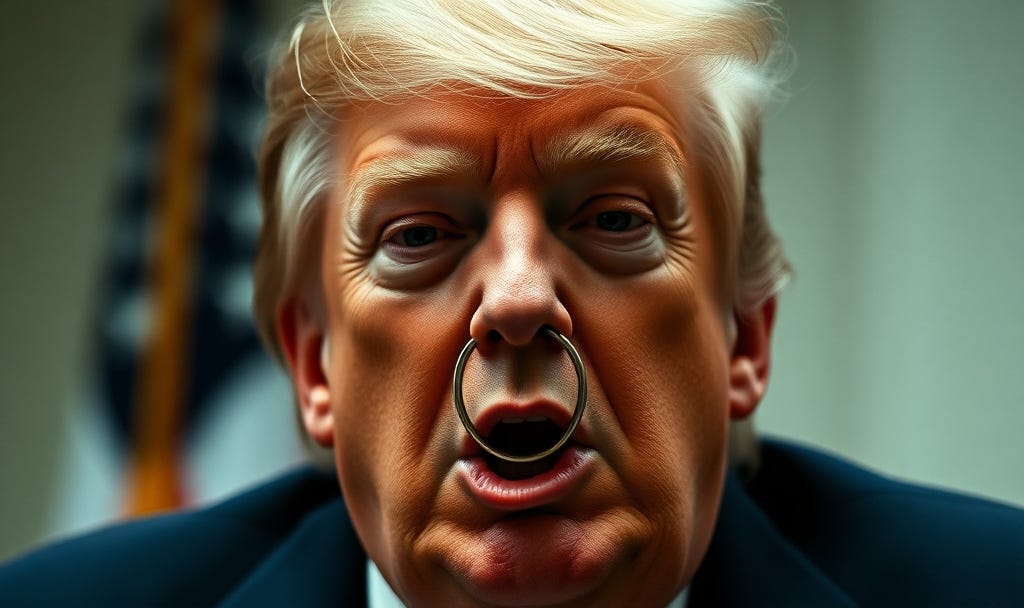 |
First Putin, now Netanyahu: Trump gladly does their bidding. (IA-generated image)
Good day. This administration’s amateur, chaotic governance, and the erratic decision-making by the Orange Menace, has now led to war with Iran and some head-spinning, conflicting rationales from Trump and his top officials.
Let’s take a look at Iran, the country: Its role in the Middle East, as well as its government, economy, and people. And the big question: What comes next?
🇮🇷 Whither Iran?
Benjamin Netanyahu has finally gotten something he has desired for decades: A war with Iran and a US president, made malleable by flattery, willing to go along and put US military members in harm’s way.
Let’s remember: Iran is not to be trifled with. It’s a pretty big country. Of the world’s 195 independent, sovereign countries, Iran ranks 17th in both population and size, with 93 million people and a land area of 636,371 square miles. Geographically, it’s bigger than France, Spain, Germany, Portugal, and Switzerland combined. It’s the second-largest country in the Middle East, behind Saudi Arabia, and the 6th largest among Asia’s 50 or so countries.
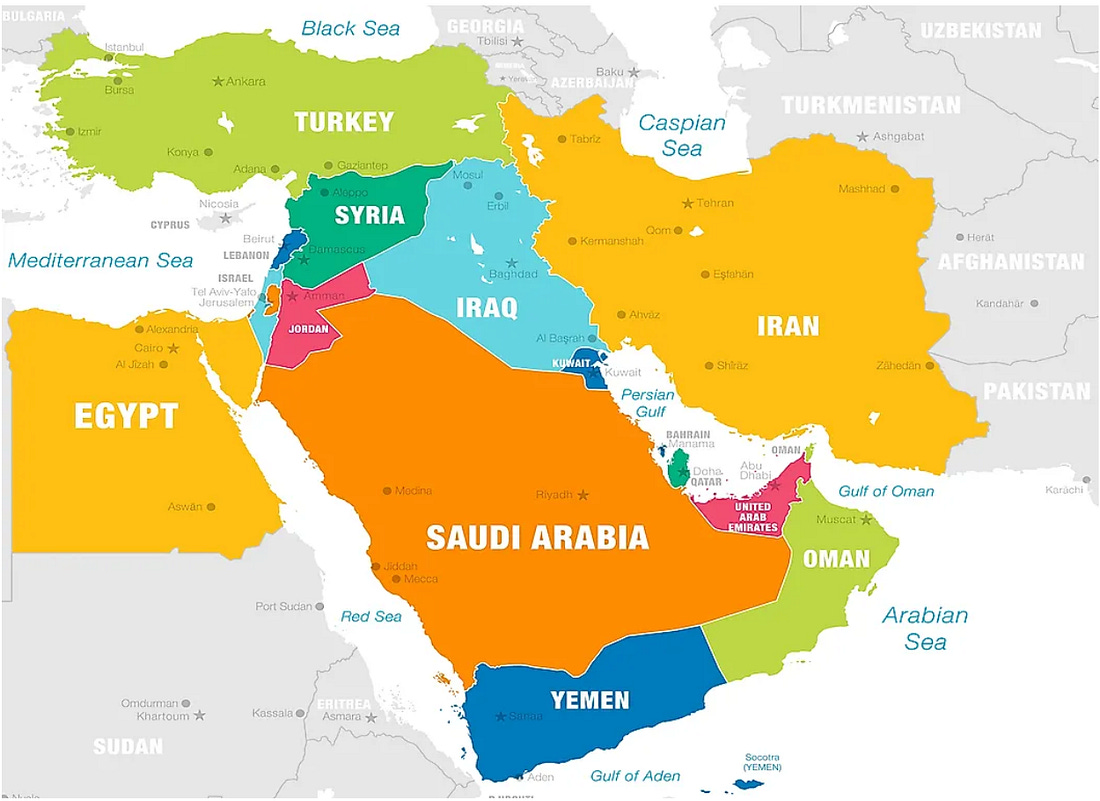 |
World Atlas
It’s located in the area of one of the world’s oldest continuous major civilizations, dating to the 7th century BC. Over the centuries, through various conquests and rulers, ancient Iran (called Persia by the outside world until 1935) was the site of some of the earliest developments of writing, agriculture, urbanization, religion, and administration. During the Islamic Golden Age, from the 8th to 13th century, there were innovations in literature, philosophy, mathematics, medicine, astronomy, and art.
Today, Iran is an energy powerhouse thanks to its massive oil and gas reserves, among the largest in the world, which help power its economy, the 19th largest in the world with a GDP of close to $2 trillion. It has lush flora and diverse fauna and 20 national parks. Tourism is big, more than 5% of the economy; it hit 9 million foreign visitors right before the pandemic, and has rebounded to more than 6 million.
It has a robust fisheries industry thanks to its access to the Caspian Sea, the Persian Gulf, the Gulf of Oman, and lots of rivers. In fact, it’s the world’s largest exporter of caviar. It’s the world’s 12th largest automaker. Construction is another hugely profitable industry, including homebuilding; 70% of Iranians own homes vs. 65% in the US.
Iran has made tremendous strides in science and medical technology. It has a space program and has launched satellites into orbit.
Culturally, Iran is known for its art, literature, architecture, carpet weaving, museums, cuisine, and more. It has 29 World Heritage sites.
Iranians are highly educated — 94% of adults are literate, vs. 79% in the US (the other 21% is the Trump family) — and 85% of its population has access to high-speed internet. There is free education through college, and universal health care covers about 90% of the population, both citizens and refugees. Residents are guaranteed a national basic income.
But the Islamic republic’s repressive practices have resulted in a brain drain. And a combination of devastating sanctions by the US and its allies, mismanagement by the ruling regime that maintains central control of many sectors of the economy, and financial support of terrorist organizations in the region, has led to huge budget deficits and high inflation.
The regime is moving toward free markets and privatizing industry, but it isn’t happening fast enough for residents who took to the streets to protest last month and were slaughtered by government forces.
Look, in modern history, Iran’s been a bad actor in the Middle East ever since the Iranian Revolution in 1979 that ousted the corrupt but Western-friendly Shah Mohammad Reza Pahlavi and put Islamist zealots in power.
They are running a totalitarian regime, trying to spread their fanatical beliefs around the world and financially and militarily supporting terrorist organizations while repressing their own people and squashing opposition.
Given what has happened, it’s important to note that when the clerics seized power, what had been an uneasy relationship with Israel immediately turned openly hostile.
For a time, the Ayatollah Khomeini government maintained clandestine relations with Israel, a strategy that paid off when Israel supplied Iran with weapons and advisers during its 1980-1988 war with Iraq in exchange for oil.
Since 1989, when Ayatollah Ali Khamenei became supreme leader, and through a series of Iranian presidents, threats against Israel have ebbed and flowed. Sometimes Israel was “a cancerous tumor” that should be “wiped off the map;” at other times, Iranian leaders quietly sought a truce and possible recognition of Israel’s right to exist.
Today, Iran’s leaders are unequivocal about their desire to see Israel destroyed, and their uranium enrichment program has everyone in the region worried. The Trump administration claims Iran is not serious about negotiating, but I’d feel more confident in that assessment if we had real diplomats at the table instead of a real estate developer (Steve Witkoff) and the president’s callow son-in-law (Jared Kushner).
It didn’t have to come to this. Under Barack Obama’s 2015 nuclear deal, Iran reduced its nuclear enrichment from 60% to 3.67%, cut its uranium stockpile by 98%, eliminated two facilities that were producing weapons-grade plutonium, and gave the International Atomic Energy Agency 24/7 access for inspections.
In exchange, the US and its allies lifted many of their sanctions, worth about $100 billion, that were crushing Iran’s economy.
Granted, the deal didn’t address Iran’s missile program, and the nuclear restrictions expired in 10 years. But if Iran had chosen to restart a nuclear weapons program, it would have taken it more than a year to enrich enough uranium, giving the rest of the world plenty of time to deal with it.
But it doesn’t matter. Trump took office in 2017 and blew up the deal, reimposed sanctions, and went for his favorite relationship move: Utter humiliation. Capitulate to his demands, or you’ll find the bloody head of your favorite dog in your bed, courtesy of Kristi Noem.
In response, Iran embarked on uranium enrichment again. Today it’s estimated that they are back up to 60%. From that level, it’s a quick step to the 90% level for producing nuclear weapons.
The recent negotiations stalled because the US demanded that Iran reduce its uranium enrichment to zero. But Iran is a signatory to the nuclear nonproliferation treaty, which gives countries the right to produce small amounts of their own nuclear fuel for atomic energy and medical research projects. It refused to go to zero.
So Netanyahu paid a visit to Trump to talk him into war, and here we are.