|
|
|
|
|
|
|
|
|
Dado Ruvic/Reuters
|
|
|
|
|
The war in the Middle East has markets on edge this week. When uncertainty rises, investors often look for a soft (and shiny) place to land. Today, we dig into whether investing in gold is still a safe investment. |
|
|
|
|
|
|
|
|
|
|
In a Fidelity poll of about 750 advisers conducted Monday, about 60 per cent said they expect investors may turn to gold as a safe haven if tensions escalate. |
|
|
|
|
Prices are already moving. Gold, often viewed as a refuge during geopolitical turmoil, rose to US$5,311.60 an ounce on Monday, up US$63.70, though still shy of its record high in late January. |
|
|
|
|
I spoke with Andrew Clee, vice-president of product and managed accounts at Fidelity Investments, about why gold tends to draw investors in moments like this. Here’s our conversation: |
|
|
|
|
Why does gold tend to be the asset investors reach for during geopolitical crises and economic uncertainty? |
|
|
|
|
It’s very much like a currency. A store of value, a medium of exchange, and a hedge against inflation and de-dollarization. It has a number of attributes that are very attractive as a safe haven asset. |
|
|
|
|
It also has an extremely long track record. It’s one of the oldest asset classes in the world, so there’s a lot of history on how it’s behaved in past crises and risk-off events. People tend to be uncomfortable with short track records, regardless of the asset class. |
|
|
|
|
It’s also priced in U.S. dollars. We’ve seen the U.S. dollar depreciate over the last 12 months, and that makes it cheaper for foreign buyers to buy gold. |
|
|
|
|
In practical terms, what does “flocking to gold” actually look like? Are investors buying bullion or gold ETFs? |
|
|
|
|
|
|
|
|
It’s both physical gold and gold ETFs. You would have seen that even Costco was selling gold. We’ve seen really strong flows into the ETF market over the past 18 months. |
|
|
|
|
It’s very tough to get a pulse on the physical market. But anecdotally, when you see retailers selling gold bars that you don’t typically see selling gold bars, I would suspect there’s demand on both sides. |
|
|
|
|
Historically, how reliable has gold been as a hedge against geopolitical shocks? |
|
|
|
|
It’s been pretty good, to be honest. Historically, it’s been one of the better performing asset classes. But it comes and goes. Gold went through a long period when we were in a very strong bull market with low inflation, effectively trading range-bound. Then, as the U.S. dollar started to get weaker and risk sentiment declined or geopolitical risk increased, we saw it really start to move. |
|
|
|
|
Postcrisis, it had a really strong run that marked the end of the commodity cycle, and then it did effectively very little until the last 18 months or so, where it started really moving again. The risk over the long term is opportunity cost versus risk assets. But that being said, it does provide diversification, a hedge against inflation risk and a hedge against risk-off or downside as a core holding over the long term. |
|
|
|
|
If investors want some exposure to gold as a hedge, how much is reasonable within a diversified portfolio? |
|
|
|
|
It depends on your investment horizon and where you are in that journey. |
|
|
|
|
As you get closer to retirement, or are in retirement, inflation is a real risk to your spending power. Protecting against that inflation risk becomes more important because you’re no longer earning income and are relying on that portfolio for purchasing power. |
|
|
|
|
Someone with a very long horizon has the ability to take more risk. But in retirement, you also need to get more defensive. Gold is known as a safe haven and it has historically helped on the downside, which matters more for someone with a shorter investment horizon than for someone who has the long term to recover from equity market drawdowns. |
|
|
|
|
The conversation has been condensed and edited for clarity. |
|
|
|
|
Subscribe to the Retire Rich newsletter
Are you reading this newsletter on the web or did someone forward the e-mail version to you? If so, you can sign up for Retire Rich here. |
|
|
|
|
|
|
|
|
|
|
|
Many people plan to travel more in retirement. But with the cost of vacations climbing, we want to hear from retirees about how or if it’s affecting their travel ambitions — are you spending more than you planned, or cutting back on the number of trips you take a year? If you’re open to being interviewed, journalist Kelsey Rolfe would like to hear from you: kannerolfe@gmail.com |
|
|
|
|
|
|
|
|
|
|
|
|
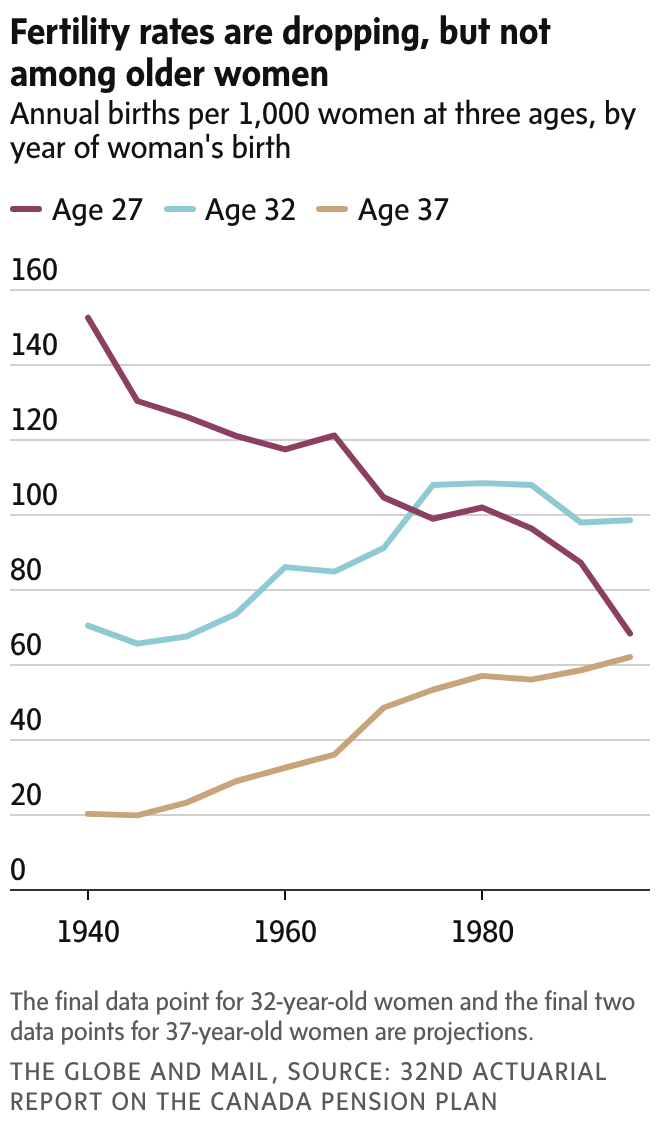
What’s happening: Canada’s birth rate is falling overall, but not evenly. Birth rates among younger women have dropped sharply, while births among women in their late 30s have risen for decades and are now nearly triple what they were in the late 1970s. |
|
|
|
|
Why it matters: Having children later shifts the financial timeline. Some parents may still be supporting children into their 60s, potentially delaying retirement and changing when major spending, and saving, years occur. |
|
|
|
|
|
|
|
|
|
|
|
|
|
|
|
Illustration by The Globe and Mail. Sources: Getty Images
|
|
|
|
|
|
|
|
|
|
|
The situation: Laura, 66, from Winnipeg, is the self-described “bossy big sister” of the family and the executor of her father’s nearly seven-figure estate. His will left money to his five children, as well as 10 grandchildren and six great-grandchildren under |