Within four years, “80% of all jobs will be capable of being done by an AI.”
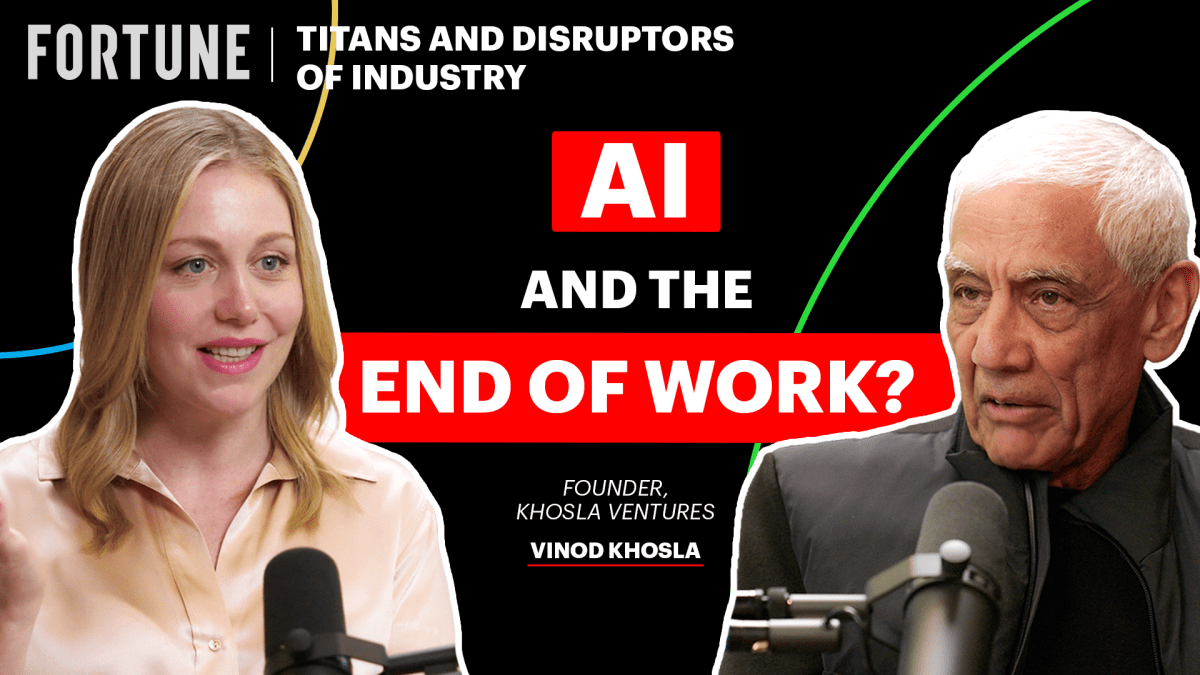
That bold claim was made by Vinod Khosla, the legendary Silicon Valley founder and startup investor, when I met with him for an in-depth interview. Khosla cofounded Daisy Systems and Sun Microsystems, and launched Juniper Networks, before opening his namesake venture capital firm, Khosla Ventures, in the early 2000s. Since then, he and his team have made early bets in Block (No. 179), DoorDash (No. 394), and Instacart, and in 2019, he was the first major backer of OpenAI, putting $50 million in at a $1 billion valuation. The company was recently valued at $780 billion.
After I cited that quote in a column this week, I received a lot of comments complaining that Khosla was drinking the AI Kool-Aid. I do think Khosla was choosing his words carefully—just because the technology is “capable,” it doesn’t mean all that work will be displaced by 2030. Still, a recent Anthropic research chart backs him up: AI is currently far more capable of doing our jobs than we are taking advantage of, across many fields. It’s a sign of what’s likely to come, once the power of the technology is fully realized.
While the idea of a workless future may sound utterly terrifying (Khosla also told me he believes no 5-year-old today will ever need to get a job), the veteran investor paints an optimistic picture of a future that could be more abundant, fulfilling, and equalizing than what we’re dealing with today—if we put the right government policies in place to support society through the AI transition.
His blueprint for abundance:
- Extreme deflation. Khosla believes AI and robotics will create a deflationary economy, and that almost all labor and expertise will become free. Because the cost to produce goods will plummet, the amount of money everyone needs to thrive will decrease significantly. He predicts that by 2040, $10,000 could buy you more than a $100,000 income could today—including your house, education, food, and health care.
- Taxing capital, not labor. To bridge the gap for those who might be left behind by the AI transition, Khosla proposes a radical restructuring of the tax code. His specific proposal includes eliminating income tax for the majority of people and eliminating the notion of capital gains, treating everything as ordinary income.
- National wealth funds for all. Khosla believes a structural change is essential in the next few years. He proposes creating some sort of AI productivity-driven wealth fund for nations, similar to Norway’s Oil Fund. A fund like this could finance a universal basic income of some sort, or pay for “near free” public services, but he notes that every country will handle the solution for their citizens differently.
- Equity versus efficiency. While 20th century capitalism was about economic efficiency, Khosla suggests that post-2040 society should “focus on equity” instead. By decoupling survival from employment, AI has the potential to “free us to be more human,” allowing future generations to “follow their passion” rather than working to survive.
For more of Khosla’s predictions, check out my podcast episode with him on Fortune 500: Titans and Disruptors of Industry.
Follow Alyson on X, LinkedIn, TikTok, Instagram, and the Titans and Disruptors vodcast.