|
 |
For Solo Chiefs—creatives, solopreneurs, and lone leaders orchestrating AI, humans, and chaos with no one to save their ass.
The Barbell Economy Is Reshaping Your Career
How Big Tech and Micro-entrepreneurs Are Changing the Workforce
|

| |||||||||||||||


 |
My friend’s employer just lost three clients to a one-person scaleup.
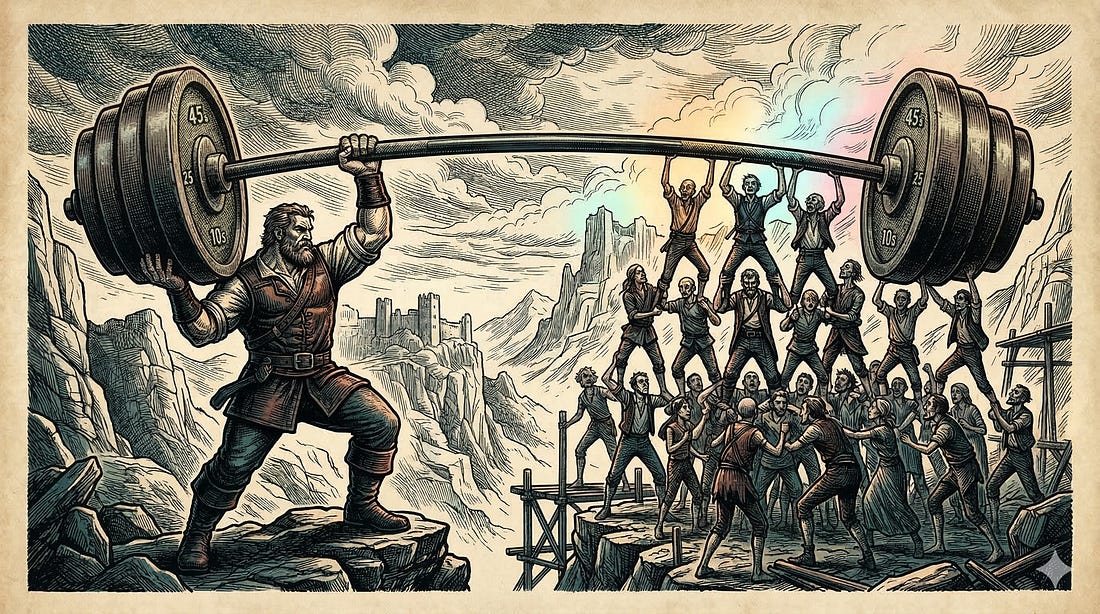
AI isn’t lifting all boats. A barbell is forming and the middle is getting crushed. Here’s how to find your place at either end before the squeeze reaches you.
My friend at a mid-sized company is losing clients to one-person scaleup. What about you? Are you the winner or the loser in the squeeze of the barbell?
With the help of AI, micro-entrepreneurs—tiny teams running small businesses with big-tech tools—are disrupting the corporate landscape, and the stakes are higher than ever. What’s emerging isn’t the “AI lifts all boats” scenario that the tech bros and evangelists promised us. Instead, we’re watching a Barbell Effect take shape: massive winners at both extremes and many businesses getting pulverized in the middle.
The Barbell Economy: Where AI Winners and Losers Are Being Made
Picture the economy as a barbell. On one end, you’ve got the heavyweight champions: massive corporations with near-infinite resources, established customer bases, and the kind of distribution power that makes the average business weep. On the other end, you’ve got the nimble specialists—solo operators and tiny teams who can pivot faster than a squirrel and serve hyper-specific niches with surgical precision.
The middle? That’s where your career goes to die.
Big Tech’s AI Advantage Has Nothing to Do with AI
Despite the breathless coverage of AI startups “disrupting everything,” big tech companies are consolidating power faster than ever. They figured out something that should have been obvious: having the best technology matters less than having unfettered access to customers.
Microsoft and Google didn’t build the first advanced LLM. They let OpenAI do that work. But the mega-corporations have something more valuable: Word, Excel, Google Docs and Sheets sitting on virtually every business computer on the planet. When they add AI features, they don’t need to convince anyone to try a new product. They just add a new button to software people are already using.
Innovative features that were entire startups in 2024—document summarization, meeting transcription, instant translation—are now Tuesday’s software update. A startup might build the most elegant AI writing assistant ever conceived, but if Google adds passable AI writing to Google Docs, most people will use that. It’s already there; it’s free, and it works well enough. What’s the point of paying for Granola when, next week, Gemini does the same out-of-the-box?
Incumbents don’t need to be first or the best. They just need to be good at satisficing: be “good enough” and “early enough” so users don’t look elsewhere.
“Incumbents don’t need to be first or the best. They just need to be good at satisficing.”
The Micro-entrepreneur Sweet Spot: Boring, Specific, Profitable
On the other end of the barbell, hyper-targeted solopreneurs and tiny teams are generating money like mini Taylor Swifts. These aren’t companies building “ChatGPT for X.“ They’re solo founders and AI-driven startups solving narrow, often mind-numbingly boring problems most people don’t even know exist.
Maritime insurance compliance. Dental practice billing codes. Predictive maintenance for industrial mixing equipment. These markets are too small for MAANG and the other Big Tech companies to care about, but plenty big enough for someone with domain expertise to build a profitable business or lucrative side hustle.
The magic happens when you combine AI with deep knowledge of how a specific industry actually works. A former insurance adjuster who builds an AI system for processing specialized claims isn’t just building a tool. They’re automating their own former job, which means they understand exactly where the risks and opportunities are.
Sam Altman’s old prediction of “one-person unicorns“ is probably still hyperbolic (running a billion-dollar company involves a lot of contracts and compliance headaches). But the core insight holds. A small team with the right AI tools can deliver output that used to require an army of cubicle workers.
“A small team with the right AI tools can deliver output that used to require an army of cubicle workers.”
The Middle Market Squeeze: Why Mid-Sized Companies Are Losing
If you’re working at a mid-sized company without a distinctive specialty, you’re getting squeezed from both directions.
From below, AI-powered freelancers and micro-agencies can deliver work at quality levels that were impossible two years ago. A three-person marketing shop using AI tools can produce the same volume as a traditional 20-person agency—at lower prices, with faster turnaround times.
From above, large enterprises are using AI to expand into markets they previously ignored. A global bank can now offer personalized financial advice to small business clients in specific industries, with a tailored offering. This was work that used to belong to regional relationship managers of small to medium-sized businesses.
This squeeze in the middle of the barbell is especially brutal for “body shop” businesses: the companies whose primary value is having warm brains and bodies to perform tasks, like marketing agencies that bill by the hour and software development shops that rent out programmers. When the marginal cost of executing a project approaches zero, charging for time becomes absurd.
The value has to come from somewhere else: network, reputation, strategy, specialization, creative direction. Not everyone can make that transition.
“When the marginal cost of executing a project approaches zero, charging for time becomes absurd.”
The Hidden Champions Exception: Niche Businesses with Infrastructure Moats
There’s one exception to this squeeze in the middle of the barbell. One type of mid-sized company is actually thriving: what