| | Even if near-term security in the Strait of Hormuz improves, a longer-lasting cost to global energy ͏ ͏ ͏ ͏ ͏ ͏ |
| |  | Energy |  |
| |
|
 - Prices still high
- Oil stock winners
- China’s disadvantage
- Mining capital
- St Paddy’s data play
 The CIA’s man inside Chevron, and new wind and oil projects off the US coast. |
|
 The war in Iran has pushed oil prices to their highest level in years. But even if near-term security in the Strait of Hormuz improves, a longer-lasting cost to global energy markets waits ahead — and just how much that cost will be is the market’s most pressing question. After the Saudi-led oil embargoes of the 1970s, the US and other countries created the modern framework for global energy security, including the establishment of strategic oil reserves and the International Energy Agency, export controls, and more domestic drilling. What will change after the current crisis? Dan Yergin — author of the definitive oil history The Prize and, as vice-chairman of S&P Global, emcee of the sprawling CERAWeek energy conference in Houston next week — predicts “we’re going to see people willing to pay more of a price for security.” That premium will manifest in different forms, Yergin told me. Certainly it will include investments in nonfossil energy sources. But it will also appear in new oil and gas pipelines to hedge against future disruptions to maritime trade. It will appear in the form of more long-term storage facilities and refineries, in more far-flung locations that suddenly look more politically and financially viable as the Gulf becomes more volatile. And it could appear in energy trading contracts, with long-term deals commanding higher prices over the spot market: “The just-in-time world is really over,” Yergin said. As to who will pick up the bill for the security premium? It will likely be shared between fossil fuel producers, their customers, and taxpayers in general, Yergin said. The current price spike looks like a multibillion-dollar windfall for oil companies — but it’s one they don’t seem to want, given the chaos and risk required to achieve it. Even though the vulnerability of the Strait has been obvious for decades, Yergin said, there was a sense of “complacency from all quarters” about how costly the disruption caused by a war like this would be. Now, he said, that sense “obviously is gone.” I’ll join Yergin and many other friends and colleagues in Houston next week — please drop me a line if you’ll be there! |
|
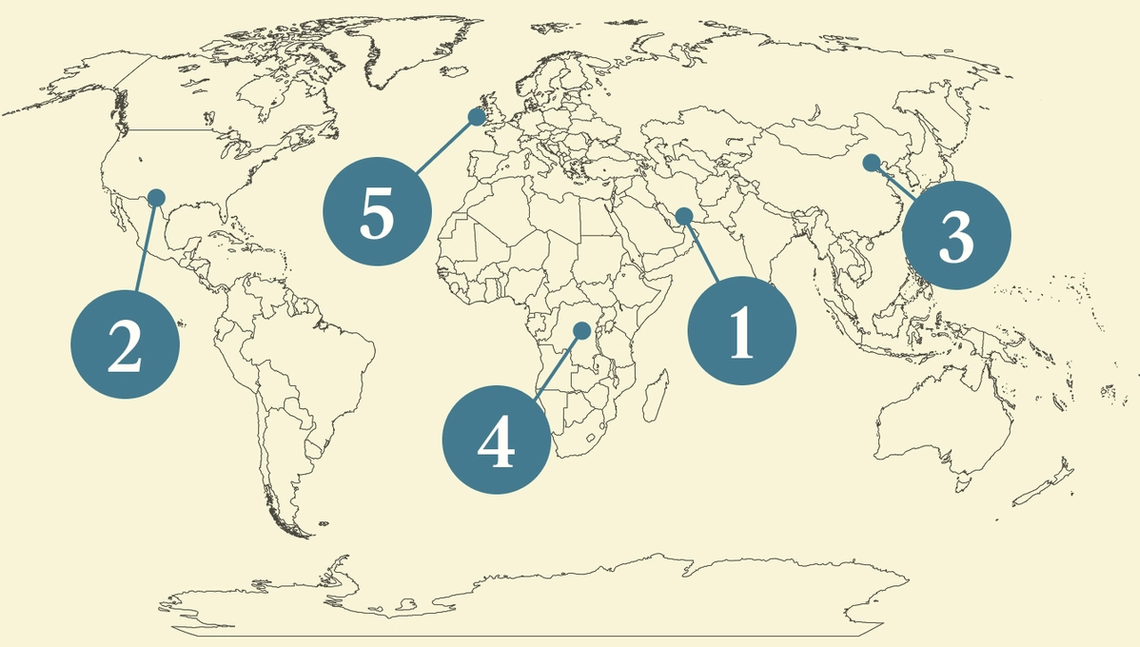
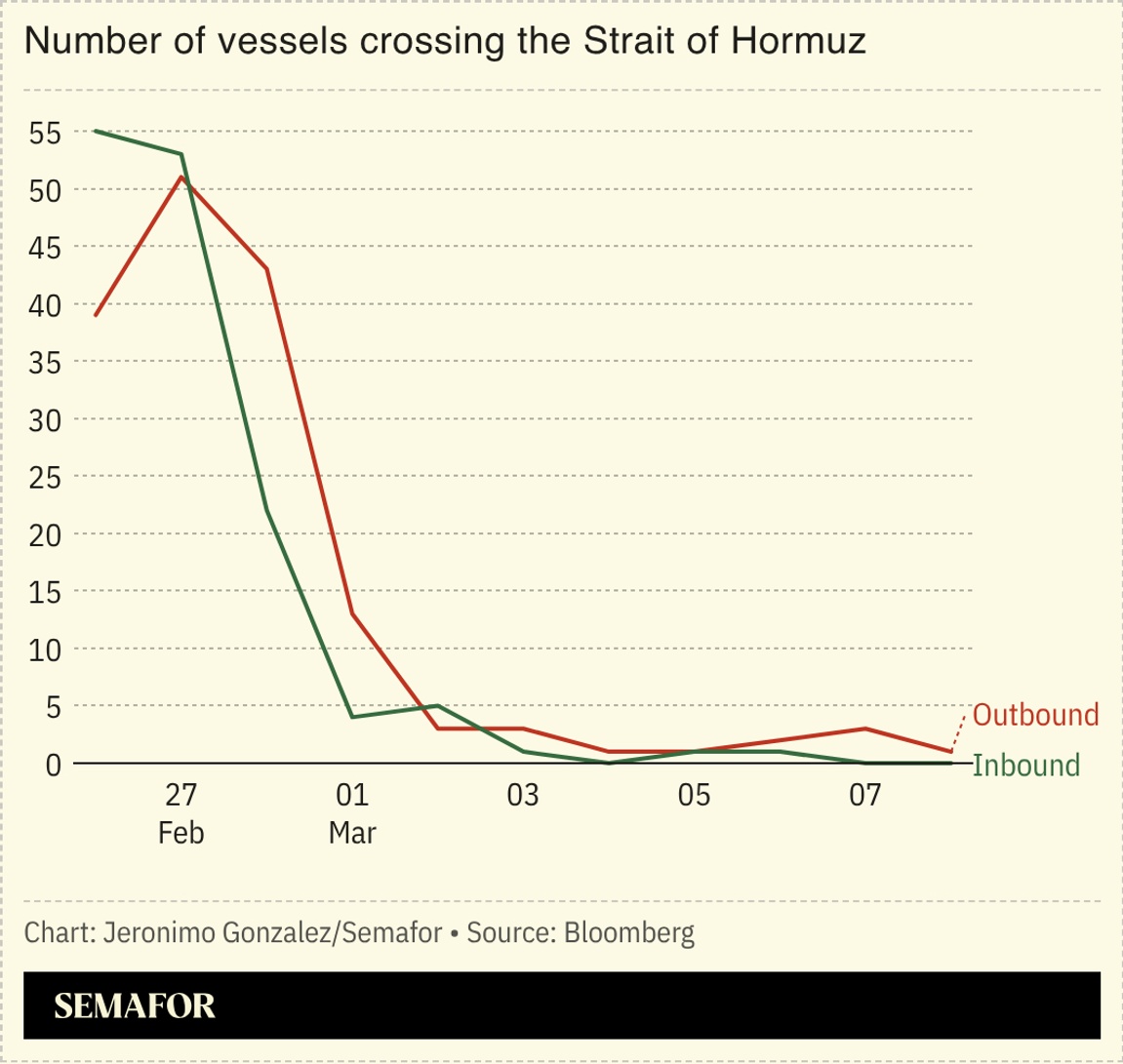 Oil and gas facilities across the Middle East suffered fresh attacks, holding oil prices above $100 a barrel with no end in sight for the Iran war. A UAE gas field suspended operations, a tanker was hit near an Emirati port, and two drones hit an oil field in southern Iraq. Though the Strait of Hormuz remains effectively closed — about 1,100 vessels, including 250 tankers, are stuck — Iran appears to be allowing “a trickle” of ships through, preventing worse global energy price rises, The Wall Street Journal reported. US President Donald Trump wants help escorting ships through the waterway, but European allies are reluctant to participate, and the International Maritime Organization warned that escorts would not offer sufficient safety. In the meantime, members of the International Energy Agency are weighing another release of crude from strategic stockpiles, only days after the largest-ever release did little to temper prices. |
|
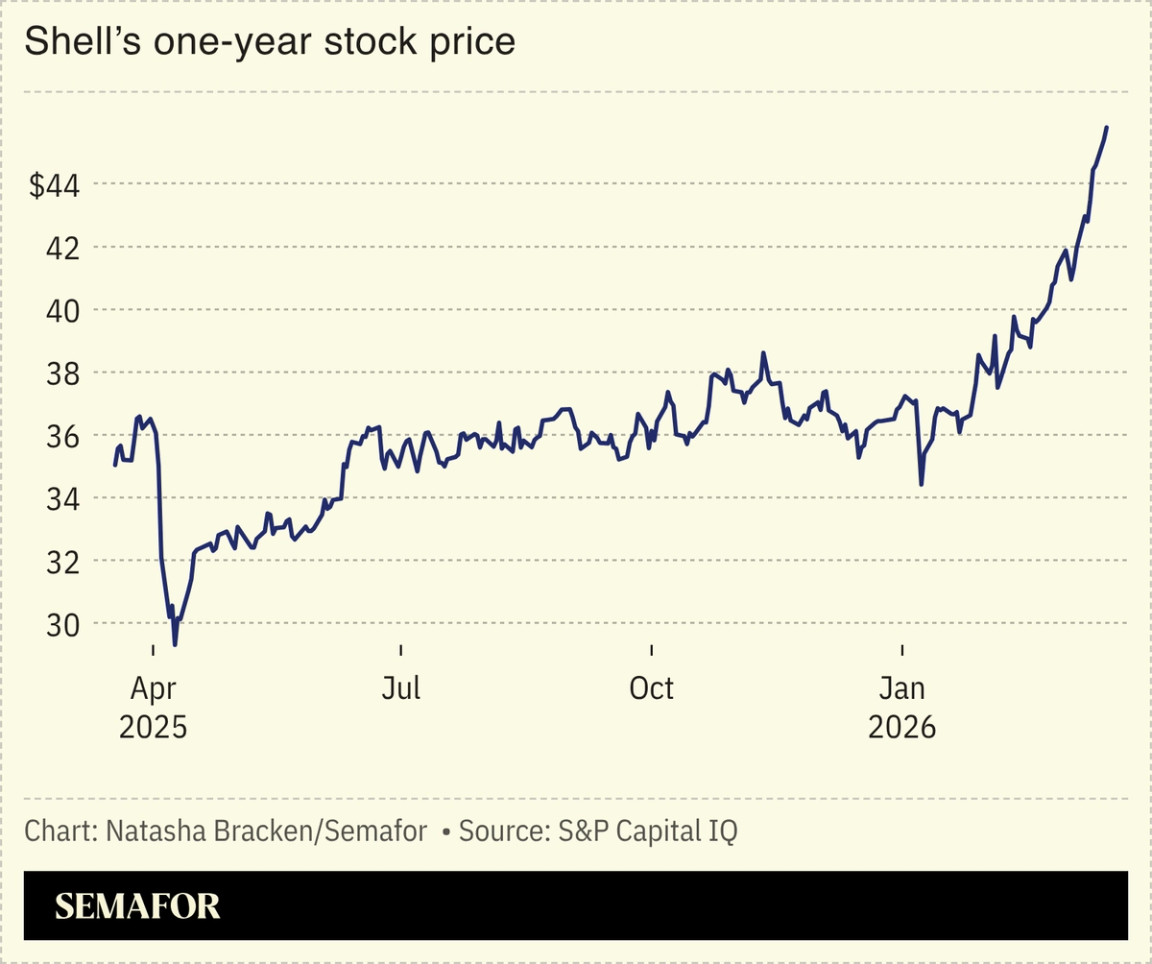 Oil and gas majors’ share prices are surging on the expectation of a windfall from the war in Iran, and a range of smaller companies across the energy industry also look like promising buys, fund managers told Semafor. Shell’s stock hit a record high on Monday, reflecting a trend across the sector. But while the majors have relatively low production costs, the biggest relative boost in profit could be for smaller producers that focus on more expensive barrels, for example oil sands producers in Canada like Suncor Energy. Companies that own natural-resource royalty rights, like Texas Pacific, “benefit from higher oil prices without having to spend capital expenditures to drill new wells,” Simon Wong, portfolio manager at Gabelli Funds, told Semafor. And even once the Strait of Hormuz reopens, “the clearest and most durable winners,” said Henry Hoffman, co-portfolio manager of the Catalyst Energy Infrastructure Fund, will be US exporters of liquified natural gas, like Venture Global, and of the ingredients for petrochemicals, like Energy Transfer. “Shipping insurance costs will remain elevated and lingering reliability concerns from potential one-off harassments could persist well after any ceasefire,” Hoffman said. “This dynamic creates a lasting shift toward US supplies as the preferred, lower-risk alternative.” |
|
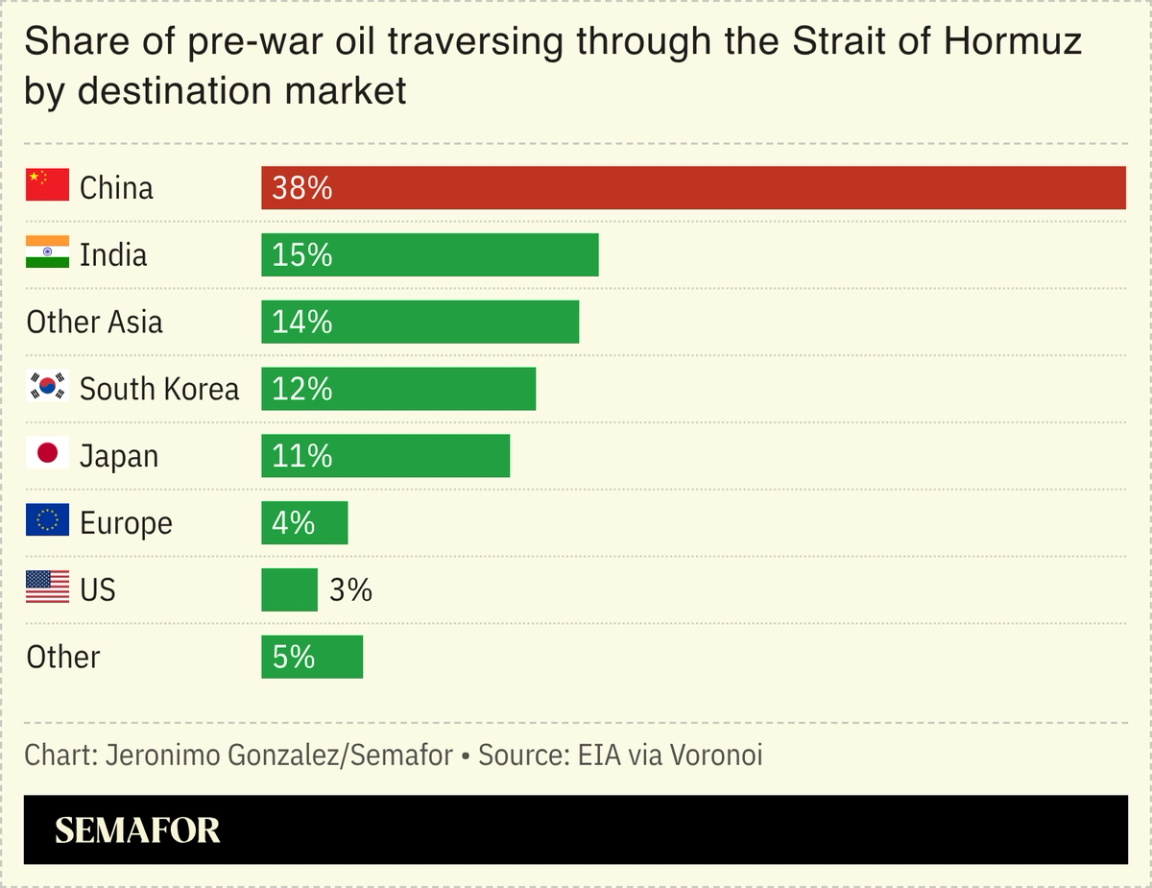 Rising oil prices could be a strategic asset for US President Donald Trump in his upcoming meeting with Chinese leader Xi Jinping, when it eventually takes place. Until now, Trump’s “energy dominance” strategy has often helped China, by keeping oil prices low and forcing Russia to offer steep discounts, Brenda Shaffer, an energy policy scholar at the US Naval Postgraduate School, told Semafor. But while China is well-positioned among its neighbors to withstand the energy crunch — having invested heavily in oil and gas storage, and in renewables — it remains deeply exposed to a protracted oil price spike. With higher prices, “Trump will be in a stronger position,” Shaffer said, “and knowing his style, when he meets peers, he likes to walk in with an advantage.” US officials will likely use the Trump-Xi summit — now delayed, the US president says — to push Beijing to buy more US crude. But for financial, political, and logistical reasons, Shaffer said, it will still be hard to convince China to walk away from its fossil fuel trade ties with Russia. |
|
 The amount Orion Resource Partners raised for its latest fund to finance the construction and acquisition of global mining projects, giving it one of the largest pools of private capital for new critical mineral production. The firm, which is also backed by the US International Development Finance Corporation, is a key player in the Trump administration’s strategy to secure critical minerals for the US and its allies, and is investing in projects in the Democratic Republic of Congo and elsewhere; more than half of the new fund’s capital is committed already, the company said in a statement. Orion has also been turning its attention to the Middle East, with the creation of Orion Abu Dhabi, a $1.2 billion partnership with the UAE’s ADQ aimed at investing in and securing supplies of strategic metals and critical minerals, and, more recently, a collaboration with SNB Capital to support the development of Saudi Arabia’s mining sector. |
|
 David Ulevitch leads Andreessen Horowitz’s American Dynamism fund, a $1.776 billion pot dedicated to defense, energy, public safety, and other national priorities. This week, Compound Interest co-hosts Liz Hoffman and Rohan Goswami talked with Ulevitch about whether those industries deserve their conservative coding, why venture capital — with its roots in capital-light code — has a right to win in heavy industry, and why he doesn’t want the “moral liability” of deciding how the Pentagon uses the weapons Silicon Valley is building. Listen to the latest Compound Interest now. |
|
St. Paddy’s data center play |
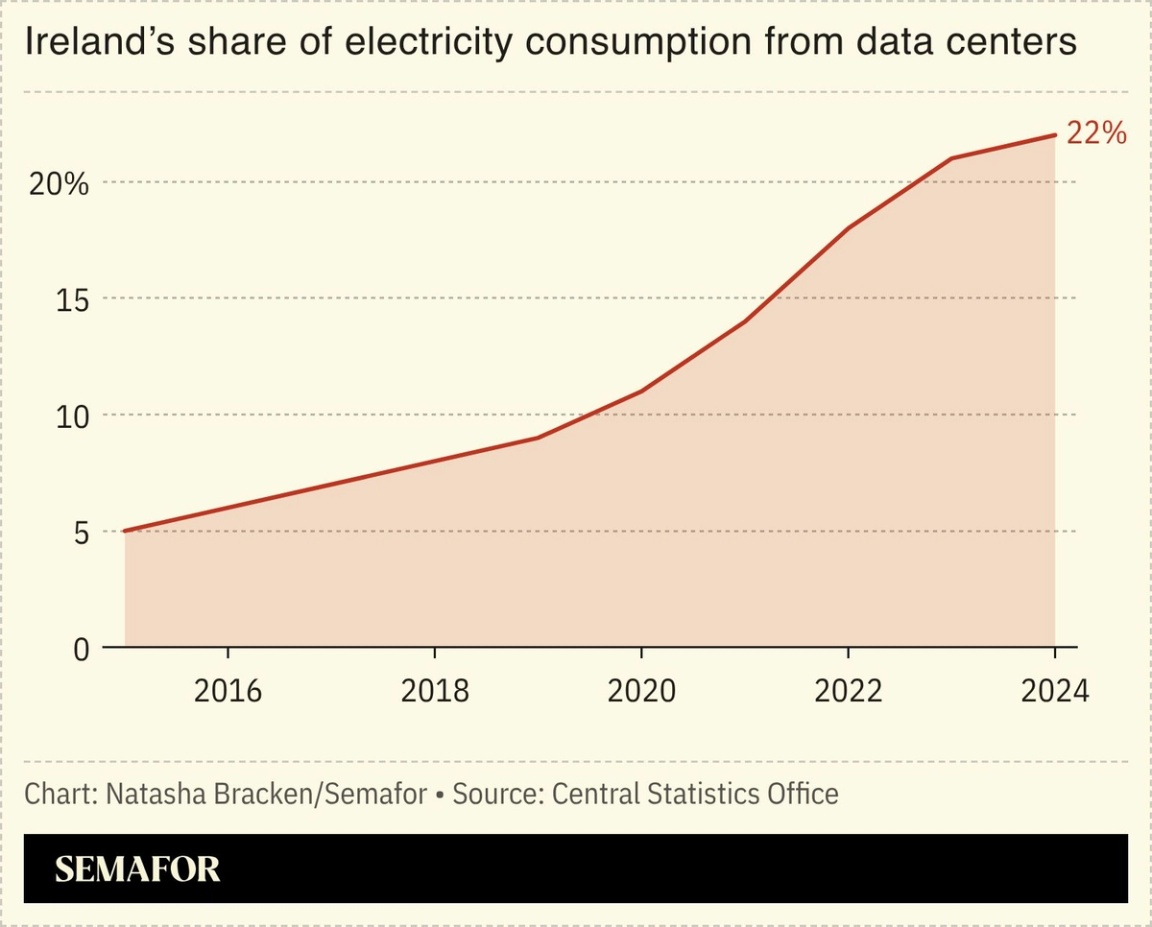 Irish companies are trying to get in on the AI data center boom in the US — and could have expertise to share about how to manage the resulting electricity crunch. Jenny Melia, CEO of Ireland’s government trade agency, Enterprise Ireland, is in DC this week to tout Irish investment in the US. On Monday, she met with Irish companies that are devoting millions to Amazon’s data center buildout in states like Virginia and Texas. Melia told Semafor that despite Trump’s economic policies, Irish companies “have a very strong confidence in the US market and the growth opportunity that’s in the US.” Data centers now consume 20% of Ireland’s total electricity, and the boom led to an effective moratorium on new projects in 2021. Dublin wants to break that, but requires 80% of new centers’ power demand to be met by purpose-built renewable energy — a potential model, the Financial Times noted, for other nations keen to boost their tech industries while capping national energy costs. |
|
 New Energy- Italy is looking to restart nuclear production — almost 40 years after it closed its last nuclear reactor — in a bid to reduce the country’s elevated energy prices.
- Vineyard Wind finished a major Massachusetts offshore wind farm, the first to do so since US President Donald Trump took office.
- A 339-mile (545-kilometer) buried transmission line, the longest in North America, is on schedule to start converting hydropower from Canada into clean electricity for New York City this spring, capable of providing up to 20% of the city’s power.
Fossil Fuels- The Trump administration approved a $5 billion oil drilling project in the Gulf of Mexico, expected to produce up to 10 billion barrels by 2030, which critics say poses significant risks to wildlife and communities.
- The Trump administration ordered the flow of oil to resume through a pipeline in California after it had been shut down for more than a decade following one of the worst oil spills in the state’s history.
Finance- The energy shock caused by the war in the Middle East has acted as a “Covid moment” for many businesses, prompting them to rethink how they power their operations, the head of State Street told the Financial Times.
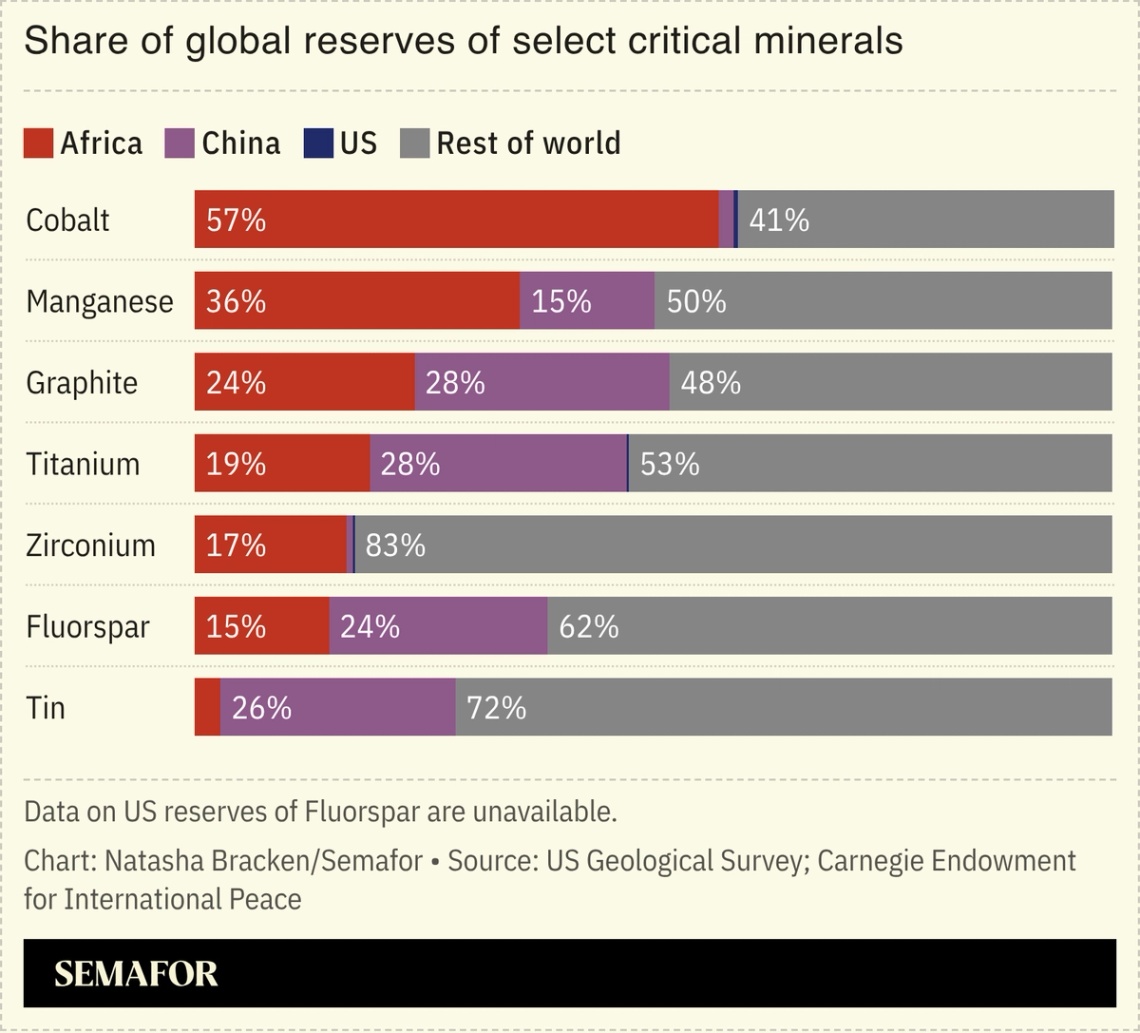
Politics & PolicyMinerals & Mining- Mineral exports curbs across Africa are upending key Chinese supply chains, and as a result sending global commodity prices soaring.
 EVs- Honda said it would cancel plans for three electric models it had planned to produce in the US and that it would record its first annual loss, joining other automaker giants such as Stellantis, Ford Motor, and General Motors in taking huge hits to their profits.
- Spiking gas prices in the US could once again
|
|
|


