| | In today’s edition: Gulf economies will contract sharply this year if the war continues, but some sa͏ ͏ ͏ ͏ ͏ ͏ |
| |  | Gulf |  |
| |
|
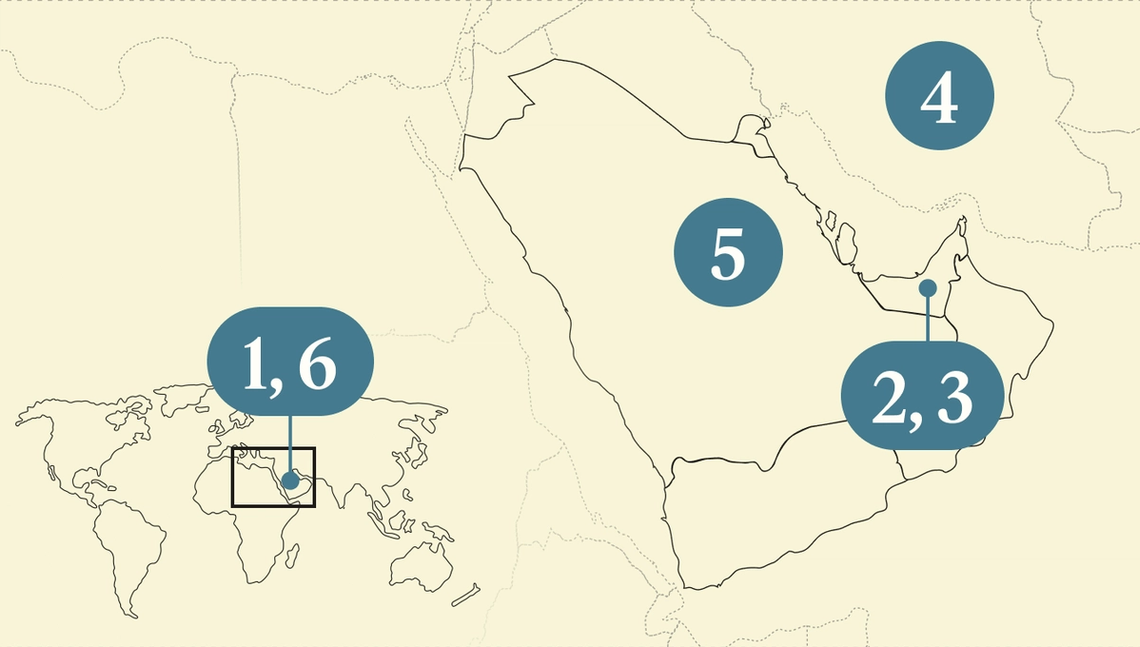 - Gulf economic fallout
- Don’t bet against the UAE
- Tech infrastructure at risk
- Iran attacks Gulf oil fields
- Fast-fashion disruption
- Crackdown on speech
 Giving the masses an outlet for their air strikes info. |
|
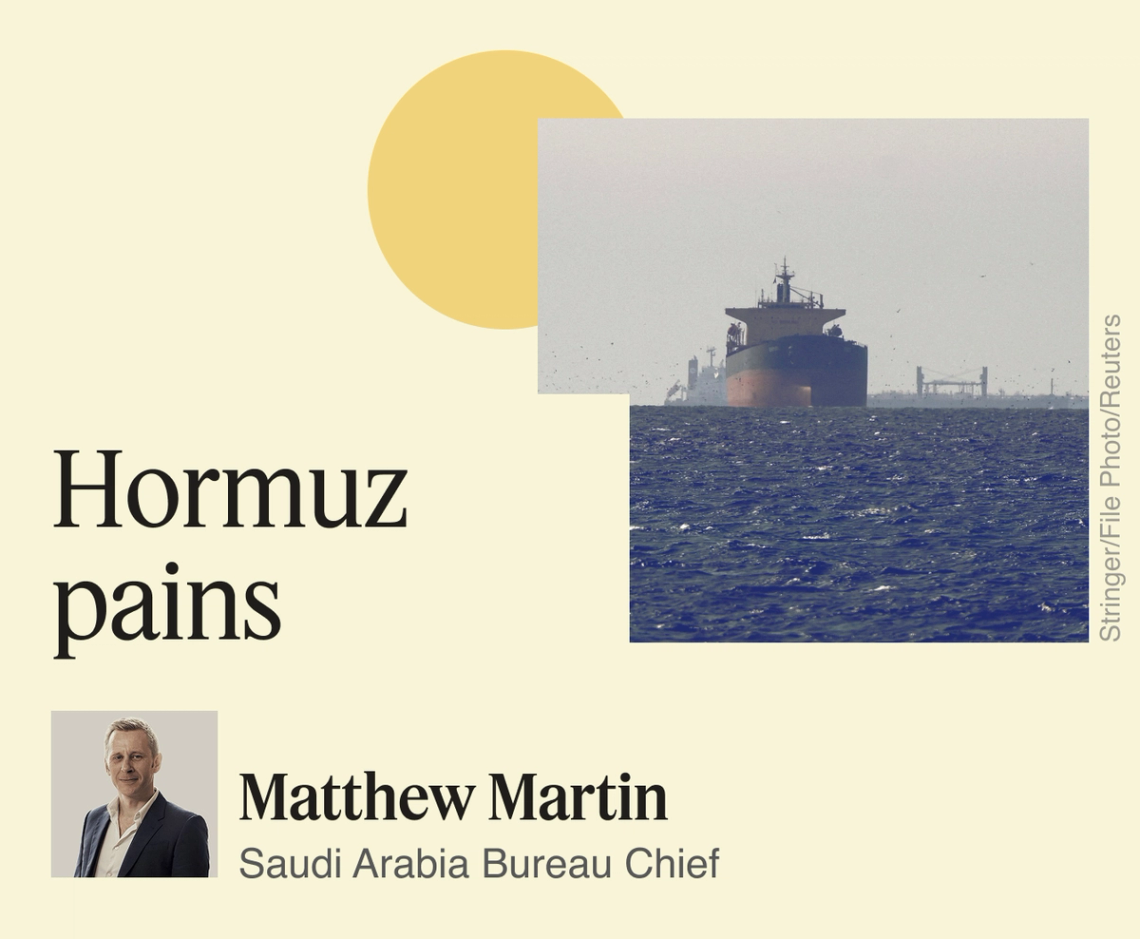 How long the Iran war will carry on for is anyone’s guess. What is becoming increasingly clear is that the economic fallout for the Gulf countries will be severe. The only real question is how bad will it be, and how long the recovery will take. The closure of the Strait of Hormuz is upending oil and gas exports. Saudi Arabia, which has long invested in contingency plans, will still be able to get some of its crude to international markets, as will the UAE. Oman, which doesn’t rely on the narrow waterway, could benefit from higher oil prices. Even so, the Gulf will suffer a sharp drop in exports. And it’s not just the oil sector that’s being hit. As Gulf nations continue to deal with an unprecedented barrage of Iranian drones and missiles, the region’s tourism industry is being decimated. Many expatriates are leaving the region for the upcoming Eid holiday. How and when they will return is unclear. At best, economic diversification, which relied on the Gulf’s safety and stability, is on pause. At worst, confidence in the region’s role as a holiday destination, financial center, logistics hub, and home for global AI data centers has been shaken for some time. Goldman Sachs forecast in a recent note to clients that, in the event of a prolonged conflict, some countries in the region could suffer economic contractions of as much as 14%. Even if the war wraps up soon, most analysts expect all the Gulf economies to shrink this year. A rebound will come, but restoring confidence will be key to the region’s future, and it won’t be cheap. |
|
A sharp economic contraction |
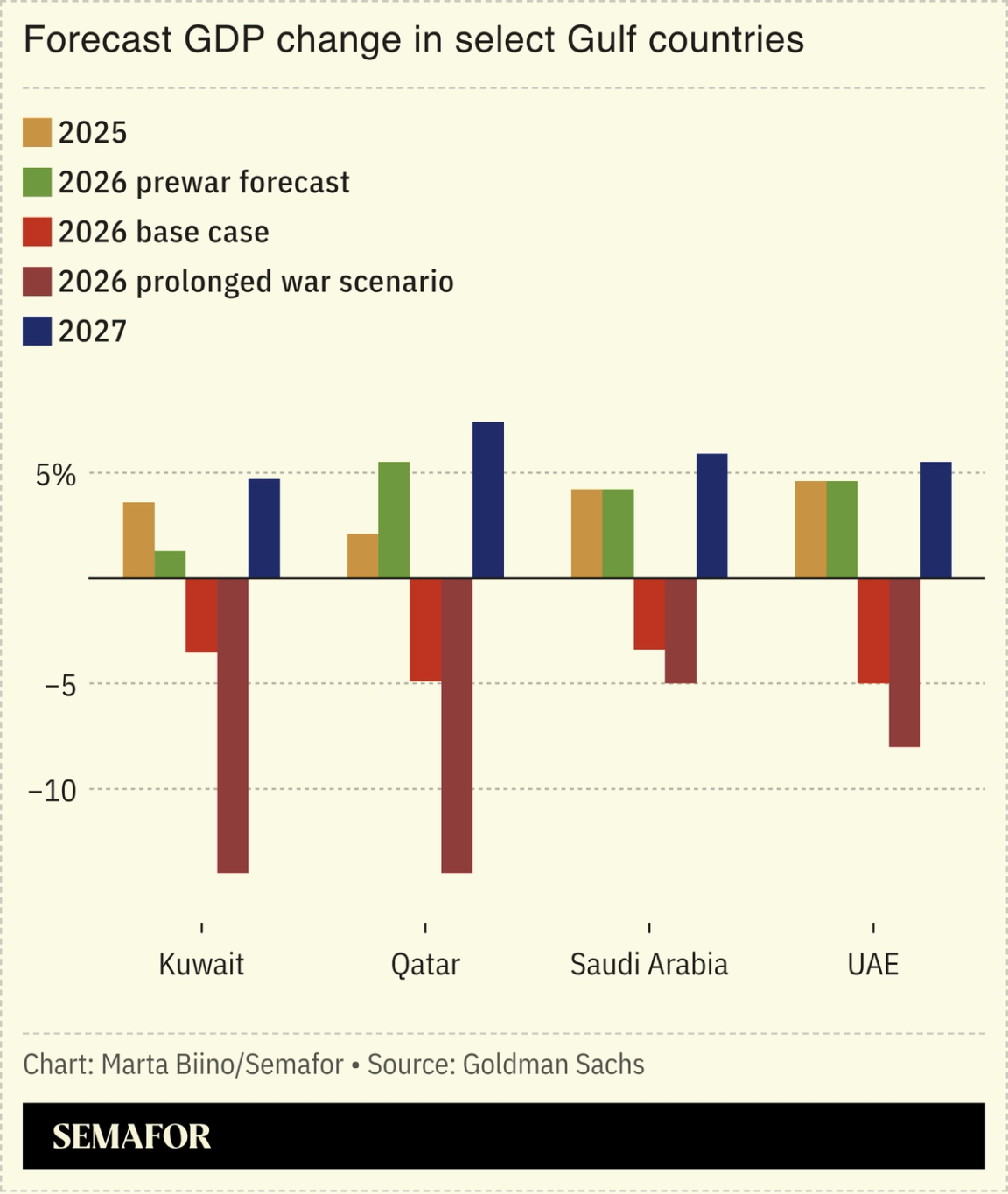 Gulf economies could contract sharply this year as a result of the war with Iran, according to Goldman Sachs. The bank’s base case, which assumes the Strait of Hormuz will be closed for most of March, forecasts that every Gulf economy will shrink this year by between 2% and 5%. In a prolonged conflict, with the Strait blocked until the end of April, the worst hit economies, Qatar and Kuwait, would contract by 14%. Saudi Arabia’s ability to export some oil from its Red Sea port of Yanbu, and its lower reliance on expatriate workers and tourism, means it should be more insulated from the economic shocks than some of its peers, Goldman economists project. In a prolonged conflict the kingdom’s economy — the region’s biggest — could shrink by 5%, and the UAE’s by 8%. The estimates broadly line up with those from other analysts that put Kuwait and Qatar most at risk because they rely entirely on the Strait of Hormuz for their energy exports, although both countries also have huge sovereign wealth funds they can lean on to support their economies. That’s not the case for Bahrain, which may struggle to recover from the impact of the war without a fresh bailout from its richer neighbors. One bright spot from Goldman’s analysis: It forecasts a significant rebound in growth next year as oil exports return to normal and the region benefits from higher prices. |
|
Q&A: The value of the UAE model |
 Badr Jafar. Benedikt von Loebell/World Economic Forum. CC BY-NC-SA 2.0. Badr Jafar. Benedikt von Loebell/World Economic Forum. CC BY-NC-SA 2.0.Badr Jafar — special envoy for business and philanthropy to the UAE’s minister of foreign affairs, and CEO of Sharjah-based conglomerate Crescent Enterprises — is fielding a flood of questions from investors with skin in the game. But they are not the ones you might expect: “The question I am hearing from global investors is not ‘Should we leave?’ It is ‘How do we position for the recovery?’ That is a fundamentally different conversation,” he told Semafor. Jafar pointed to the UAE’s track record and its ability so far to blunt Iran’s relentless attacks as evidence that the more pessimistic narrative — that the region is fundamentally exposed — is misguided. Betting against the UAE, he argued, means betting against the “most connected commercial platform between Europe and Asia, backed by the largest concentration of sovereign capital on Earth.” The mood in Dubai reflects that resilience. At a recent charity event, hundreds of millions of dollars were raised for malnourished children worldwide, in an act of “resilience [that] cannot be manufactured. And it cannot be bombed away.” |
|
Tech haven status under threat |
 “Submarine Cable Map,” via TeleGeography, licensed under CC BY-SA 4.0. “Submarine Cable Map,” via TeleGeography, licensed under CC BY-SA 4.0.The Gulf’s tech sector — once seen as an emerging hub, with cheap energy, abundant land, and plentiful government and consumer appetite — is confronting a newly uncertain future. Iran has made a point of targeting its “enemy’s technological infrastructure,” with US tech firms Amazon, Google, IBM, Microsoft, Nvidia, Oracle, and Palantir all in the firing line. Amazon data centers have already been damaged in Bahrain and the UAE. Meanwhile, Meta’s work on a subsea cable to boost internet connectivity in Africa via the Gulf, in partnership with a Saudi telecom company, has been put on pause, Bloomberg reported. The tech giants that flocked to the Gulf, spurred on by the region’s push to be a major player in AI, are now belatedly confronting the risks that were always there. “Most non-energy investors in the Gulf underpriced risk before the current war, including US tech companies,” Steffen Hertog, an expert on the Gulf economies, told The New York Times. — Kelsey Warner |
|
Fresh attacks on Gulf oil facilities |
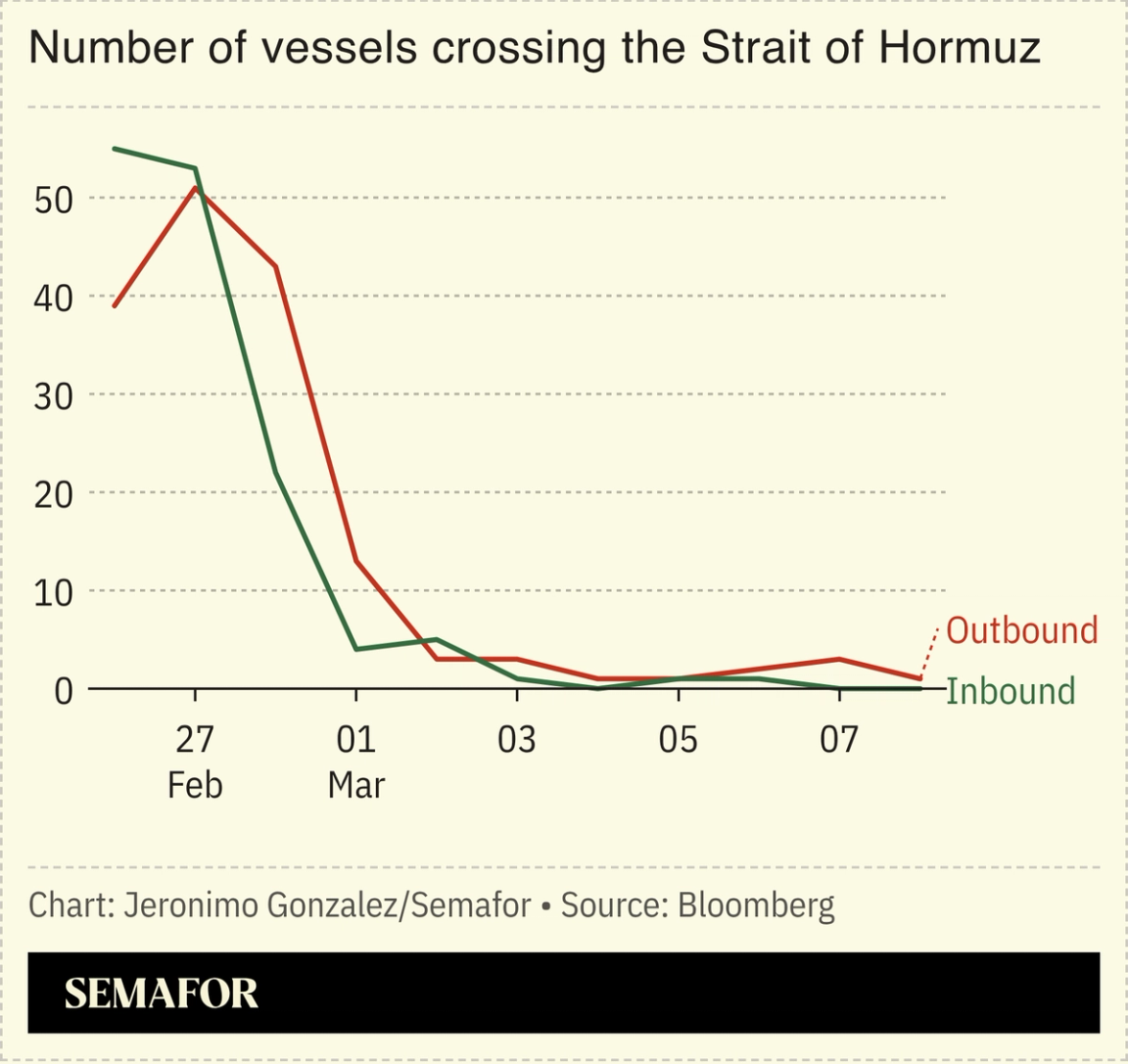 Oil and gas facilities across the Middle East suffered fresh attacks, holding oil prices above $100 a barrel with no end in sight for the Iran war. A UAE gas field suspended operations, a tanker was hit near an Emirati port, and two drones hit an oil field in southern Iraq. Though the Strait of Hormuz remains effectively closed — about 1,100 vessels, including 250 tankers, are stuck — Iran appears to be allowing “a trickle” of ships through, preventing worse global energy price rises, The Wall Street Journal reported. US President Donald Trump wants help escorting ships through the waterway, but European allies are reluctant to participate, and the International Maritime Organization warned that escorts would not offer sufficient safety. In the meantime, members of the International Energy Agency are weighing another release of crude from strategic stockpiles, only days after the largest-ever release did little to temper prices. |
|
Eid shoppers flock to the malls |
 Crowds of shoppers at Red Sea Mall in Jeddah. Manal Albarakati/Semafor. Crowds of shoppers at Red Sea Mall in Jeddah. Manal Albarakati/Semafor.Eid al-Fitr, the holiday marking the end of Ramadan, is this weekend, and — as with everything in the region — it has been disrupted by war. The usual ritual of buying new clothes, for example, with some families planning outfits weeks in advance, has become more complicated. Iran’s attacks have hit shipping routes through the Strait of Hormuz, a key corridor for goods entering the Gulf. Clothes that were supposed to be dispatched for delivery are stuck on ships, forcing shoppers to turn to whatever is available locally. This last-minute shift to in-store shopping is turning up in government statistics. Saudi point-of-sale transactions rose 11% to 16.1 billion riyals ($4.3 billion) in the week ending Mar.7 compared to the previous week, according to the Saudi Central Bank, while spending on clothing and apparel jumped 32% to 2.5 billion riyals. Social media is filled with posts complaining about delayed orders from fast-fashion platforms like Shein, with viral videos joking about Eid outfits “sitting at the bottom of the Strait of Hormuz.” Shein didn’t respond to a request for comment. — Manal Albarakati |
|
 Some of the people arrested for posting videos showing Iranian attacks. Bahrain News Agency. Some of the people arrested for posting videos showing Iranian attacks. Bahrain News Agency.In the AI age, it is harder than ever for governments to control the news narrative, but in the Gulf they are trying: Since the war began, hundreds have been arrested around the region, accused of posting both real and fake news. In Qatar, more than 500 are facing charges, while Bahrain has arrested more than 40 people, and at least 35 are being subject to expedited trials in the UAE. It is impossible to know just how much information is being suppressed, but the ubiquity of phone cameras means a full clampdown is impossible in cities. The success of Iranian strikes on targets away from major population centres, such as military bases and oil fields, is far harder to ascertain; major satellite imagery providers have stopped sharing data on the region, The Economist noted. The restrictions limit the potential for distressing images to induce panic among locals, but also deny Tehran information about how effective its campaign is. As the World War II idiom had it, loose lips sink ships. Abdulla Alhamed, chairman of the UAE’s National Media Authority, has a similar message today: “Fortresses are no longer brought down by cannons, but by poisoned words and misleading news.” — Dominic Dudley |
|
 David Ulevitch leads Andreessen Horowitz’s American Dynamism fund, a $1.776 billion pot dedicated to defense, energy, public safety, and other national priorities. This week, Compound Interest co-hosts Liz Hoffman and Rohan Goswami talked with Ulevitch about whether those industries deserve their conservative coding, why venture capital — with its roots in capital-light code — has a right to win in heavy industry, and why he doesn’t want the “moral liability” of deciding how the Pentagon uses the weapons Silicon Valley is building. |
|
|