|
 |


In 2022, Donald Trump sued CNN for defamation. Donald Trump, of course, sues a lot of people and businesses on that basis. This case had a singular focus: he sued CNN over its use of the phrase “the Big Lie” to describe his lies about the 2020 election being stolen from him.
On July 28, 2023, Federal Judge Raag Singhal in the Southern District of Florida dismissed Trump’s lawsuit. In it, Trump claimed that CNN defamed him by “making statements comparing him to Hitler and the Nazi regime.” Trump identified five instances of what he alleged was defamatory conduct:
Publication of a January 2021 piece by contributor (and friend of Civil Discourse) Ruth Ben-Ghiat that was headlined “Trump’s big lie wouldn’t have worked without his thousands of little lies,” and in which Ruth wrote, “This is Trump’s ‘Big Lie,’ a brazen falsehood with momentous consequences.” She “likened the Plaintiff to an authoritarian dictator.”
Publication of a July 2021 piece by Editor-at-Large Chris Cillizza, entitled “Donald Trump just accidentally told the truth about his disinformation strategy.” Cillizza compared Trump to Nazi propagandist Joseph Goebbels: “One can only hope that Trump was unaware that his quote was a near-replication of this infamous line from Nazi Joseph Goebbels: ‘If you tell a lie big enough and keep repeating it, people will eventually come to believe it.’”
Publication of a September 2021 piece by Cillizza entitled, “Donald Trump’s Mental Health becomes an issue again.” Cillizza wrote that Trump “continued to push the Big Lie that the election was somehow stolen despite there being zero actual evidence to back up that belief.”
Airing a January 2022 segment of Jake Tapper’s show where Tapper talked about Trump continuing to “push his big lie.”
Publication of a February 2022 piece by Cillizza entitled, “Here’s the terrible reality: Trump’s election lie is on the march.” Cillizza wrote, “This is the insidiousness of Trump’s big lie. It’s like an earworm – you may hate the song, but you just keep finding yourself humming it in the shower. Trump has created a constant low-level buzz within the American electorate that something is wrong with the way we conduct elections. That he has no proof doesn’t seem to matter; by sheer repetition, his false claims are wheedling their way into the consciousness of the public.”
Trump alleged that the use of the phrase “the Big Lie” was defamatory because it associated Trump with Hitler, and “incited” readers/viewers to have hate, contempt, distrust, ridicule for and “even fear” of Trump. He claimed that CNN damaged both his reputation and his future political career and asked for $475 million in damages (Noteworthy: Lindsey Halligan, who served a brief stint as Trump’s appointed, but never confirmed, U.S. Attorney in the Eastern District of Virginia, was one of the lawyers who filed the lawsuit.)
There is a very low threshold for a civil lawsuit to survive a motion to dismiss. These motions are usually brought after the plaintiff brings the case but before any discovery changes hands. They test the “legal sufficiency” of a plaintiff’s case: assuming all the facts the plaintiff alleges are true, do they have a case under the relevant statutes?
In Florida, to establish defamation, a plaintiff must be able to show that a false, defamatory statement was published with knowledge of or “reckless disregard” for its falsity and the defendant suffered actual damages as a result. The Judge pointed out that the law is well-established that statements of opinion don’t qualify as defamation: “A claim of defamation requires a false statement of fact.” He concluded, “even if the statement is made with bad or evil intent, it is not actionable under the law if it is pure opinion.”
The reason the Judge dismissed the case is this: “The next question is whether the statements were false statements of fact. This is where Trump’s defamation claims fail.” Judge Singhal held that the statements Trump complained about were opinions not statements of fact, which means they can’t support a verdict for defamation. And even, he noted, if CNN had acted with “political enmity” for Trump, that “does not save this case; the Complaint alleges no false statements of fact.”
Trump’s claim that the phrase “the Big Lie” associated him with Hitler and genocide didn’t hold water with the Judge either. He held that the phrase “does not give rise to a plausible inference that Trump advocates the persecution and genocide of Jews or any other group of people. No reasonable viewer could (or should) plausibly make that reference.” Even if they could, “Being ‘Hitler-like’ is not a verifiable statement of fact that would support a defamation claim.”
And so, Judge Singhal dismissed the case with prejudice. Trump was entitled to appeal, and he did. A three-judge panel of the Eleventh Circuit ruled against Trump in an unpublished opinion and without oral argument in November 2025, affirming the district court’s decision.
Judges publish opinions when they have important precedential value. Historically, the Eleventh Circuit has published fewer than 15% of its decisions every year. Just over 13% of cases in the Circuit go to oral argument, Again, it’s the most significant cases, or those that are complicated and require argument for judges to hear a full explanation of the issues, that make the cut. Trump’s case didn’t clear either bar. The court heard it because it was obligated to do so and then it dismissed it without much ado.
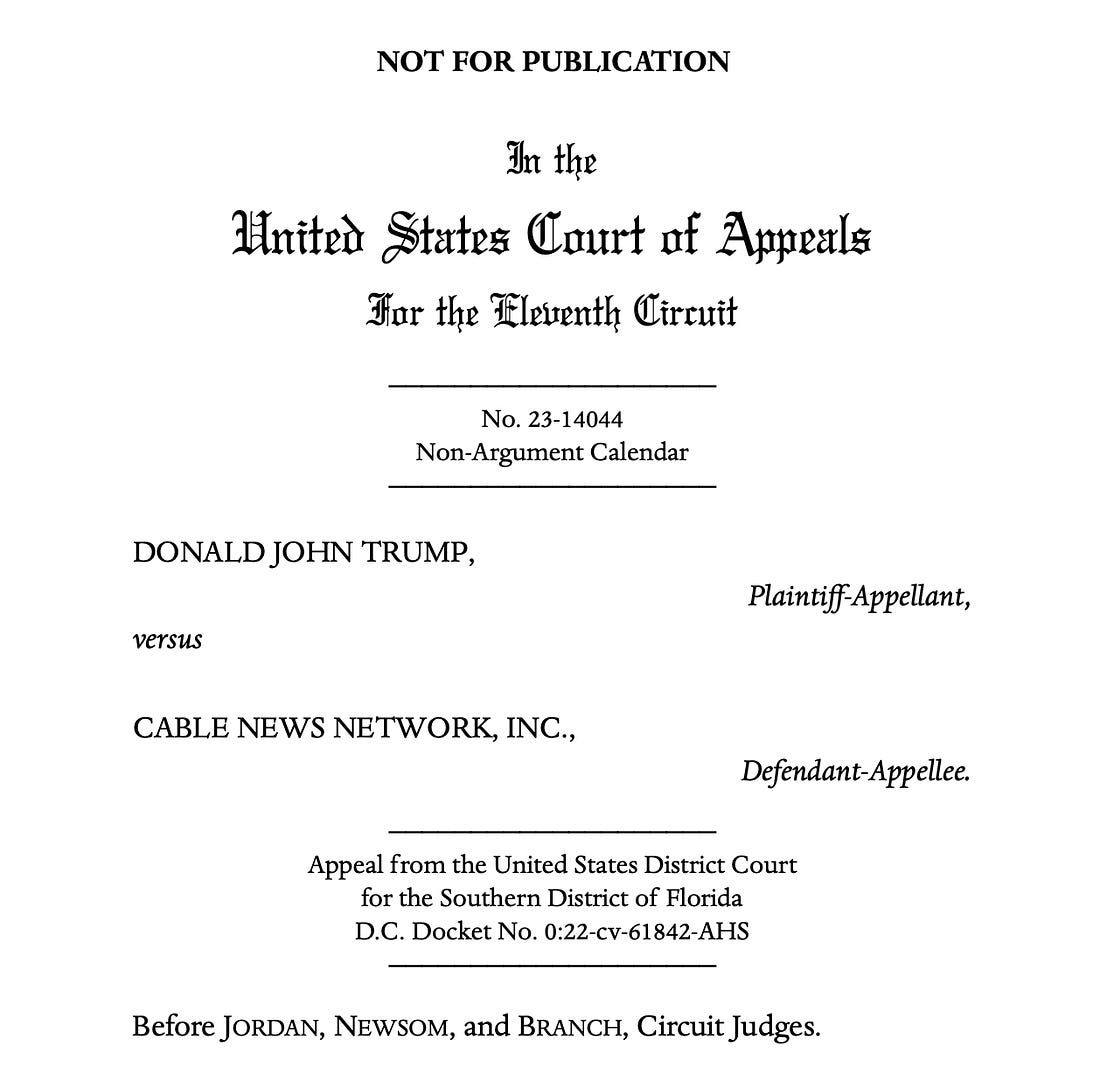 |
The panel judges, Aldaberto Jordan (appointed by Obama), Kevin Newsom (appointed by Trump), and Elizabeth Branch (appointed by Trump) ruled against Trump 3-0 in a per curiam opinion that held “We agree that Trump did not adequately plead falsity. Therefore, we affirm the dismissal of Trump’s claim.” They explained, “To be clear, CNN has never explicitly claimed that Trump’s ‘actions and statements were designed to be, and actually were, variations of those [that] Hitler used to suppress and destroy populations.’ … But, according to Trump, this assertion is implied in CNN’s use of the phrase ‘Big Lie.’” They conclude, “Trump’s argument is unpersuasive.”
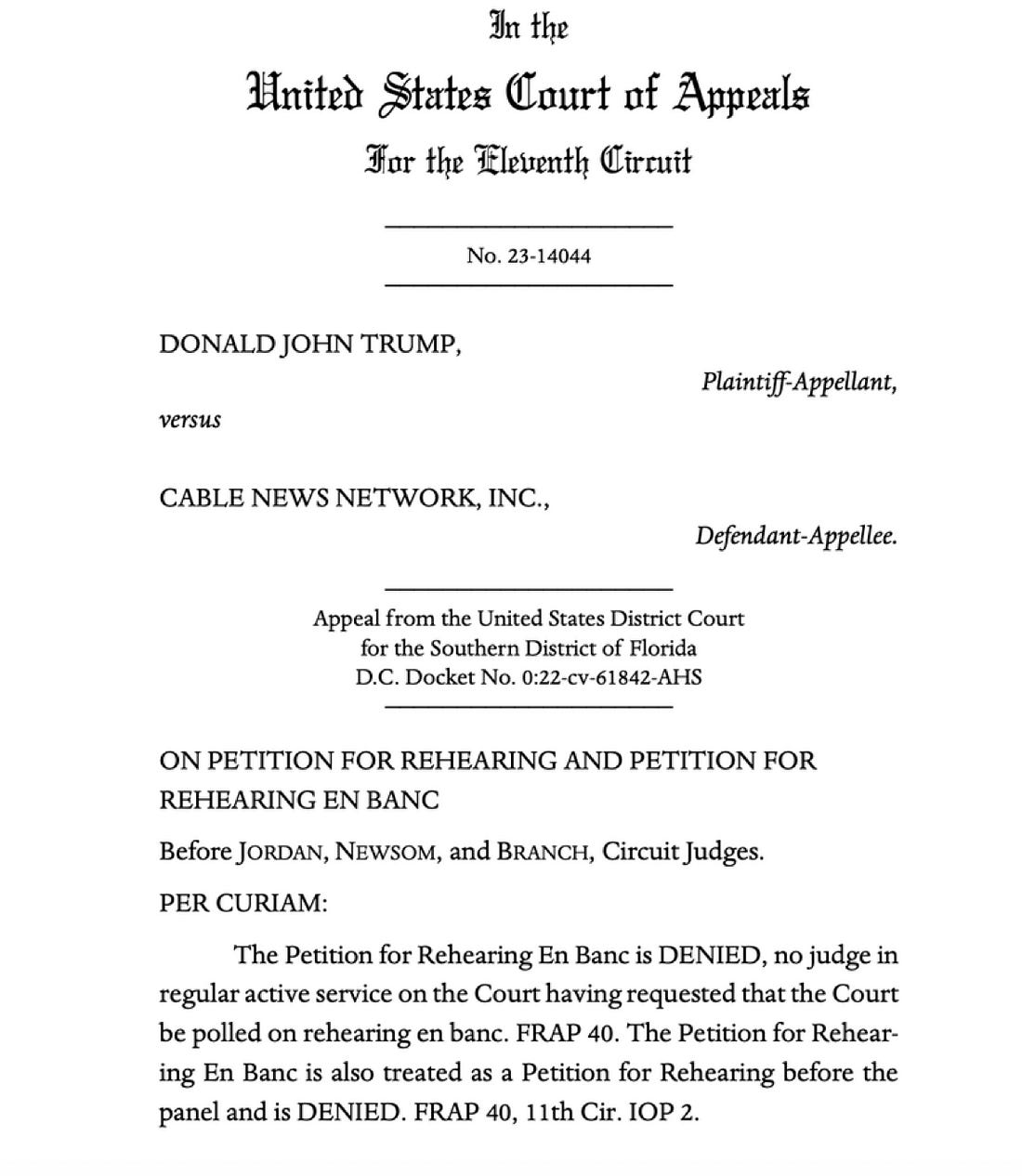
Donald Trump doesn’t like to take no for an answer, so he asked for the full Eleventh Circuit Court of Appeals to reverse the panel’s decision. Each Circuit typically hears only a handful of cases en banc in every term of court. So it was not particularly surprising, but still reassuring, when the Eleventh Circuit turned down Trump’s request today.
 |
Of course, Trump can still petition the Supreme Court to hear his case. He has a similar petition pending before the Supreme Court currently, an attempt to get it to reverse E. Jean Carroll’s victory. He will have a similarly small chance there.
It’s a significant victory when our courts stand up for the First Amendment and free speech. Donald Trump has long been of the view that it’s too difficult for public figures to succeed in defamation cases, and that the law should be changed to make it easier. After Trump won in 2024, Reuters wrote, in a carefully worded story, that he was adopting “a wide-ranging legal strategy in suing media companies over what he describes as false or misleading coverage about him, filing cases under civil anti-fraud laws in addition to defamation lawsuits. Some legal experts say the cases appear aimed at punishing outlets for critical coverage, and that the novel legal strategies are an effort to get past steep hurdles in defamation lawsuits, which can be difficult for public figures in the U.S. to win.”
We’ve seen how those cases have turned out, with a number of defendants, like CBS and ABC, settling cases legal experts deemed marginal for astronomical sums. But in cases where litigants have proceeded in court, courts like the Eleventh Circuit have largely backed the First Amendment.
We don’t always have the opportunity to appreciate the many and varied ways federal courts continue to stand for the rule of law. Much of the time, it’s quiet cases like this one that don’t attract a lot of attention. But this decision underscores that Trump is not a monolith; he is not entitled to special treatment in court, and when parties that he sues stand up to him, they can win when they are entitled to. And when CNN wins in a case like this, the rest of us do too.
If you want to truly understand how the First Amendment is shaped—not just in headlines, but in the courts where it actually evolves