|
 |



Even though Donald Trump went to war in Iran, arguably according to at least some commentators and even a Republican congressman, to distract from the Epstein Files, we have not forgotten about them or about the survivors who deserve justice. The survivors have not forgotten either.
Something new in the offing? Yesterday, New York Times business reporter Matthew Goldstein tweeted this:
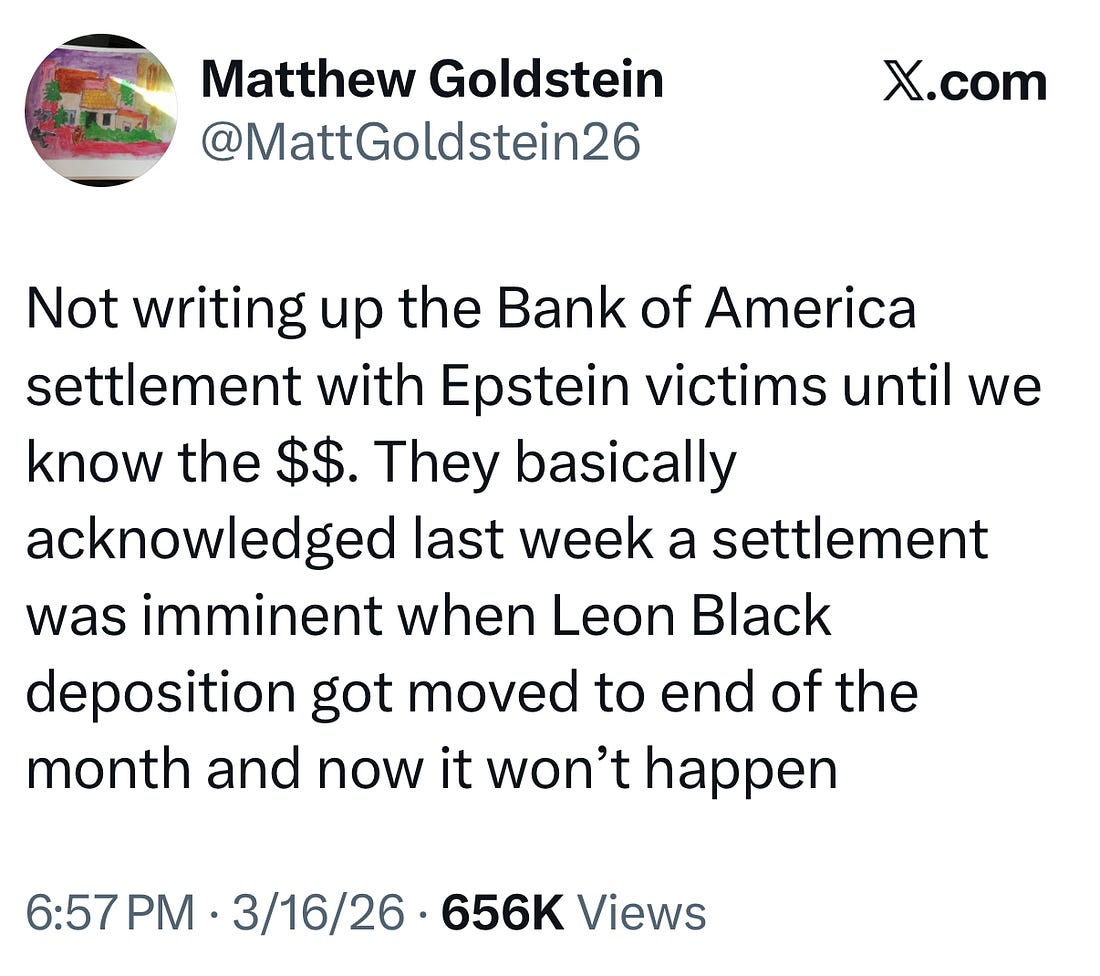 |
This is a reference to one of the two federal lawsuits filed by Epstein survivors last October. One was against Bank of America and the other against Bank of New York Mellon. The lawsuits accused both banks of being “complicit financial institutions” that were more concerned with keeping their wealthy and well-connected clients happy than they were with complying with anti-trafficking laws. Both lawsuits allege multiple violations of the Trafficking Victim Protection Act and negligence.
For example, the complaint against Bank of America alleges: “Rather than merely providing routine banking services to Epstein, Bank of America went far beyond what a non-complicit bank would have done and instead assisted Epstein in setting up the necessary financial structure to operate his sex-trafficking venture.”
Late last week, Epstein survivors announced they had reached a proposed settlement in principle with Bank of America. Such a settlement requires approval from the federal judge overseeing the case, and its terms are not public. It follows on the heels of 2023 settlements with JPMorgan Chase and Deutsche Bank.
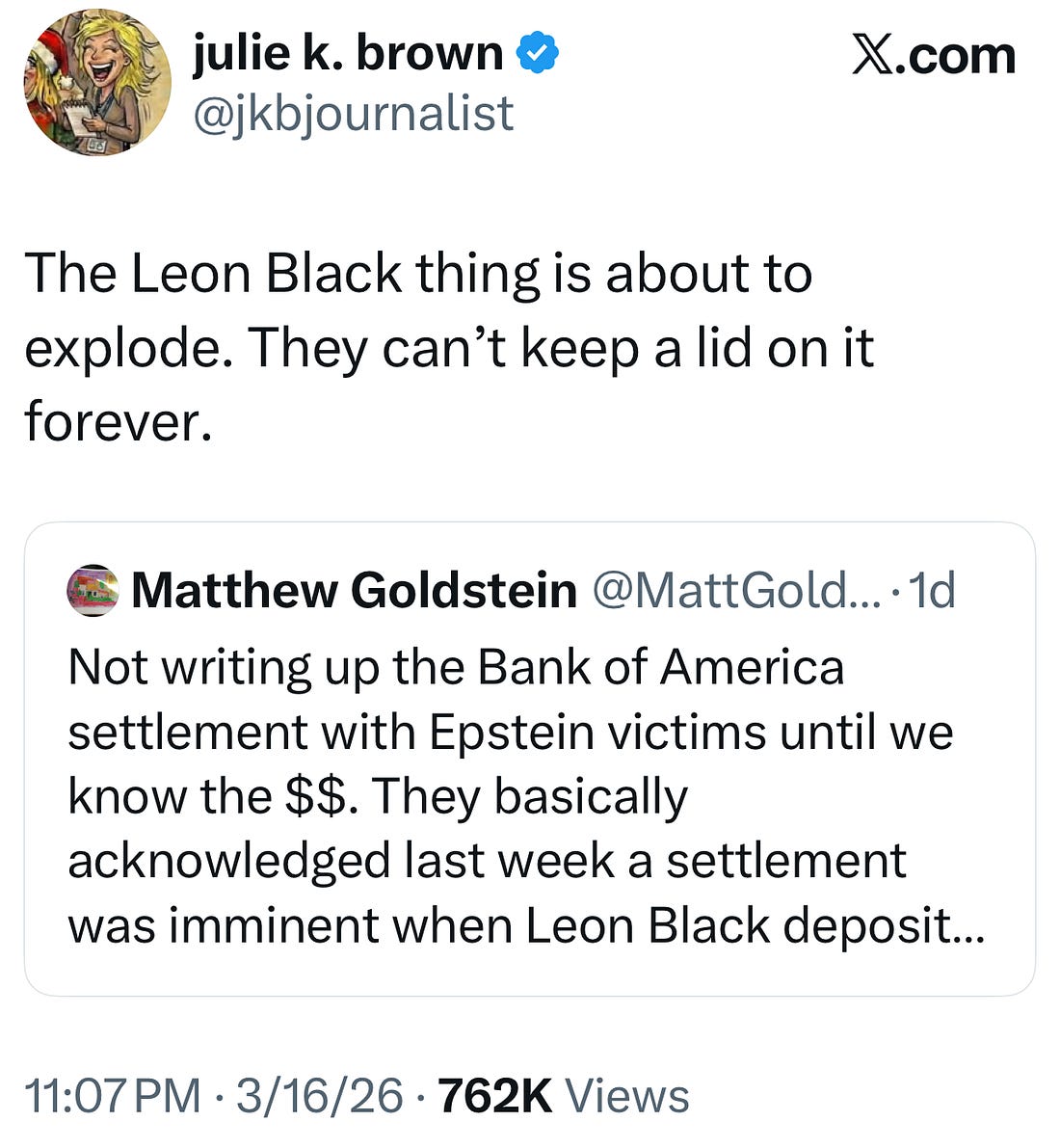
Julie K. Brown, the reporter responsible for putting the Epstein story on America’s front burner, retweeted Goldstein, commenting: “The Leon Black thing is about to explode. They can’t keep a lid on it forever.”
 |
Julie K. Brown’s reporting was instrumental in unearthing the unconscionable sweetheart plea deal Epstein got in Florida and forcing further investigation into the matter, which led to the prosecution of Jeffrey Epstein and Ghislaine Maxwell. So when she makes a statement that is this definite, it’s time to pay attention.
Leon Black is an American private equity investor. He co-founded Apollo Global Management, which is billed as one of the world's largest alternative investment firms. It makes investments in asset classes other than capital stocks, bonds, and cash. Black was Apollo’s CEO until 2021, when he resigned amid revelations of his business relationship with Jeffrey Epstein. To give you some idea of how well he has done, he recently sold his Beverly Hills home for $47 million, according to the Wall Street Journal.
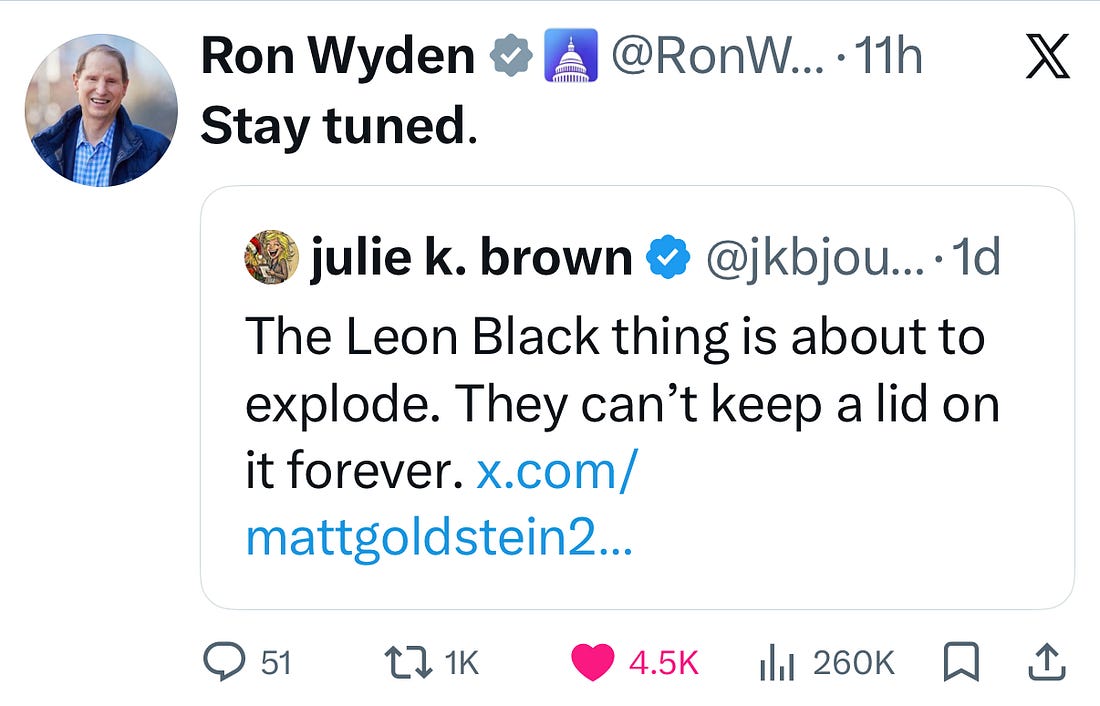
Oregon Senator Ron Wyden is the ranking member of the Senate Finance Committee and someone who understands what is meant by “follow the money.” He retweeted Julie K. Brown’s tweet. “Stay Tuned,” he added.
 |
In fact, both lawsuits filed by Epstein survivors last year refer to the long-term investigation Wyden has been conducting. In a January update, he wrote, “Every one of these banks that enabled Epstein by waiting years to flag his suspicious transactions ought to face criminal investigation for violating the Bank Secrecy Act, and individual bankers ought to be investigated too. If the Trump administration wasn’t running a full-on pedophile protection program, these investigations would already be underway.”
Wyden’s investigation began in 2022, when he started looking into Epstein’s financial relationship with Black. According to his Senate Finance Committee release, he received information documenting Black’s payment of $170 million to Epstein, “ostensibly for tax and estate planning services.” Last June, before the Epstein Files Transparency Act was passed and documents started to be released, Wyden wrote a blueprint for what he characterized as “a proper follow-the-money investigation.”
When folks like this are paying attention, it suggests something important is coming. Scrutinizing the allegations in the civil case against Bank of America reinforces that.
 |
The lawsuit starts with a charge based on an unusual criminal-civil hybrid theory. It involves a provision in federal criminal law that can be enforced only by the DOJ. However, the law also specifically allows victims to recover through a civil lawsuit.