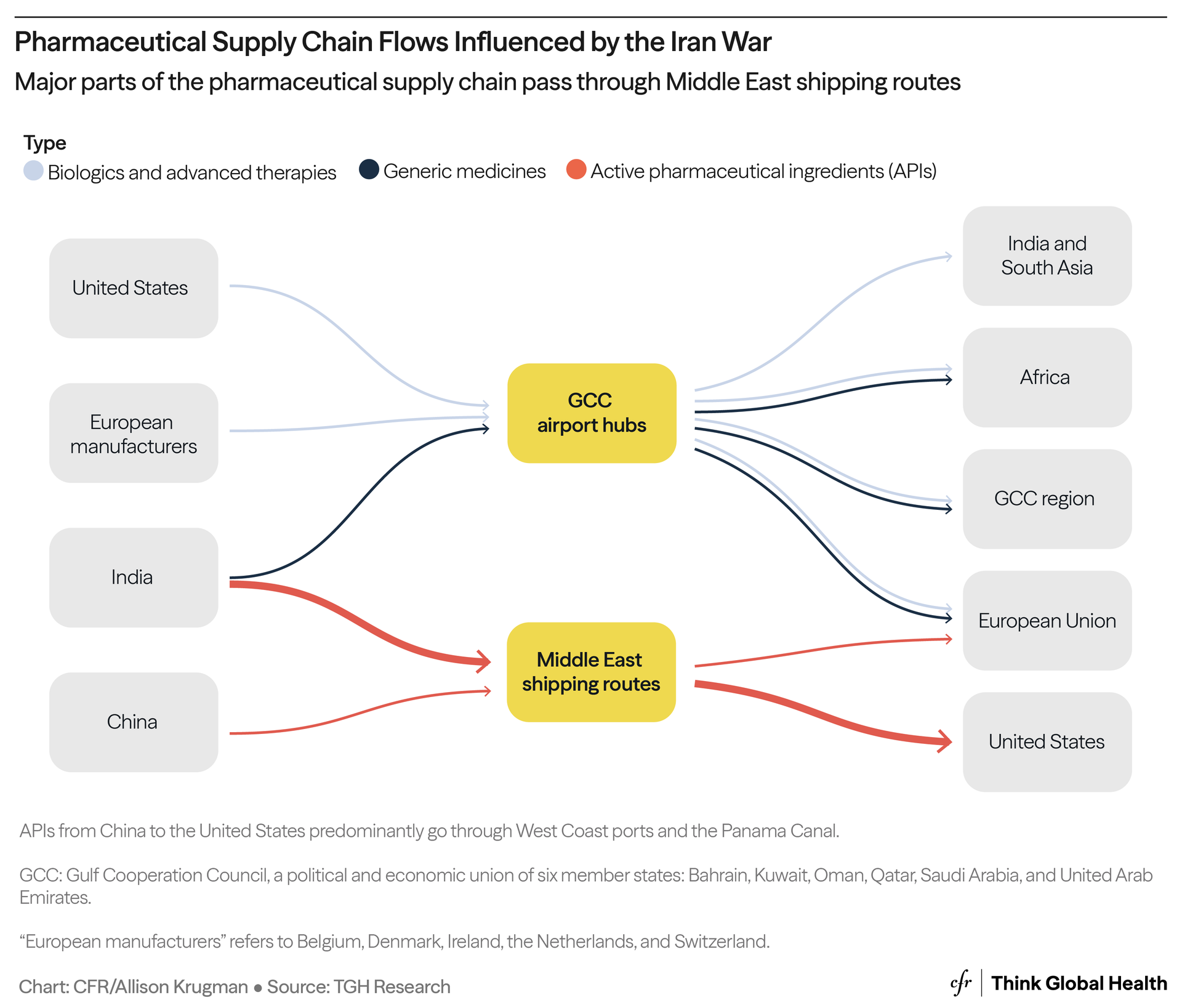
Almost three weeks since the war in Iran began, thousands of people—including civilians—have been killed and up to 3.2 million have been displaced. Further aggravating the humanitarian crisis is the disruption of some of the world’s most critical logistics corridors—the Strait of Hormuz and major Gulf air hubs. The interruptions are triggering delays across global supply chains, including those for pharmaceuticals.
To lead this week’s coverage, CFR’s Prashant Yadav and Anya Hirschfeld outline how pharmaceutical company executives are responding to the immediate supply-chain threats by actively targeting unconventional routes.
As more health-care systems adopt artificial intelligence (AI) tools to improve diagnoses, lower delivery costs, and strengthen quality of care, South Africa is using the technology to enhance HIV prevention and treatment. Sarah Morris, chief product officer at Audere, and Jirair Ratevosian, PEPFAR’s former chief of staff, describe how Aimee—a WhatsApp-based AI companion—is encouraging HIV self-testing and helping users adhere to treatment plans.
Six years after COVID-19 lockdowns swept Europe, journalist Emma Smith examines how the recent closure of several long-COVID clinics in England leaves thousands of patients without access to specialized care.
Until next week!—Nsikan Akpan, Managing Editor, and Caroline Kantis, Associate Editor