|
|
|
|
Good morning. In focus today, we look at how Donald Trump is fighting wars on many fronts — including at home, where his dairy-driven antagonism toward Canada is doing major damage to the U.S. tourism industry. |
|
|
|
|
|
|
|
|
|
|
|
|
|
|
|
|
Middle East: Oil climbed back above US$100 a barrel yesterday as the war in Iran continued. Today, it crept back below that level on hopes of a ceasefire. |
|
|
|
|
- Air strikes battered Iran and Iranian missiles and drones targeted Israel and sites across the Mideast yesterday, even as Trump said the U.S. was in talks with the Islamic Republic to end the war.
- Iran has received an American 15-point plan for a ceasefire through intermediaries from Pakistan, officials in Islamabad said Wednesday.
-
But Iran’s military scoffed at the diplomatic efforts and launched more attacks on Israel and the Persian Gulf region.
|
|
|
|
|
Travel: U.S. officials are looking at staffing, fatigue and communication failures after the Air Canada crash at LaGuardia airport. |
|
|
|
|
|
|
|
|
|
|
Trade: Canadian businesses compliant with USMCA still getting hit by soaring duties and fees. |
|
|
|
|
|
|
|
|
|
|
|
|
|
|
|
Cows are milked at a dairy farm in South Mountain, Ont., in June, 2018. CHRIS WATTIE/Reuters
|
|
|
|
|
|
|
|
|
|
|
|
|
|
|
|
|
|
|
|
|
U.S. President Donald Trump appears to have no shortage of grievances with Canada, with new perceived slights rolling out on a regular basis. When we’re not mistreating U.S. aircraft manufacturers, we’re (somehow) ripping off the U.S. with the new Windsor-Detroit bridge. |
|
|
|
|
But Canada’s original trade sin in Trump’s eyes – which he regularly trots out on social media, often in ALL CAPS – is dairy.
Specifically, how Canada uses its supply management system to control the volume and type of dairy products entering the country. In the U.S. Trade Representative’s report last year on foreign trade barriers, dairy featured prominently in the Canada section, and trade experts widely acknowledge the sector will be at the heart of this year’s talks to renew the Canada-U.S.-Mexico Agreement (CUSMA). |
|
|
|
|
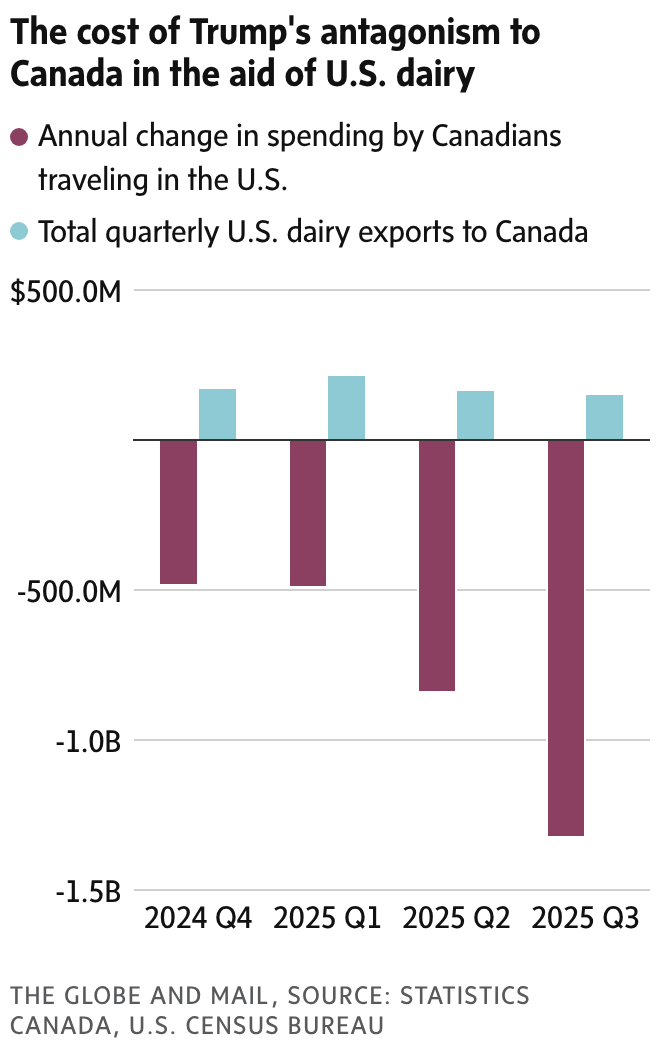
However, the way Trump has gone about championing the U.S. dairy lobby’s case – with tariffs, insults and repeated threats against Canadian sovereignty – has left a sour taste in the mouths of most Canadians and prompted a travel boycott the likes of which has never been seen. |
|
|
|
|
For the latest edition of Report on Business Magazine, I compared what Trump may hope to gain on dairy against what the U.S. has already lost on forgone Canadian travel spending. The gap is wide and growing. For instance, total imports of U.S. dairy in the third quarter of 2025 were $154-million. In that same quarter, Canadians spent $1.3-billion less while travelling in the U.S. than the year before. |
|
|
|
|
|
|
The Trump administration hasn’t said how much additional U.S. dairy it wants Canada to import. Under the CUSMA deal signed in 2019, which Trump praised at the time, imports of U.S. dairy were envisioned to grow by around $400-million a year. |
|
|
|
|
That never happened. And the U.S. has a good case to make that the way Canada allocates the licences to import tariff-free dairy is unfair, since only Canadian dairy processors and distributors can get them, and they have little incentive to import U.S. dairy. |
|
|
|
|
Indeed, there are plenty of economists on this side of the border who’d like to see Canada scrap the supply management system, which they argue acts as a tax on Canadian consumers by making dairy and some other agricultural products more expensive than they otherwise would be. |
|
|
|
|
Instead, antagonism by the White House – along with very real fears about border detention – is keeping Canadians at home, leaving the U.S. tourism industry begging for them to return. |
|
|
|
|
|
|
|
|
|
|
In fact, outside of the pandemic lockdown period, the number of Canadians travelling abroad over a month outpaced ground trips to the U.S. for the first time since at least 1972, when Statistics Canada began keeping records, the agency said in a report earlier this week. |
|
|
|
|
In January, 1.5 million Canadian residents returned from overseas, a jump of 10.6 per cent from the same month a year earlier. By contrast, the number of residents crossing back into Canada from the U.S. by automobile fell 26.3 per cent to 1.3 million over the same period. |
|
|
|
|
The travel boycott, which took hold in early 2025 in response to Trump’s tariffs on Canada and his rhetoric targeting Canadian sovereignty, has resulted in 13 consecutive months of year-over-year decline in travel to the U.S. |
|
|
|
|
Canada is the largest source of international tourism to the U.S. In 2024, travellers from Canada generated US$20.5-billion in spending and supported 140,000 jobs, according to the U.S. Travel Association. |
|
|
|
|
You can read more here on how the shift represents what one economist called “a channel of harm that trade policy debates often overlook.” |
|
|
|
|
|
|
|
|
|
|
|
|