|
|
|
|
Good morning. The chief executive of the country’s largest airliner is facing heavy criticism after posting an English-only message of condolences after this week’s fatal collision between an Air Canada plane and a firetruck at a New York airport. |
|
|
|
|
|
|
|
|
|
|
|
|
|
|
|
|
Telecoms: Edward Rogers has triggered a clash over the will and estate of the matriarch of the billionaire Rogers family. |
|
|
|
|
|
|
|
|
|
|
|
|
|
|
|
|
|
|
|
|
|
|
|
|
|
|
|
Rousseau giving a speech – famously, in English – at the Montreal Chamber of Commerce in 2021. Mario Beauregard/The Canadian Press
|
|
|
|
|
|
|
|
|
|
|
Air Canada’s CEO faces a familiar encore |
|
|
|
|
|
|
|
|
|
|
Four years after drawing headlines for his admission that he had not learned French, despite living in Montreal for more than a decade, despite being the chief executive officer of a Montreal-based airliner, despite the company’s status as a federally regulated company operating under sweeping French-language rules, Air Canada chief executive Michael Rousseau is drawing attention for his English-only message of condolence after a fatal collision between a plane and a firetruck at New York’s LaGuardia Airport. |
|
|
|
|
|
|
|
|
In a four-minute video posted about 13 hours after the crash, Rousseau said he wanted to express, “first, and most importantly, our deepest sorrow for everyone affected. |
|
|
|
|
“Our efforts are focused on the needs of our passengers and crew members, along with their families and loved ones.” |
|
|
|
|
Antoine Forest, the pilot in command of the Air Canada Express flight when it collided with a fire truck, was a francophone from Coteau-du-Lac, Que. |
|
|
|
|
It’s perhaps no wonder, given his family’s background and the significance of language to the province’s identity, that media and political leaders across Quebec – then across Parliament Hill in Ottawa – were so quick with their criticisms. |
|
|
|
|
The public nature of the response from Prime Minister Mark Carney, who said yesterday that he was “disappointed by the video message” and that it “lacks judgment and compassion,” might seem blunt to some, but it’s an instinct built on years of fraught relations between Ottawa and the province. |
|
|
|
|
In the decades after the 1995 referendum, in which Quebeckers voted by the slimmest of margins against sovereignty, the federal government has made efforts to recognize the province as a distinct society, but through symbolic gestures that don’t allow for the reopening of the Constitution. |
|
|
|
|
|
|
|
|
|
|
Regardless of Ottawa’s history with the province, those in leadership positions have long acknowledged that knowing at least a little of the country’s two official languages helps. And another simple truth: teleprompters exist. In January, Alberta Premier Danielle Smith delivered a small section
of her speech to a Conservative Party convention in French, earning applause from the audience when it was clear her attempt had mercifully come to an end. In his time running in federal election campaigns, Reform Party founder Preston Manning gave French his level best – even if one comedian joked that they “preferred it in the original German.” |
|
|
|
|
Instead, with the exception of a “bonjour” and a “merci,” the decision was made to record the video entirely in English, because Rousseau’s “ability to express himself in French does not allow him to convey such a sensitive message in that language as he would wish,” an Air Canada spokesperson told The Globe, noting the video had subtitles. |
|
|
|
|
My time in public relations was relatively short-lived – and it’s always easier to solve problems in retrospect – but across my four-odd years, I might have recommended, so many hours after the crash, so many years after a promise to learn the language, knowing a francophone community had just lost a loved one, a more considered focus on the pilots and their families. |
|
|
|
|
I might have suggested he express at least some of his sympathies in French. But it’s hard to explain why that would need suggesting in the first place. |
|
|
|
|
|
|
|
|
|
|
|
|
|
|
|
|
|
|
|
|
|
|
|
|
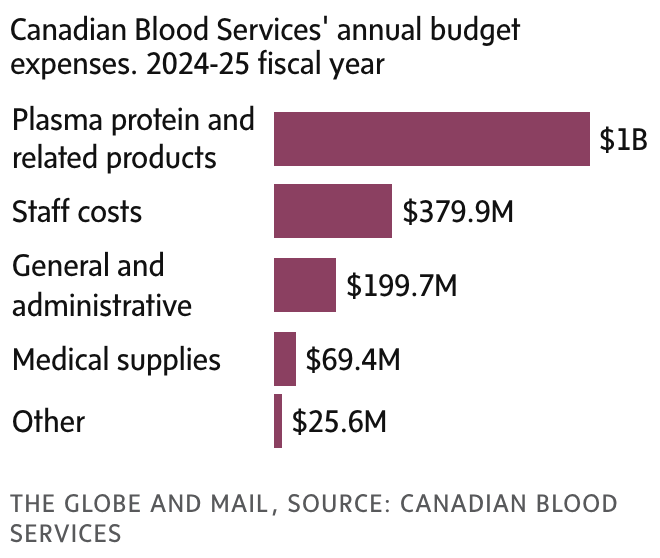
Canadian Blood Services is known as the operator of Canada’s blood collection and distribution system outside of Quebec. The government-funded charity runs a network of donation sites where donors roll up their sleeves, and it provides the logistics to get life-saving blood transfusions to hospitals across the country. |
|
|
|
|
But its financial statements reveal that it spends most of its money on a service most Canadians aren’t familiar with: buying and dispensing Canada’s supply of pharmaceutical products derived from human plasma. |
|
|