| | The US expands its Gulf forces even as worries grow over its resources to prosecute the war, energy ͏ ͏ ͏ ͏ ͏ ͏ |
| |  Algiers Algiers | Mexico City | Panama City |
 | Flagship |  |
| |
|
The World Today |  - US expands Gulf presence
- Israel, US war shortages
- War hits Asia energy price…
- …and boosts African sales
- Risk of global food crisis
- Putin seeks oligarch help
- Anthropic’s court success
- LatAm graft concerns
- China holds Panama ships
- Dogs’ long history
 A Schiaparelli exhibit in London that delves into ‘fashion’s house of surrealism.’ |
|
US may send 10,000 troops to Gulf |
 Jose Luis Gonzalez/Reuters Jose Luis Gonzalez/ReutersThe US may send up to 10,000 additional ground troops to the Gulf, even as Washington touts a possible diplomatic end to the war. The force would include infantry and armor, Pentagon officials told The Wall Street Journal, and would likely deploy within striking distance of Iran and its crucial oil export hub of Kharg Island. The US has continued to amass units in the region — 2,000 paratroopers, 5,000 marines, and an aircraft carrier group among them — but analysts said it has few palatable options and, if anything, Iran retained the upper hand because of its control of the Strait of Hormuz and its armed forces’ resilience in the face of continued attacks. |
|
Israel, US face military constraints |
 US Navy/Handout via Reuters US Navy/Handout via ReutersThe US and Israel are running short on resources to carry out the war in Iran. Israel’s opposition leader warned that the country’s military — which is also carrying out operations in Lebanon — was “stretched to the limit and beyond,” while one Israeli general reportedly said the force was “on the verge of collapse.” Semafor, meanwhile, reported this month that Israeli forces told Washington that they were running critically low on missile interceptors. The US is similarly squeezed: Arsenals are strained by previous conflicts and replenishment rates remain low, an analyst wrote. The situation is comparable to 1950, when an underfunded Army deployed a task force to Korea with “insufficient ammunition, outdated equipment, and units unable to sustain combat operations.” |
|
Asia scrambles to ease energy prices |
|
War spurs interest in Africa energy |
 Feisal Omar/Reuters Feisal Omar/ReutersAlgeria agreed to increase LNG exports to Spain, part of renewed foreign interest in African energy supplies as the war in Iran sends prices soaring. The decision came just days after Italy’s prime minister traveled to Algiers to secure greater gas supplies; Ukraine also said it would increase gas imports from Mozambique. Though African energy producers have seen revenue bolstered by the conflict, many of the continent’s import-dependent economies have been badly hit: Tuktuk drivers in Somalia have stopped working as their margins erode, and African capitals are trying to ease fears that they may soon be running out of supplies, with some moving to punish people hoarding fuel. The “rising prices of fuel could lead to strife on the continent,” Bloomberg said. |
|
War risks grave global food crisis |
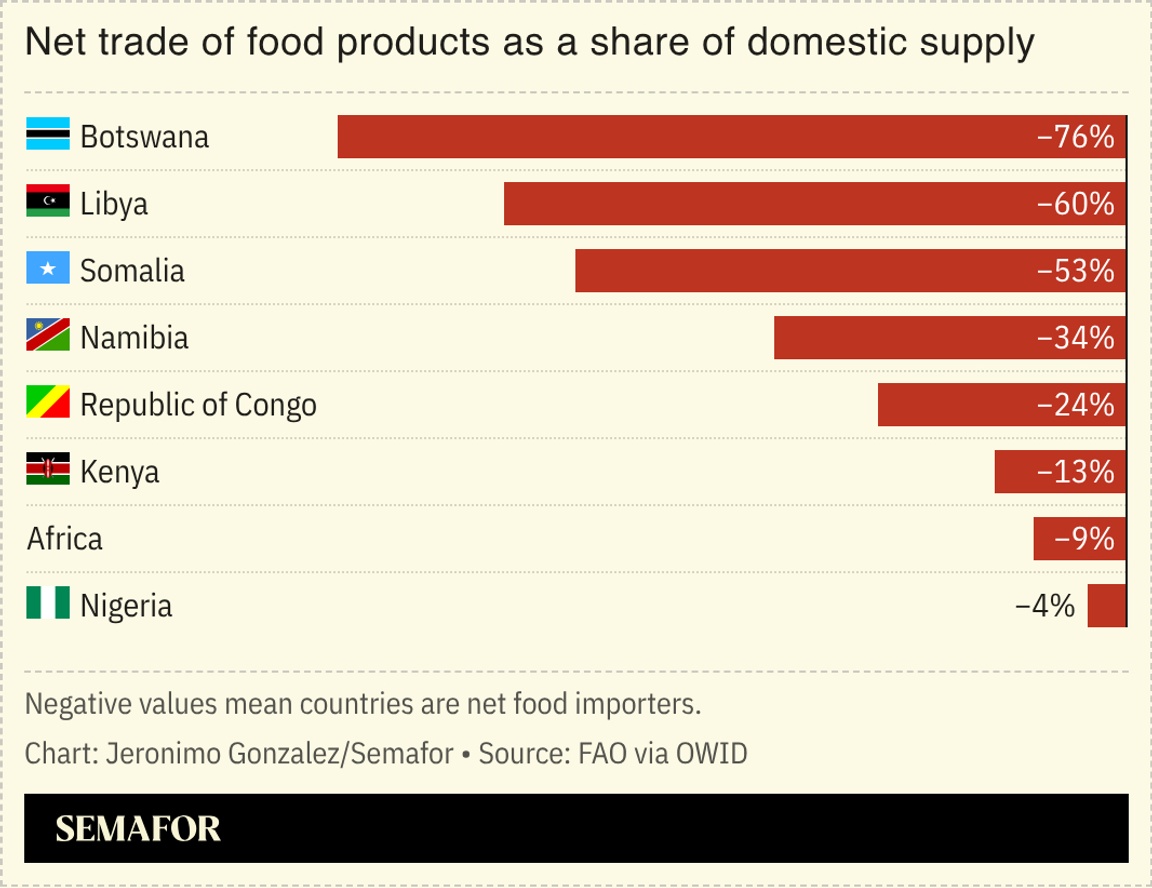 The war in the Middle East threatens to unleash a global food crisis, with experts forecasting the impact could be worse than that sparked by Russia’s invasion of Ukraine. Iran’s closure of the Strait of Hormuz, through which a large share of the world’s fertilizer passes, is putting farmers at risk of missing the spring planting season. Higher energy prices are also raising the costs of storing and cooking food, and poorer countries are bearing the brunt: The World Food Programme warned that as many as 45 million more people could fall into acute food insecurity if the conflict doesn’t end soon. “It’s setting up to be a far worse situation” than 2022, an expert told the Financial Times. |
|
Putin seeks oligarchs’ war help |
 Ramil Sitdikov/Reuters Ramil Sitdikov/ReutersRussian President Vladimir Putin reportedly asked oligarchs to donate to the strained national budget as the cost of the Ukraine war soared. Moscow has seen a recent boost in revenues as the Iran war drove up oil prices, but Ukrainian attacks on its export and refinery infrastructure have limited those gains, and the Kremlin’s defense bill rose 42% last year, the Financial Times noted; its budget deficit for January and February was more than 90% of its projected whole-year figure. Kyiv, meanwhile, is seeking to strengthen its hand in the war as a result of the Middle East conflict: Ukraine’s president signed a defense cooperation deal with Saudi Arabia on a surprise visit to the kingdom this week. |
|
 Former Sony Entertainment CEO Michael Lynton made a decision that led to one of the most consequential hacks in history: approving The Interview, the Seth Rogen-James Franco comedy that provoked a cyberattack from North Korea. Now chairman of Snap Inc., Lynton joins this week’s Mixed Signals to revisit that moment, why he broke his own greenlight process, and how he managed the fallout as private emails were leaked and careers were upended. Plus, he talks about his new book with Josh Steiner, and why he was frustrated by the US federal government’s inaction on its own TikTok ban. Listen to the latest episode of Mixed Signals now. |
|
Anthropic gets a boost in DoD case |
 Al Drago/File Photo/Reuters Al Drago/File Photo/ReutersA US judge blocked the Pentagon’s designation of Anthropic as a “supply chain risk.” The Department of Defense wanted to stop all military suppliers from contracting with the AI company after a row in which Anthropic refused to allow its products to power domestic surveillance or fully autonomous weapons. The court called the move “contrary to law and arbitrary and capricious,” and restored the status quo ante, although the DoD is still free to find other contractors and is not obliged to employ Anthropic. The decision is temporary, but a symbolic victory for Anthropic, WIRED reported, reducing concerns that the company could be made “an industry pariah” and lose customers beyond defense contracts. |
|
Graft erodes LatAm voter confidence |
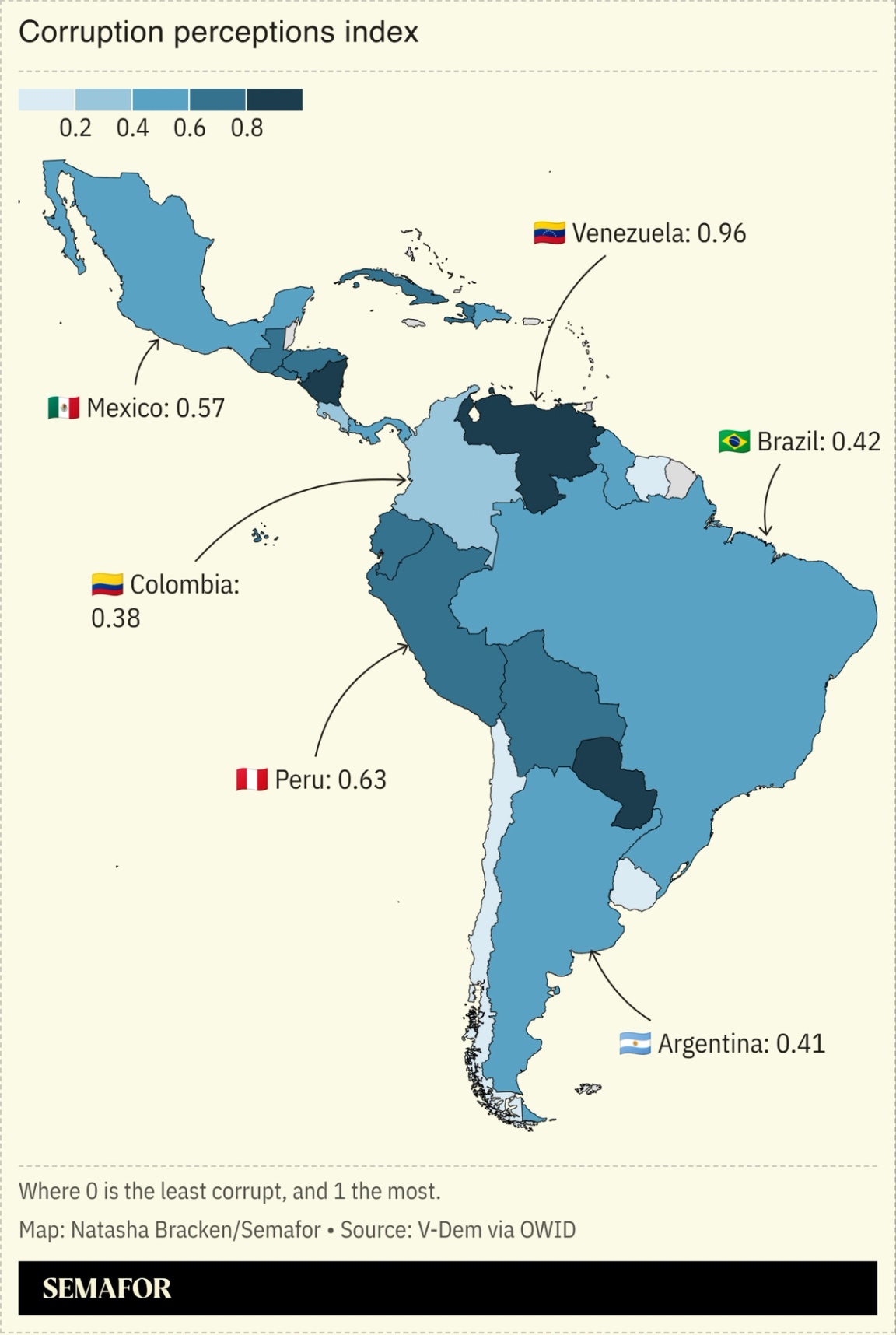 Rampant corruption is eroding voter confidence in Argentina and Mexico, whose leaders ran on anti-graft campaigns. Argentina’s President Javier Milei and his Mexican counterpart Claudia Sheinbaum vowed to fight corruption, but voters in both countries now say it is their main concern after several scandals. The pattern is repeated across much of the continent: The Inter-American Development Bank has put the annual cost of corruption in Latin America at around $220 billion, roughly equivalent to the entire GDP of Peru, the region’s sixth-biggest economy. Graft also hollows out basic public services, leaving schools and hospitals short of essential supplies. “Corruption harms the poor and vulnerable the most,” the World Bank said. |
|
 This April, global CEOs, officials, and industry leaders will join Semafor World Economy — the largest gathering of government and executives in the US — to sit down with Semafor editors for conversations on the forces shaping global markets, emerging technologies, and geopolitics. See the full lineup of speakers, including Global Advisory Board members, Fortune 500 CEOs, and elected officials from the US and across the G20. |
|
|


