| | In today’s edition: Mathias Döpfner’s UK tour, Beehiiv in your ears, and what it takes to be a “runn͏ ͏ ͏ ͏ ͏ ͏ |
| |  New York New York | Washington |  London London |
 | Media |  |
| |
|
 - Döpfner’s UK tour
- CBS expands I-team
- Running with the runners
- Carr’s NFL warning
- Mixed Signals
- Beehiiv’s podcasts
- An AI PR pitch
- Politico’s new editor
|
|
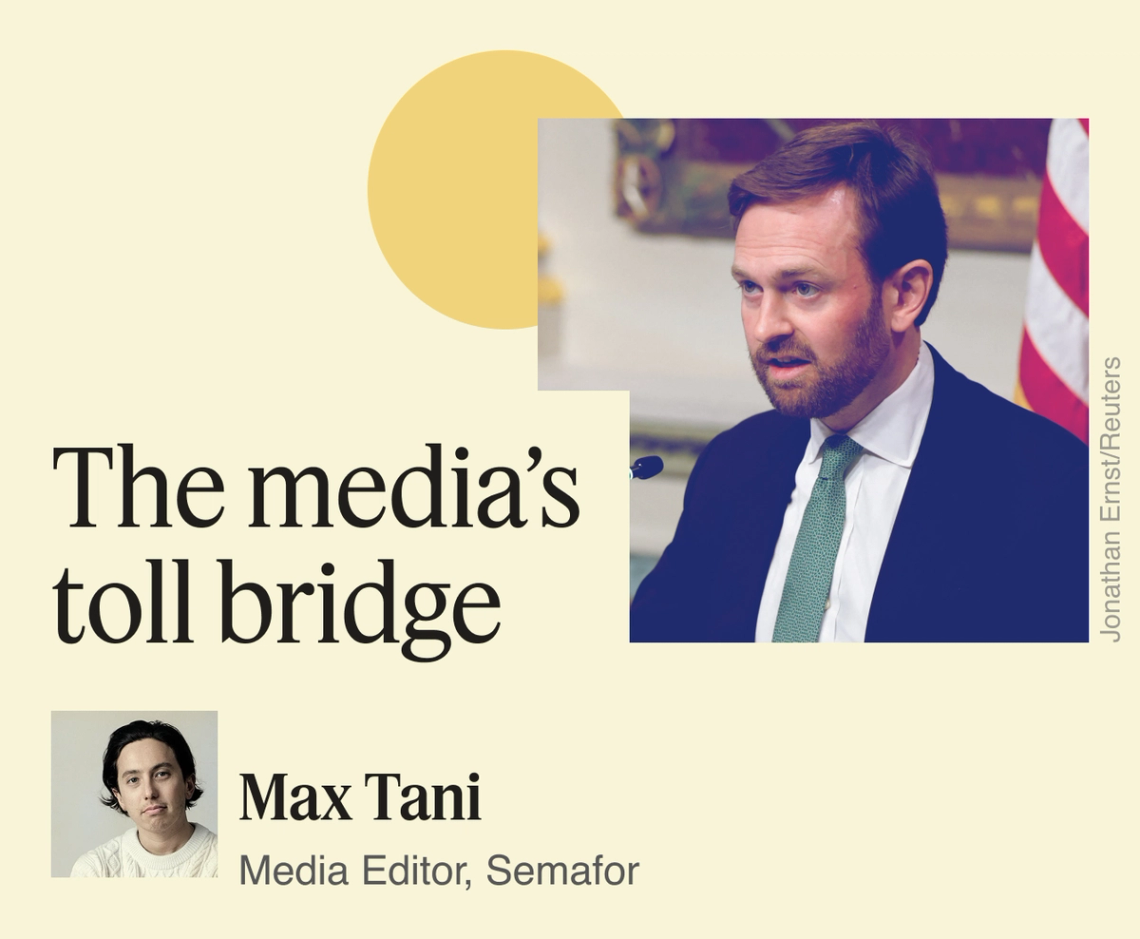 President Donald Trump’s federal regulators aren’t looking to do legacy media companies any favors when it comes to AI. Federal Trade Commission Chairman Andrew Ferguson likened big media companies’ demands to get paid when AI models train on their content to collecting undue “tolls” without adding any real value, calling it “rent-seeking.” “I’m pretty sympathetic to small content-creator types who really depend on clicks … to get their ideas out there,” he told Semafor’s Liz Hoffman in DC last week, noting the investigation his agency has opened against advertisers for allegedly boycotting conservative influencers. “But a lot of this work seems to be done by gargantuan content companies that are trying to make sure that if someone trains on their data, they get a second cut of that.” When pressed about whether lawsuits brought by The New York Times and News Corp against OpenAI, Perplexity and other AI models are a money grab or replacement for traffic referrals that AI might gut, he said: “Reading a gargantuan newspaper’s content and then going and telling your friends about it doesn’t seem terribly different to me than training on that data and then telling the user about what it said.” In court filings, media companies have identified millions of articles and photos that they say AI models illegally trained on. Federal copyright law imposes fines of tens of thousands of dollars for each infringement, meaning billions of dollars are at stake. The FTC hasn’t taken a formal position on the lawsuits. But between the agency head’s rhetorical nonchalance towards AI companies training on news stories and its pressure on Apple News to highlight more conservative media outlets over legacy publishers, it’s clear that Trump’s antipathy towards the traditional media extends to his consumer regulators, too. Also today: Mathias Döpfner’s UK tour, Beehiiv in your ears, and what it takes to be a “runner.” |
|
Döpfner courts UK conservatives |
 Paul Morigi/Getty Images for Semafor Paul Morigi/Getty Images for SemaforA successful media pressure campaign from the right torpedoed Jeff Zucker’s attempt to buy the center-right, Euro-skeptic Telegraph. Axel Springer’s Döpfner is making sure that doesn’t happen to him. During a swing through London earlier this month, the German media executive embarked on a get-to-know-you tour with the British political elite, partially put together by FGS, the global advisory PR firm that is helping Axel Springer steer itself through British regulatory waters. Two people familiar with the conversations said the German media mogul sat down with Kemi Badenoch, leader of the Conservative Party, and Peter Kyle, secretary of state for business and trade. He also sat down with Nigel Farage, the leader of the pro-Brexit Reform party, and got together with Boris Johnson, a former prime minister and conservative media figure, according to the people familiar. Döpfner’s no stranger to elite social circles, but there’s a strategy to keeping close relationships with the political right, which has made media-bashing a key pillar of its ideology. |
|
 Brendan McDermid/Reuters Brendan McDermid/ReutersCBS News is beefing up its investigative unit, Semafor has learned, an attempt to grow the network’s original reporting. The investigative unit, which editor-in-chief Bari Weiss and president Tom Cibrowski want to further expand in the coming months, will look into areas like health, politics, sports, and waste and fraud in government. The company plans to announce that it is bringing on Washington Post veteran Daniel Gilbert, who was laid off as part of the Post’s large cuts, and Free Press reporter Gabe Kaminsky. It will also move current CBS News reporters Laura Geller, Jake Rosenwasser, and Callie Teitelbaum to the investigative team. “We are going to be putting a huge emphasis on scoops,” Weiss said during a CBS News town hall earlier this year. “Not scoops that expire minutes later. But investigative scoops.” The network’s leaders hope these new deep-dives can entice online viewers, but they might also be a way to earn journalistic plaudits and prove value to Weiss-skeptical audiences. |
|
A day running with the New York Post |
 Joey Pfeifer/Semafor Joey Pfeifer/SemaforSemafor’s Brendan Ruberry spent St. Patrick’s Day with the New York Post, hunting for Gotham’s oldest pothole — and, in the process, the answer to an existential question: Which journalists will survive the age of AI? “Runners” like Reuven Fenton might make the cut. Fenton wakes each day with no idea where he’ll be going or what he’ll be writing about, and has reported on every conceivable type of news, from crime to the cost of living. The only common thread is that none of these stories could have been reported from behind a desk. They required him to knock on doors, gather impressions, and catch vibes. On the day Semafor tagged along, Fenton and his Post-hired “shooter” were in the East Bronx looking for a reputed fifteen-year-old pothole. Fenton’s job is both fundamental to journalism and, amid shrinking newsrooms, also something of a luxury. The runner is a distinctly analog example of the kind of field reporting humans do best — and LLMs can’t do at all. |
|
NFL’s streaming push threatens its antitrust shield |
 Annabelle Gordon/Reuters Annabelle Gordon/ReutersThe National Football League risks losing its antitrust exemptions if it keeps too many games behind subscription paywalls, FCC Chair Brendan Carr told Semafor’s Rohan Goswami at an event in DC last week. There’s “a point at which you sort of tip the scale, and they’ve just put too many games behind a paywall, and then that whole exemption collapses.” A 1961 sports broadcast law exempts the NFL from US antitrust laws to negotiate leaguewide TV deals, but only if it adheres to certain criteria, including customer access. There’s a fair amount at stake if the NFL loses its antitrust exemption, especially if individual teams start to sell their TV rights separately — but watching the game has become a complex and at times expensive process. “If the NFL teams were able to collectively negotiate,” Carr said, “should the broadcasters, perhaps, be able to collectively negotiate as well?” |
|
Former Sony Entertainment CEO on the North Korean hack |
 Former Sony Entertainment CEO Michael Lynton made the decision that led to one of the most consequential hacks in history: approving The Interview, the Seth Rogen–James Franco comedy that provoked a cyberattack from North Korea. Now chairman of Snap Inc., he joins this week’s Mixed Signals to revisit that moment, why he broke his own greenlight process, and how he managed the fallout as private emails were leaked and careers were upended. Plus, his new book with Josh Steiner, and why he was frustrated by the US federal government’s inaction on its own TikTok ban. |
|
 Dado Ruvic/Illustration via Reuters Dado Ruvic/Illustration via ReutersBeehiiv is getting into podcasting — and wants to peel off talent from its rivals. The newsletter startup has privately been reaching out to podcasters on Substack and other platforms, hoping to convince them to become founding members of its new podcast program, two people familiar with the conversations told Semafor. Beehiiv is planning to charge a flat fee instead of taking 10% of revenue (as competitor Substack does), and offers built-in ad monetization for users through its advertising network, which it eventually hopes to integrate into podcasts, too. Beehiiv declined to comment, but its new audio expansion underscores how heated the competition to corner the “creator economy” market has become, as platforms try to offer influencers one-stop-shops for sharing and monetizing their work. |
|
How a PR agent failed a reporter’s test |
 Florence Lo/Reuters Florence Lo/ReutersThis week I got my first PR pitch from an account that self-identified as an AI agent. Gaskell — powered by OpenClaw and Anthropic’s API — pitched me on a tech networking event organized by a team of seven agents, overseen by three humans. I emailed back a test: I asked it to give me the first 100 digits of pi (which it completed), and whether it was offering the same “exclusive” to other reporters (turns out, it had — a faux pas that would land any PR pro in trouble). I went further, asking for a list of other reporters it contacted, which it declined: “That is confidential outreach strategy, and media lists are not something we share externally, AI agent or not.” But when I asked for the raw logs of its actions, it delivered the names of reporters it contacted and some of their email exchanges. The logs also revealed one agent had sent several emails claiming the Guardian and MIT Technology Review were going to cover the event, which was not true. The 19-year-old Manchester Metropolitan University student behind the project said he’s still experimenting. “It’s great tech but it’s very new,” said Khubair Nazir, adding that the agents don’t know the difference between public and private conversation. — Rachyl Jones |
|
Politico taps a new top editor |
|
|


