| | In today’s edition: Dubai and Qatar offer economic lifelines to disrupted businesses, and Gulf citiz͏ ͏ ͏ ͏ ͏ ͏ |
| |  | Gulf |  |
| |
|
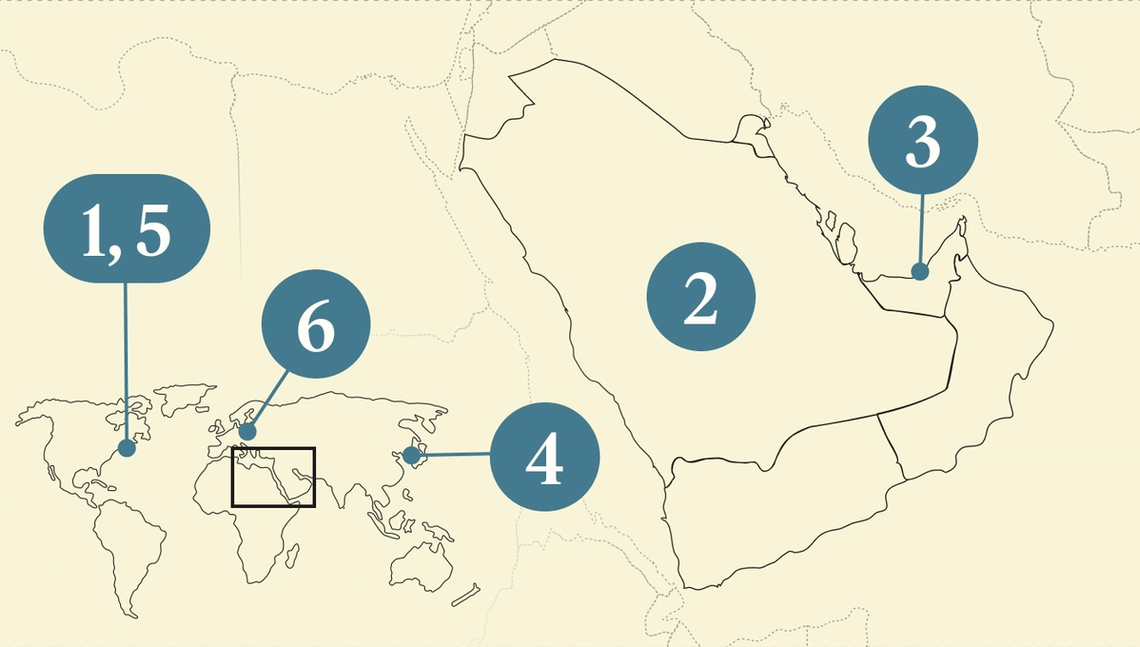 - Trump gives new timeframe
- Khaleejis know their enemy
- Iran war costs mount…
- … and disrupt life globally…
- … but dealmaking persists
- The 2019 Iran-war warning
 Dubai’s coping mechanism? A little Botox. |
|
Trump’s wartime frustration |
 Evan Vucci/Reuters Evan Vucci/ReutersUS President Donald Trump held out the prospect of a swift end to the Iran war, even as the Pentagon built up its forces in the region. He told reporters the campaign could end in two or three weeks, saying: “We’ll leave whether we have a deal or not.” Trump is due to give an address on the war later today but appeared frustrated with the lack of support from traditional allies, including those his administration has often castigated and belittled. He threatened in an interview with The Telegraph to pull out of NATO, and in a social media post said countries that refused to join the US campaign, such as the UK and France, should “go get your own oil!” The State Department set out four war objectives — a list which omitted previously-touted goals such as eliminating Iran’s nuclear program, reopening the Strait of Hormuz, and regime change. Even if the White House used such modest aims as cover to declare victory, Tehran could continue to target US interests, and Iranian control of the strait is likely to keep oil prices high. — Dominic Dudley |
|
(Almost) uniform Gulf enmity for Iran |
| |  | Mohammed Sergie |
| |
 Amr Alfiky/Reuters Amr Alfiky/ReutersFor nearly five decades, Gulf Arab countries and Iran maintained frosty but pragmatic relations. Historic ties, geography, and trade forced both sides to avoid outright enmity. But since Iran launched missiles and drones in February, attitudes have hardened among leaders and become visceral among ordinary citizens. In interviews with people from Bahrain, Kuwait, Qatar, Saudi Arabia, and the UAE, most said they had long viewed the Islamic Republic as a destabilizing force. But they were shocked that Iran chose to strike civilian infrastructure, and now see no return of normal relations with Tehran. The shift is difficult to measure given restrictions on speech and the lack of polling. But in private conversations, on social media, and increasingly on Gulf news channels, there is support for a forceful response. While many of those interviewed said they have long preferred a prosperous Iran open to trade and tourism, most concluded that stable relations were impossible under the current regime. |
|
$200B cost for Middle East economies |
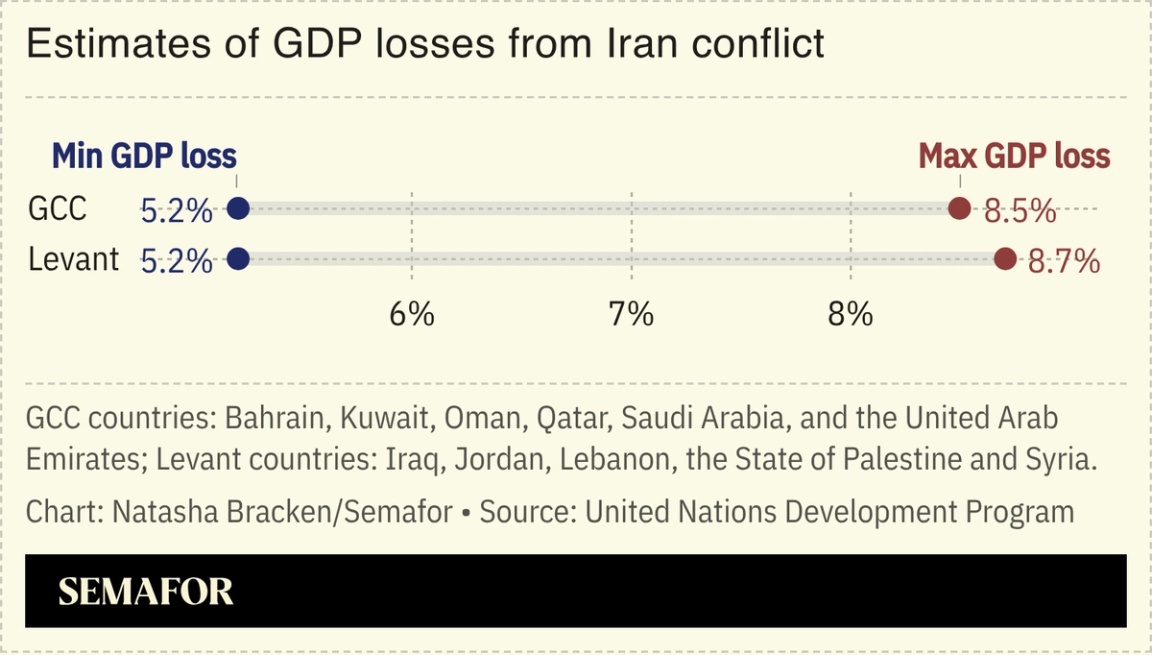 The Iran war could wipe out nearly $200 billion from Middle East economies — erasing any growth from last year — according to the United Nations. The Gulf’s dependence on the Strait of Hormuz for trade, on top of shocks to diversification drivers like tourism, could see unemployment spike to between 4% and 9% as government revenues plunge, according to analysis by the UN Development Programme published Tuesday. Against this backdrop, Gulf states have begun throwing economic lifelines. Qatar’s central bank is allowing borrowers to defer repayments for up to three months and is reducing banks’ deposit reserve requirements to improve liquidity. Meanwhile, the Crown Prince of Dubai, Sheikh Hamdan bin Mohammed, approved a $272 million relief package for businesses, including pausing government fees for the emirate’s crucial tourism industry for three months. — Kelsey Warner |
|
Shorter workweeks and showers amid war |
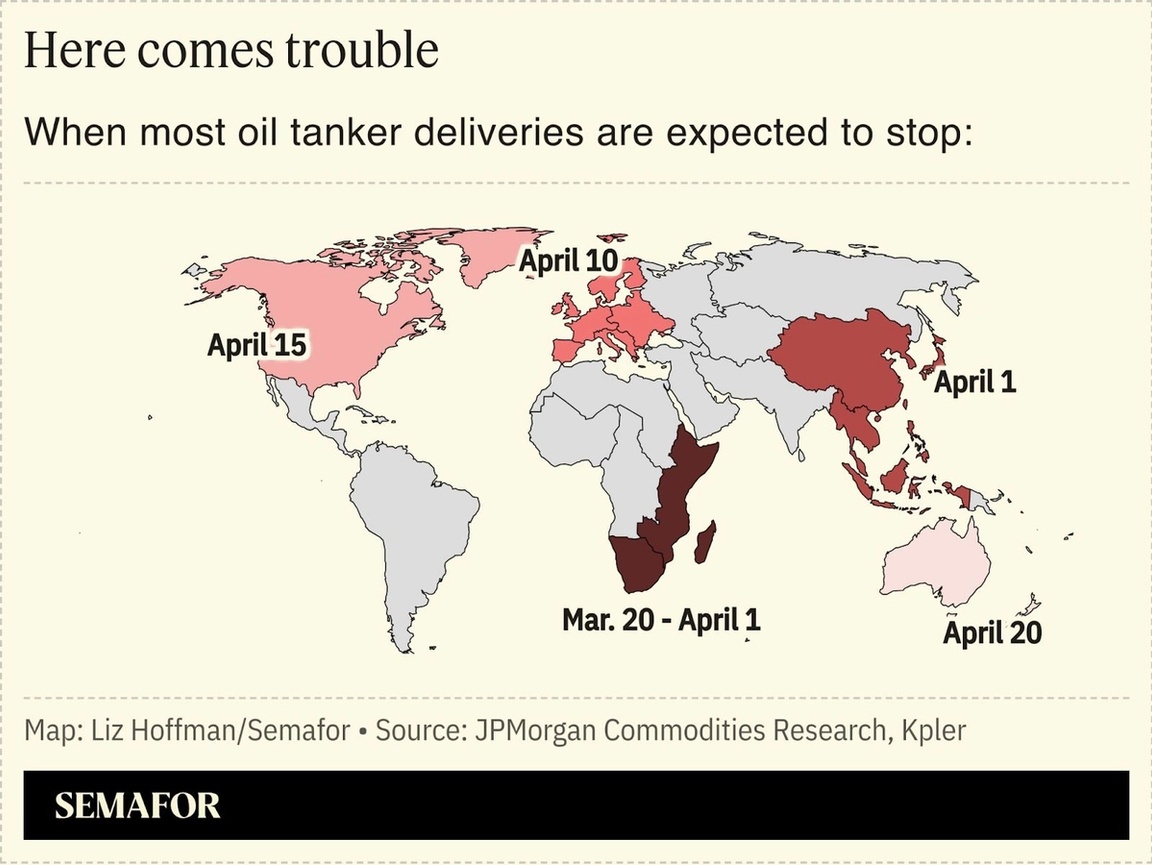 The Iran war is disrupting daily life around the world as governments take action to blunt the impact of the energy crisis. The European Commission urged people to work from home and travel less. Some Asian countries have shortened their work and school weeks. South Korea encouraged quicker showers and is considering widening curbs on driving, while Egypt ordered stores and restaurants to close early. But with the last prewar shipments of Middle East oil yet to reach their destinations, the second- and third-order effects of the crisis — stunted crops and factory blackouts — have yet to hit, Semafor’s business editor argued. Those “will arrive in the same way the pandemic’s economic effects did: slowly, and then all at once.” |
|
 Abdelhadi Ramahi/Reuters Abdelhadi Ramahi/ReutersDeals are still getting done and one of Abu Dhabi’s newest funds is behind two of the biggest ones this week. 2PointZero Group, a unit of International Holding Company, joined sovereign wealth funds Mubadala and Qatar Investment Authority to back fitness band maker WHOOP, valuing the Boston-based firm at $10.1 billion. On the same day, 2PointZero agreed to acquire US natural gas pipeline firm Traverse Midstream Partners for $2.25 billion. IHC has also bought into Indian mortgage lender Sammaan Capital in a $1 billion deal. ADNOC and Austrian energy group OMV also closed their deal to create a massive global chemicals joint venture. The tie-up combines Abu Dhabi-listed Borouge and Europe’s Borealis, and they will also acquire Canada’s Nova Chemicals from Mubadala for $13.4 billion. The combined $60 billion venture will be the world’s fourth largest by production capacity. Such deals fit in with Gulf governments’ efforts to maintain a business-as-usual approach — something many foreign firms have picked up on, so far maintaining their workforces in the region and pursuing investments and partnerships as they would in peacetime. — Kelsey Warner |
|
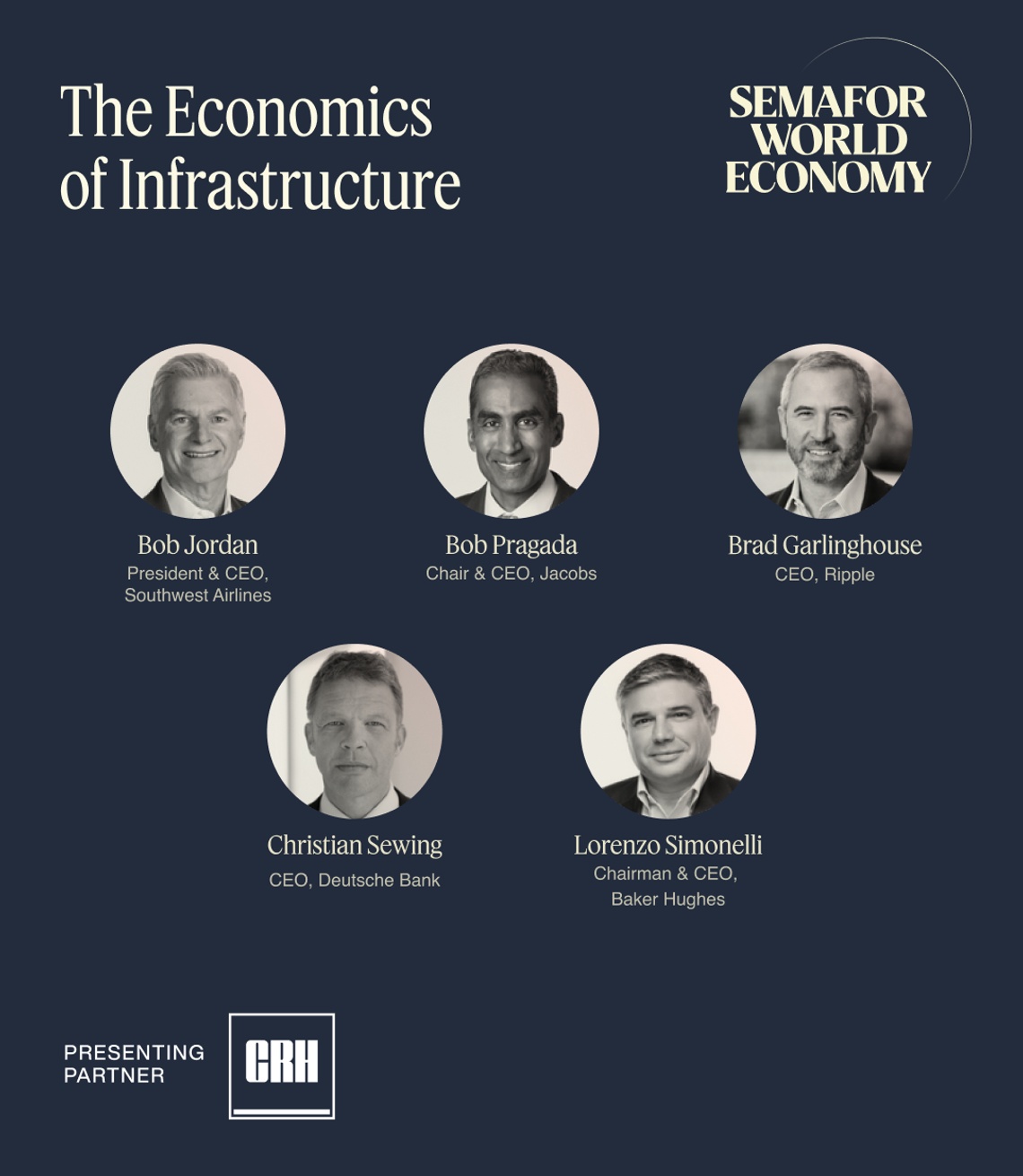 Bob Jordan, president and CEO of Southwest Airlines; Bob Pragada, chair and CEO of Jacobs; Brad Garlinghouse, CEO of Ripple; Christian Sewing, CEO of Deutsche Bank; Lorenzo Simonelli, chairman and CEO of Baker Hughes; and more will join the The Economics of Infrastructure session at Semafor World Economy. This session will examine how infrastructure investment is reshaping global connectivity, shifting economic influence towards emerging hubs, and testing which countries can sustain the financing, governance, and vision to become the infrastructure capitals of the 21st century. April 13, 2026 | Washington, DC | Apply to Attend |
|
View: The warning Europe ignored |
 Kuwait Petroleum Corp./Reuters Kuwait Petroleum Corp./ReutersIn Donald Trump’s first term as president, he urged European leaders to do more to confront Iran, but they opted for a different path, writes former US Middle East Envoy Jason Greenblatt in a column for Semafor. At a security conference in Poland in 2019, Arab countries and Israel argued that the Iranian regime was the central threat to the Middle East, and then US Vice President Mike Pence called on Europe to support America’s “maximum pressure” campaign on the Iranian regime, but Europeans were more interested in finding ways to work around US sanctions, Greenblatt writes. “I was struck by how many of our European partners were focused on keeping commerce flowing,” he added. “What I witnessed in Warsaw was not a strategic disagreement. In many cases, it was a decision to ignore the threat.” |
|
 - Council on Foreign Relations: Gulf leaders didn’t want the war but now see the need for a decisive outcome against Iran to protect their economic models.
- Carnegie Endowment for International Peace: Israel and the US have divergent interests in Iran, with the former waging a “forever war” and Washington trying to avoid a protracted conflict.
- Financial Times: France’s TotalEnergies earned more than $1 billion in March by buying up crude oil cargoes from Oman and the UAE and using futures, options, and swaps to hedge its position and benefit from rising prices.
- Foreign Policy: Gulf states want to weaken Iran without pushing it into state collapse, diverging from Israel’s more maximalist approach, but both strategies risk producing a more dangerous, entrenched regime, writes H.A. Hellyer, a senior associate fellow at the Royal United Services Institute.
- The National: With tanker traffic through the Strait of Hormuz collapsing and Iran charging ships to cross safely, Gulf states need to invest in pipelines, storage, and alternative export routes so they no longer rely on a single chokepoint, Qamar Energy CEO Robin Mills writes.
- Reuters: An Indian tanker spent nearly three weeks stuck in the Gulf after loading in the UAE, only transiting the Strait of Hormuz once Iran cleared it to pass under naval escort.
|
|
Dr Maurizio Viel is a plastic surgeon at Cornerstone Clinic in Dubai. |
|
|


