
|
 |
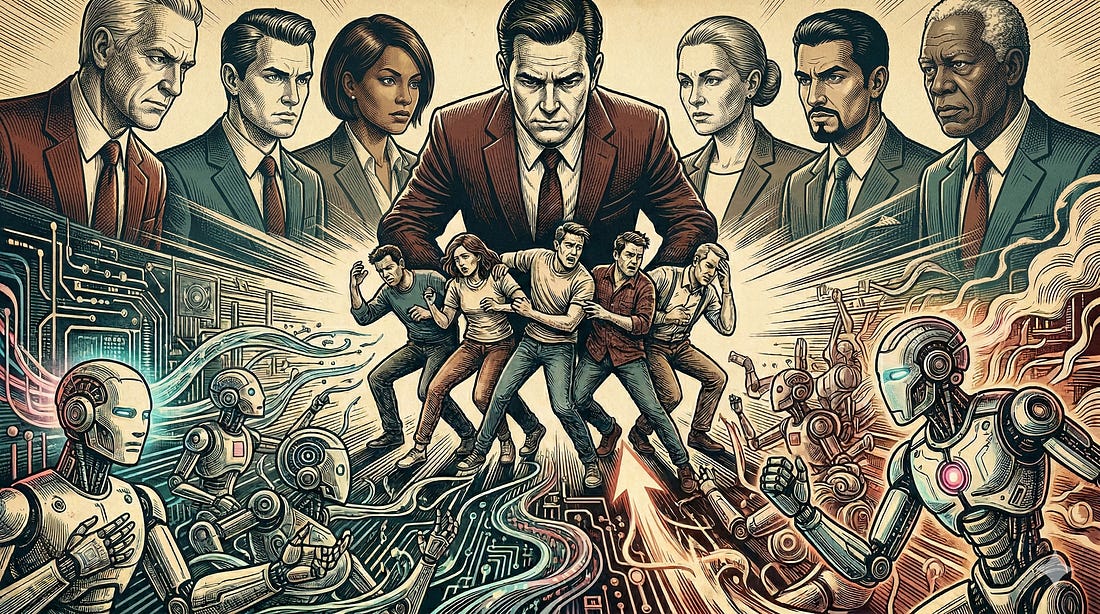
For Solo Chiefs—creatives, solopreneurs, and lone leaders orchestrating AI, humans, and chaos with no one to save their ass.



 |
I’m a founder, intrapreneur, and former CIO rethinking governance for the one-person business, navigating sole accountability in the age of intelligent machines—informed by plenty of scar tissue. All posts are free, always. Paying supporters keep it that way (and get a full-color PDF of my book Human Robot Agent plus other monthly extras as a thank-you)—for just one café latte per month.
I wrote this piece for class 22 of ScaleUpNation‘s Board Program. Interested in participating in one of their next classes? Check out their upcoming webinar:
Art of Scaling’ Webinar by Menno van Dijk.
On the 22nd of April ScaleUpNation hosts a (free) webinar about ‘The Art of Scaling’ from a Board perspective.
ScaleUpNation has 300 plus alumni, all specialist in the ScaleUp world.
This webinar is for executives interested in ScaleUps.
Founders, Investors, Advisors, C-level and (future) Board members.
You can subscribe using this link:
https://lnkd.in/eSHqfAUR
Hope to see you on the 22nd of April at 13.00 CET/1.00 PM
AI can now do half of the advisory board’s job. The courts want governance boards to do the other half.
Advisory boards are squeezed between AI tools that produce strategic advice cheaply and governance boards absorbing oversight responsibilities. Only contextual judgment survives.
Here’s an uncomfortable question for anyone sitting on an advisory board:
What exactly do you offer that Claude and ChatGPT can’t?
Governance boards just received a legal nudge that feels less like guidance and more like a deadline. The EU’s AI Act (Regulation 2024/1689) requires accountability for high-risk AI systems by August 2026, and regulators are treating that accountability as a board responsibility. The timeline is public and fairly blunt: enforcement for high-risk systems begins on August 2, 2026.
When regulations set a date, boards eventually pay attention.
The advisory board model, meanwhile, is drifting into an awkward middle position. A host of AI models and tools are making some of the board’s traditional contributions cheap and immediate. Meanwhile, governance boards are absorbing the rest because liability travels toward whoever signs the documents. The advisory board isn’t disappearing. But the version many organizations still maintain looks suspiciously like a relic of the past.
Let’s walk through the pressure points.
The Compliance Stampede
Corporate governance has a curious rhythm. Boards move slowly until courts or regulators start writing opinions. That phase has begun for AI.
A 2025 Deloitte Global Survey reported that 66 percent of boards say they have limited or no AI expertise. The number itself isn’t shocking. Boards historically recruit for finance, operations, and regulation. Deep technical literacy rarely makes the shortlist. What changed is the expectation surrounding it.
The oversight principle is gradually expanding toward technological risks. Recent Delaware Court of Chancery rulings have clarified that directors must receive regular briefings on mission-critical technologies. AI is quietly joining that category. The message from the courts is simple: directors cannot claim ignorance about the systems shaping their company’s core operations.
On my side of the Atlantic, regulators went further and put a date on the obligation.
The EU AI Act entered into force on August 1, 2024. High-risk system obligations begin in 2026. Boards now have roughly one governance cycle left to figure out what responsible oversight looks like, and organizations are responding with predictable speed.
Board intelligence platforms are building AI tools directly into governance workflows. Vendors such as Diligent and Nasdaq Boardvantage now advertise automated briefings, document summaries, and preparation tools that reduce director reading time by as much as 60 percent and board preparation time by up to 80 percent.
Anyone who has sat through a board meeting recognizes the irony. The typical board pack runs well beyond 200 pages. AI can now summarize it in minutes. Whether that represents efficiency or an admission that those pages shouldn’t have existed in the first place remains an open question.
Either way, governance boards feel the pressure to develop internal AI competence quickly. Committees are being created. Charters are being updated. Recruiters are searching for directors who understand machine learning well enough to challenge management.
The baseline is shifting.
The Squeeze on Advisory Boards
Advisory boards historically filled a gap that governance boards could not.
Directors carry fiduciary responsibilities. That makes them cautious. Advisory boards had the freedom to think more experimentally. They offered specialized domain insight, industry connections, and candid feedback without legal exposure.
That arrangement worked because two things were scarce: information and perspective.
Both are changing.
General-purpose AI tools now produce credible strategic analysis in seconds. A founder exploring pricing models, market entry, or regulatory exposure can run