|
 |
Today’s newsletter shines a bright light on the dysfunction and corruption of the Trump administration’s 2027 military budget. You will not find a piece like this in the Washington Post. That publication’s owner, Jeff Bezos, is focusing on profiting from this budget by collecting big government contracts for his space company, Blue Origin.
Unlike the Washington Post, Popular Information is not owned by a billionaire. If you value this kind of in-depth accountability journalism, we need your support. Upgrade to paid for $50 per year or $6 per month.


 |
Last week, President Donald Trump declared that the federal government cannot afford to spend “any money for day care” because “we’re fighting wars.” According to Trump, the well-being of America’s children is not a concern of the administration. “We have to take care of one thing: military protection,” Trump declared. “We have to guard the country.”
These comments were made at a luncheon that Trump thought was private but was inadvertently live-streamed on YouTube.
A few days later, as the Iran War raged, Trump submitted an eye-popping $1.5 trillion defense budget for the 2027 fiscal year. This figure alone represents a 44% increase over 2026 funding.
The request does not account for the war in Iran, which, according to a detailed calculation by Stephen Semler, is costing $2.1 billion per day. The Trump administration says it will request another $200 billion in supplemental defense funding to finance the war in Iran and other programs.
The combined $1.7 trillion is double the funding baseline before Trump’s second term of about $850 billion, according to an analysis by Taxpayers for Common Sense.
This funding level, if maintained, would dramatically expand federal spending. The Committee for a Responsible Budget found that the increased military spending proposed for 2027 would cost an additional $3.2 trillion over ten years. In 2024, only two other countries spent more than $100 billion annually on defense — China ($317 billion) and Russia ($149 billion).
A comprehensive federal subsidy for childcare and universal preschool would cost about $65 billion per year.
Notably, the “Department of War” cannot account for the money it is currently allocated. Congress has mandated an annual audit of defense spending since 2018, and the Pentagon has failed every single one. Hundreds of billions of dollars in spending and more than $1 trillion in assets are not accounted for appropriately.
Thus far, the White House has released few details about exactly how the Pentagon will spend this money. But we do know this: many billions of dollars will be directed to Trump’s political allies to pay for unproven technology that some experts believe will never work.
The Pentagon’s golden egg
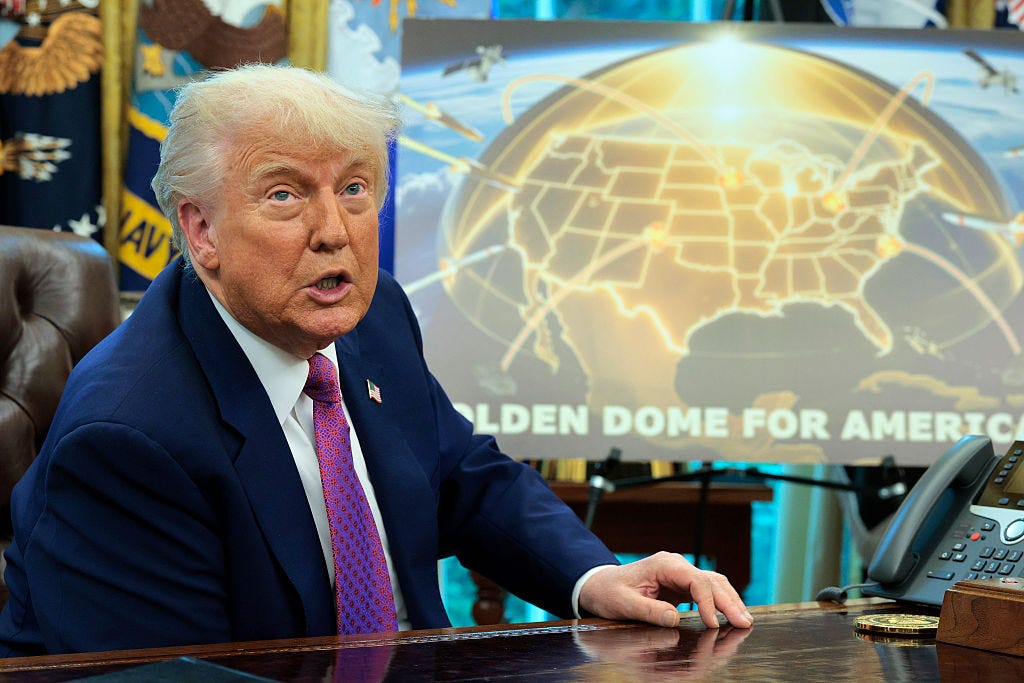
While there is no money for childcare, Trump’s defense budget allocates at least $17.5 billion to the “Golden Dome” — a space-based missile defense system. This is in addition to $25 billion that was earmarked for the project last year.
When the Golden Dome was first announced by Trump in May 2025, he claimed the project would cost $175 billion and be operational before the end of his term. Already, the price tag has increased to $185 billion, and the Pentagon says it will not be operational until at least 2035. Both of those estimates are likely much too optimistic.
In September 2025, Todd Harrison of the American Enterprise Institute estimated that a system actually capable of neutralizing threats from all countries would cost $3.6 trillion. Among other limitations, a $185 billion system would not be effective against threats from China or Russia, which have thousands of missiles, Harrison argues. Bloomberg’s independent analysis found that an effective system would cost about $1.1 trillion. Senator Tim Sheehy (R-MT), a Trump supporter and the founder of the Golden Dome caucus, acknowledged that “[i]t will likely cost in the trillions if and when Golden Dome is completed.”
Some scientists believe that, no matter how much is spent, a space-based missile defense system will not be effective. A February 2025 paper by the American Physical Society (APS) found that to defend against just one North Korean missile would require “a constellation of at least 1600 interceptors.” To defend against 10 missiles fired simultaneously, the United States would need 40,000 space-based interceptors, about three times the number of active satellites currently in orbit.
Even if a mutli-trillion-dollar system with tens of thousands of interceptors could be deployed, it could still be defeated with relatively inexpensive countermeasures, like decoys. The White House seems to acknowledge that the missile defense system it is building will not actually defend the country against a missile attack. “The goal is to not create a ‘perfect’ defense, but to provide an increasingly effective shield,” the White House budget document states.
While the efficacy of the Golden Dome is uncertain at best, the project will undoubtedly be a windfall for key Trump political allies.
Elon Musk spent over $250 million supporting Trump in the 2024 election. His company SpaceX is expected to receive “$2 billion to develop satellites that can track missiles and aircraft“ for the Golden Dome. This is likely the first of many payments to SpaceX to build and deploy hundreds — or even thousands — of satellites that the Golden Dome requires. SpaceX is slated to go public later this year and much of its valuation is tied to its