|
 |
👋 Hi, this is Gergely with a subscriber-only issue of the Pragmatic Engineer Newsletter. In every issue, I cover challenges at Big Tech and startups through the lens of engineering managers and senior engineers. If you’ve been forwarded this email, you can subscribe here.
Cycles of disruption in the tech industry: with software pioneers Kent Beck & Martin Fowler
Parallels between technology shifts in the past decades and what we’re seeing with AI. Also: ways to avoid burnout when working with AI agents, TDD back in style, and more.
|

| |||||||||||||||


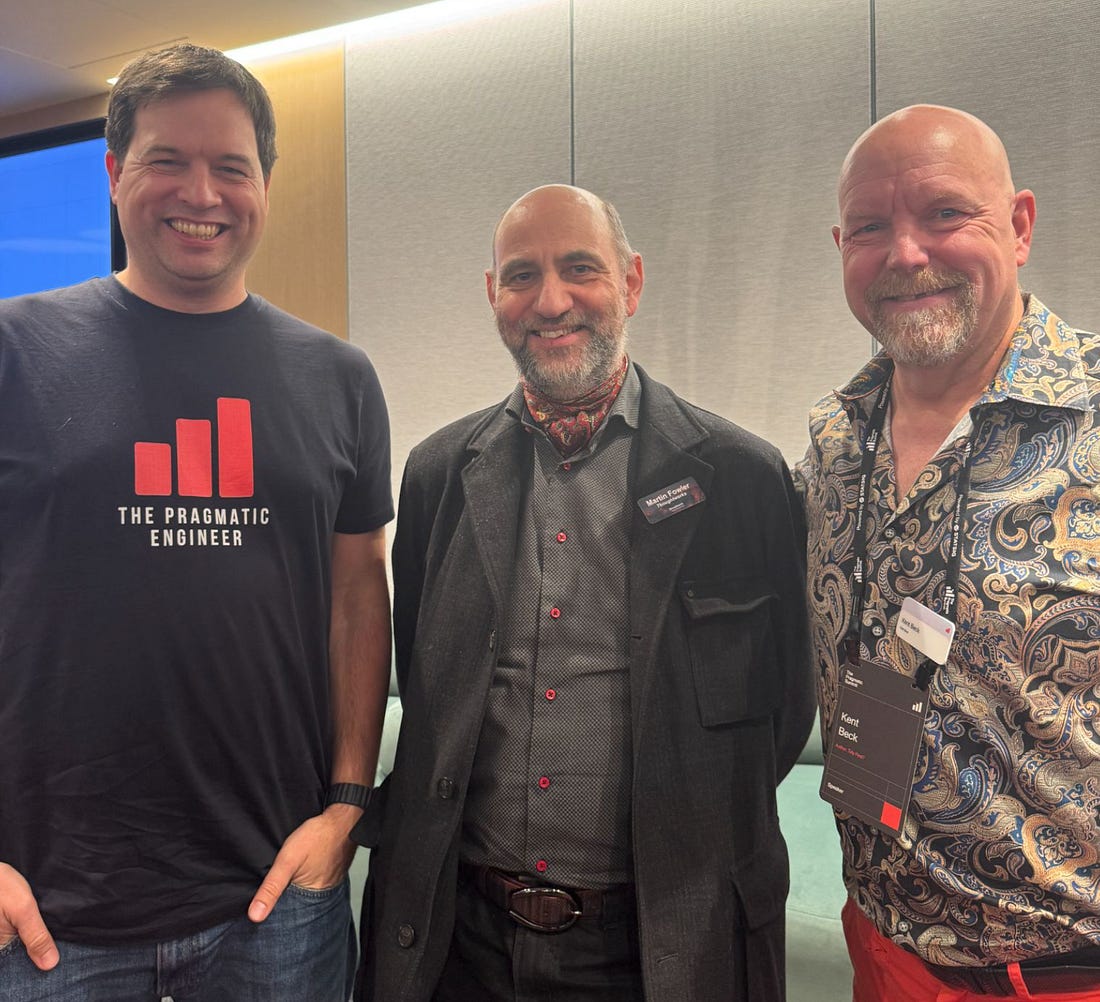
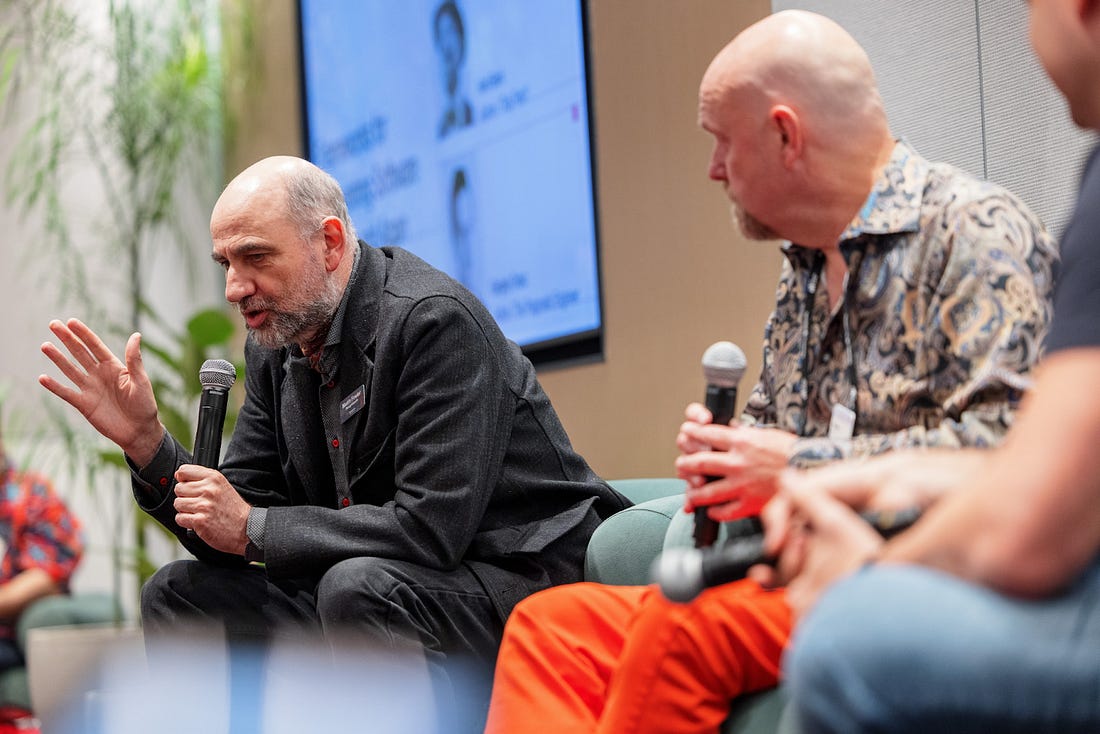
The recent Pragmatic Summit saw two legends of software development share a stage in what was one of the most popular sessions at our debut live event in San Francisco. In front of a packed audience, Martin Fowler and Kent Beck tackled a range of highly-relevant topics, with me hosting proceedings.
Martin and Kent go back decades, and Martin jokes that his career is “mostly about writing down Kent Beck’s ideas.” They first collaborated in the 1990s, and each has published influential books – ‘Extreme Programming Explained’ and ‘Test-Driven Development’ by Kent, and ‘Refactoring’ and ‘Patterns of Enterprise Application Architecture’ by Martin.
At the Pragmatic Summit, they each shared a wealth of hard-earned learnings and decades-worth of perspective, along with a healthy dose of skepticism. Needless to say, the conversation did not disappoint, and this article summarizes what we discussed in their own words. You can also check out the full recording.
We cover:
Technology shifts similar to AI. The arrival of the microprocessor, introduction of object-oriented languages, the Internet, and agile software development principles were all major changes – but one big difference was that it took time for these technologies to be adopted. Not so with AI.
Agile and AI similarities. With Agile, company incentives were often misaligned, “snake oil” vendors were everywhere, and a “mid pack” of developers who resisted the change saw their career prospects hit. These trends look likely to repeat with AI.
What’s happening inside companies. There’s some confusion – and even panic – at large companies, while AI tools don’t work nearly as well on large and complex codebases as on greenfield projects. Also, a “re-soloing” of software development is inbound.
Avoiding burnout with AI agents. Set and maintain boundaries, and pay attention. Martin suggests to catch when you start producing “negative value”: that’s when to take a break.
Unhealthy performance metrics. Companies are starting to measure things like frequency of pull requests – when they should be looking to quantify outcomes and results.
Lower quality on purpose? It seems every business is optimizing for speed with AI, but quality can get dropped. Also: building features is more obvious with AI, than investing in “futures.”
Test-Driven Development (TDD): tests no longer optional? Kent pioneered TDD, and today it’s more relevant than ever for working with AI.
Thriving in an AI-native industry. Focus on working with agents to express your craft, try to get more enjoyment in understanding your domain, and take on more ambitious work.
 |
Before we start, a programming note: this week, there will be no The Pulse on Thursday — I’ll be attending AI Engineer Europe in London on Thursday and Friday, including doing a fireside chat, and hosting one with Linear CTO Tuomas Artman.
1. Technology shifts similar to AI
Do you recall a tech change as similarly promising and unpredictable as AI?
Martin: “Nothing has hit with the magnitude of AI. This is a whole size different from anything we’ve faced before. On a smaller scale, we were very much involved in the growth of object oriented languages, which scared a lot of people. It didn’t scare us so much because we were part of it.
Looking back, the internet had a huge impact on us all, and of course, Agile software development, too. Agile had a very big impact on a lot of organizations: you could tell by how hard they resisted it. We had to persuade people of the importance of these technological changes; yes, even the internet! It may sound surprising but there were people who didn’t think it was important.
The thing about AI is that today there is no argument about how important it is.”
 |
Kent: “The other analogy I have is the introduction of the microprocessor. Before that, computers were big boxes; you couldn’t move them around. If you wanted another computer, you’d mortgage your house for it. Having a computer was a big deal.
I was a kid in Silicon Valley with my dad as a programmer when the Intel 4004 hit the market [in 1971]. We went: “Wait a minute, that chip is a computer? Oh my goodness!” The possibilities of computing suddenly expanded thanks to it. If you could figure out how to write software on this chip and figure out how to design hardware around this thing, you could suddenly do things you hadn’t even imagined.
And so I think part of AI is this expansion of imagination. I’m writing projects that are ridiculously ambitious: I’m working on a persistent