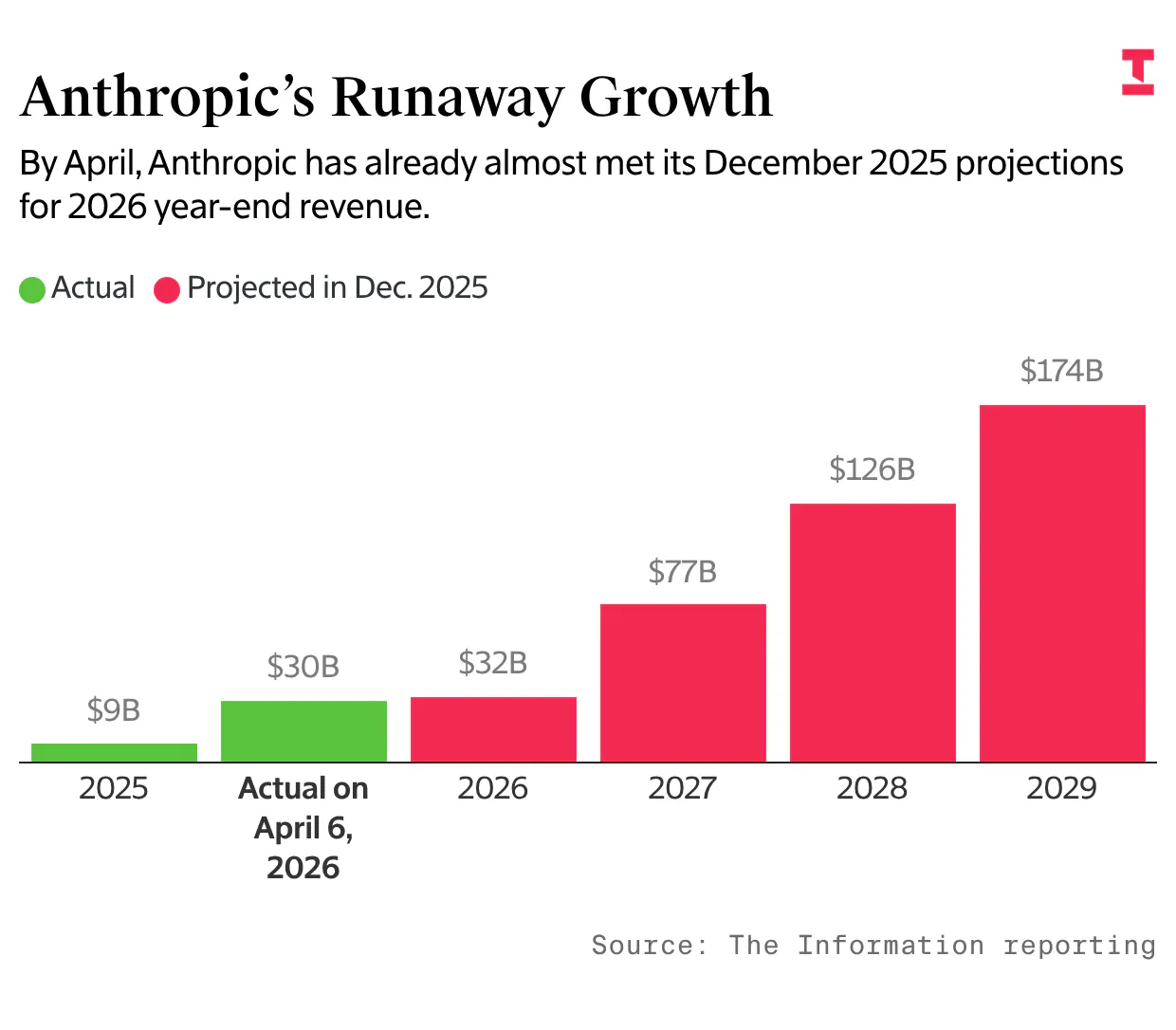
What could stop Anthropic now? The maker of the Claude chatbot said Monday it is generating more than $30 billion in annualized revenue, up from $19 billion about a month ago and more than triple its year-end level. At that pace, the company is on track to surpass its mid-December projection of $32 billion in annualized revenue by the end of this year—and could do so eight months early! In fact, Anthropic already beat its conservative year-end annualized revenue goal of $28 billion, according to the projections, which haven’t previously been reported. That impressive growth has already likely pushed it ahead of the older and larger OpenAI, whose annualized revenue topped $25 billion at the end of February. That’s likely even taking into consideration some differences in how the two AI leaders account for sales of their software through cloud partners, as I’ll get into more below.
Please join The Information at the New York Stock Exchange on Monday, April 27, to hear from top executives and investors on how the rapid buildout of AI is reshaping tech, finance, and capital markets. Learn more here.
Welcome back!
What could stop Anthropic now? The maker of the Claude chatbot said Monday it is generating more than $30 billion in annualized revenue, up from $19 billion about a month ago and more than triple its year-end level. At that pace, the company is on track to surpass its mid-December projection of $32 billion in annualized revenue by the end of this year—and could do so eight months early!
In fact, Anthropic already beat its conservative year-end annualized revenue goal of $28 billion, according to the projections, which haven’t previously been reported.
That impressive growth has already likely pushed it ahead of the older and larger OpenAI, whose annualized revenue topped $25 billion at the end of February. That’s likely even taking into consideration some differences in how the two AI leaders account for sales of their software through cloud partners, as I’ll get into more below.
Anthropic’s growth rate over the last four months means it could easily outstrip next year’s revenue targets as well, which are shown in our chart. Since December, its annualized revenue has jumped more than three times. If that growth rate continues, it will hit $100 billion in the next three months—and $2 trillion by year end!
Of course, there are many reasons $2 trillion in revenue—nearly three times Amazon’s revenue last year—is an unreasonable outcome.
For a start, Anthropic would need a lot more servers to run the AI customers are buying. It just inked a new deal with Broadcom and Google for multiple gigawatts of server capacity starting in 2027. About 3.5 gigawatts could potentially cover an additional $100 billion in revenue, according to newsletter writer Ben Thompson.
The company wants more compute capacity. Anthropic previously discussed securing at least 10 GW of capacity over the next several years. As a point of reference, Amazon Web Services brought 4 GW of capacity online last year.
The market for AI, too, is still nascent and couldn’t support $2 trillion in AI sales this year.
And lastly, growth will slow at some point. It’s likely that Anthropic is in the exponential phase of what’s known as the S-curve. In the last phase, growth slows with market saturation and increased competition.
The red-hot growth streak does hold enormous ramifications for the company, as well as its competitors and backers.
For one, Anthropic could potentially become cash flow positive earlier than it has projected. In December, it forecast generating cash in 2028, two years earlier than OpenAI’s projection. That’s a good story to tell if Anthropic eventually goes public, which could be as soon as the fourth quarter.
On the other hand, the need for expensive compute could drive up inference costs, the expenses of running AI, cutting into cash flow and margins. Already, Anthropic’s gross margins last year were 10 percentage points lower than it had previously expected as revenue growth surged and inference costs spiked.
The company may try to strike compute deals and find ways to make inference more efficient to offset these growing pains.
And Anthropic’s performance will put more pressure on OpenAI to speed up its own revenue growth. OpenAI, under senior executive Fidji Simo, has been slashing cash-burning projects like video app Sora as it tries to focus on revenue-generating projects and business customers, which are Anthropic’s bread and butter.
Some defenders of OpenAI have pointed out that OpenAI’s revenue would look bigger if it followed the same accounting treatment for revenue it gets from selling AI through partners such as Microsoft and Amazon as Anthropic does.
As I explained in this Dealmaker, OpenAI counts 20% of the sales of its models through Microsoft Azure as revenue.
Anthropic, in contrast, counts all of the Claude sales made through Amazon Web Services, Microsoft and Google as revenue. The difference stems from OpenAI’s longstanding relationship with Microsoft, which has exclusive rights to use OpenAI’s intellectual property and controls the Azure OpenAI service.
Still, the differences in accounting treatment wouldn’t narrow the revenue gap by much. If OpenAI structured its cloud partnership with Microsoft the same way Anthropic does with Amazon, Microsoft and Google—and accounted for sales through the cloud providers the same way—its annualized revenue would be higher by the low billions of dollars, according to a person with knowledge of OpenAI’s finances.
Today on TITV
Anthropic’s Revenue Surge, Meta Employees’ ‘Tokenmaxxing’
Start your day withApplied AI, the newsletter from The Information that uncovers how leading businesses are leveraging AI to automate tasks across the board.Subscribe nowfor free to get it delivered straight to your inbox twice a week.
Join The Information’s Kevin McLaughlin and Laura Bratton as they discuss the future of software businesses with Evan Skorpen, an investor at Lead Edge Capital, and Nimesh Mehta, CISO of National Life Group.
Join The Information at the New York Stock Exchange on Monday, April 27, to hear from top executives and investors on how the rapid buildout of AI is reshaping tech, finance, and capital markets
Save the date for The Information’s annual AI Agenda Live in San Francisco, where top AI researchers, founders, investors and executives come together for a day of conversations about the breakthroughs and applications shaping the future of AI.