|
 |
No corporate overlords. No false equivalencies. No BS.
Upgrade to paid to support independent accountability journalism.


 |
For weeks, President Trump has threatened to destroy civilian infrastructure in Iran as retribution for the Iranian government’s refusal to open the Strait of Hormuz. On March 21, Trump posted the following to Truth Social:
If Iran doesn’t FULLY OPEN, WITHOUT THREAT, the Strait of Hormuz, within 48 HOURS from this exact point in time, the United States of America will hit and obliterate their various POWER PLANTS, STARTING WITH THE BIGGEST ONE FIRST!
That deadline, and subsequent deadlines set by Trump, have been pushed back. But Trump has continued to make similar threats. On March 30, for example, Trump threatened to end the war by “blowing up and completely obliterating all of their Electric Generating Plants, Oil Wells… and possibly all desalinization plants!”
The targeting of civilian infrastructure is a war crime. The Geneva Conventions prohibit attacks on civilian targets and “acts or threats of violence the primary purpose of which is to spread terror among the civilian population.” It would also violate a domestic law, the War Crimes Act.
Trump could argue that the power plants are essential for the Iranian military, but he hasn’t bothered. Instead, he has explicitly stated he is “not worried“ about whether he commits war crimes.
If there were any doubts about Trump’s intentions, he removed them on Tuesday morning, when he posted that, unless Iran opens the Strait of Hormuz by 8 p.m., “A whole civilization will die tonight, never to be brought back again.”
Trump’s threats have appalled even some of his strongest allies. “I think it would be a huge mistake. I mean, he loses me if he attacks civilian targets,” Senator Ron Johnson (R-WI) told the Wall Street Journal. “Whatever we do has to be within the laws of warfare.”
As the 8 p.m. deadline approached, Trump announced that he “agreed to suspend the bombing and attack of Iran for a period of two weeks.” Crucially, Trump has not renounced his plans to attack civilian targets. If an agreement to end the war is not reached over the next two weeks, it will be back on the table.
Trump appears confident he will never be held accountable for war crimes, and, as the president, he is probably right. The same cannot be said for members of the military who follow Trump’s orders to strike civilian targets.
Members of the military have an obligation to refuse illegal orders
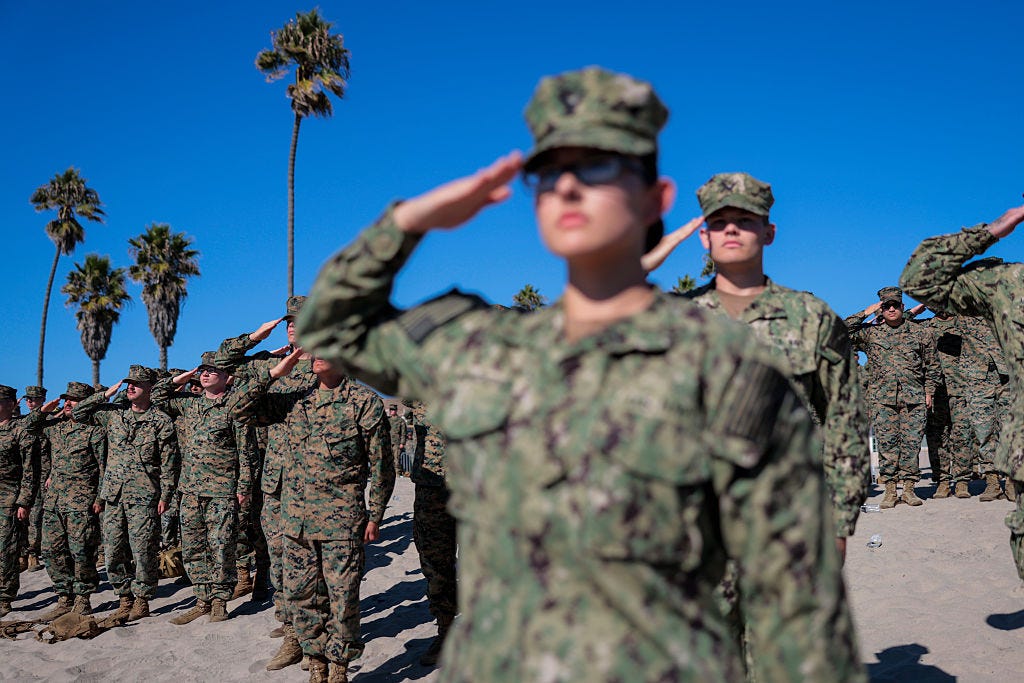
The Uniform Code of Military Justice states that it is a crime for a member of the armed forces to violate or fail to obey “any lawful general order or regulation” (emphasis added). According to the Manual for Courts-Martial, an order is lawful “unless it is contrary to the Constitution, the laws of the United States, or lawful superior orders.” An order to destroy civilian targets — or kill a civilization — clearly fails this test. The Military Task Force of the National Lawyers Guild explains that “members of the military have the right, and in some cases have the duty, to refuse illegal orders.”
In March 1968, during the Vietnam War, members of the military killed hundreds of civilians in an incident known as the My Lai massacre. In a subsequent court-martial, Lt. William Calley argued that he was simply following orders from superior officers. Calley was convicted, and the U.S. Court of Military Appeals found that conformity with an illegal order is not a valid legal defense.
Therefore, any members of the military who help destroy power plants or assist Trump in killing the entire Iranian civilization could be liable for war crimes. In an appearance on PBS News, retired Lt. Col. Rachel VanLandingham argued that Trump is “threatening to make our military engage in war crimes and therefore stain their honor and their soul and come back with moral injury.”
In November, Senator Mark Kelly (D-AZ), a retired Navy captain, appeared in a video with five other members of Congress. The video asserted: “Our laws are clear. You can refuse illegal orders.” Trump claimed that the video was “seditious behavior” that was “punishable by death.” The Pentagon announced that it was investigating Kelly for possible violation of military law. Kelly responded by suing Secretary of War Pete Hegseth.
The DOJ also launched an investigation and sought to indict Kelly and the other members. But the information in the video was accurate. As a result, a grand jury unanimously rejected the DOJ’s indictment.
A federal judge also ruled in Kelly’s favor in his lawsuit against Hegseth, finding the actions against Kelly constituted unconstitutional retaliation.
 |