|
 |



Well, that was all pretty dumb, wasn’t it? Happy Wednesday.
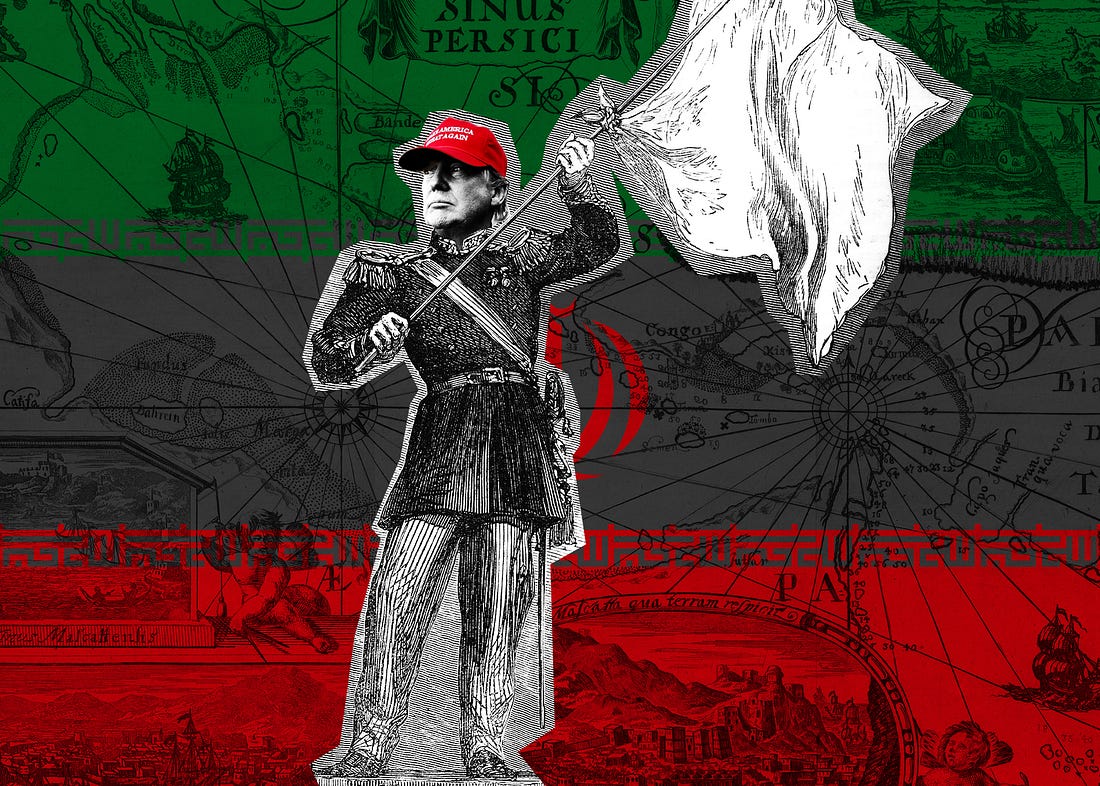 |
Trump Surrenders
by William Kristol
I’m old enough to remember when President Trump assured us, “There will be no deal with Iran except UNCONDITIONAL SURRENDER!”
That was a month ago.
Since then, Trump has bombed and blustered and caused all manner of damage to Iran, to its neighbors, to the United States, and to the world. But Iran hasn’t unconditionally surrendered. It hasn’t even conditionally surrendered. It’s agreed to a ceasefire followed by negotiations. These negotiations will be based not on Iranian surrender but, as Trump said last night, on a ten-point proposal from Iran that Trump believes “is a workable basis on which to negotiate.”
So we’re off to negotiations. Trump and the Iranian regime are making wildly contrasting claims and promises about what has been or will be agreed to. For now, as Gregg Carlstrom, Middle East correspondent of the Economist, put it:
So if you’re keeping score at home, the ceasefire includes Lebanon but also doesn’t include Lebanon, America has agreed to all of Iran’s demands and Iran has agreed to all of America’s demands, America will recognize Iran’s right to enrichment and also insist on zero enrichment, Hormuz is completely open but also Hormuz is subject to unclear limitations.
Oil market researcher Rory Johnston wittily called this “Schrödinger’s ceasefire.”
But the fog of ceasefire doesn’t mean that we don’t know anything. In fact, we know quite a lot already.
We know that the Iranian regime remains in place. The mullahs and the IRGC remain in control of Iran.
We know that the Iranian regime still has its enriched uranium (even if they can’t get to a lot of it right now). And we know that while its military capabilities have been much degraded, it still has functional missile and drone capabilities. We know there’s no reason not to expect Russia and China to be willing to rearm Iran.
We know that primary and secondary sanctions on Iran seem likely to be relaxed or even lifted.
We know that at least for now the Strait of Hormuz will be reopened. But it’s unclear whether it will remain an international waterway, as it was before, or whether Iran will be able to charge fees or tolls for passage. And we know that the fact that the Iranian regime was able to close the waterway, cause significant damage to the global economy, and live to boast about it, can’t be unseen. Whatever promises are now made, Iran will retain leverage with respect to the strait.
We know more generally that Trump’s war has further shaken any confidence our allies might still have in us. It will be seen as confirmation that Trump’s United States of America has become just another rogue nation in the international arena, if a less disciplined and cunning one than Putin’s Russia or Xi’s China. We know that the old international order with the United States as its anchor is gone.
What we know mocks Trump’s claim in an interview with AFP last night that the United States “won a total and complete victory. One hundred percent. No question about it.”
What we know tends to support the judgment by the distinguished military analyst, Phillips O’Brien, that “It’s a total fold by Trump. . . . What a waste all this was.”
And we know, as Jonathan V. Last put it on last night’s Bulwark livestream, that “This entire thing was avoidable and predictable. Donald Trump made America walk into the diner to eat the shit sandwich.”
The fact that this a shit sandwich doesn’t mean that one shouldn’t welcome this ceasefire. A ceasefire is better than war crimes. A deal to stop the fighting will be better than more death and destruction and economic damage. But the whole episode is a defeat for the United States, and for Donald Trump.
At 12:01 this morning, Trump tried to make the best of it all with a seven-exclamation-point post:
A big day for World Peace! Iran wants it to happen, they’ve had enough! Likewise, so has everyone else! The United States of America will be helping with the traffic buildup in the Strait of Hormuz. There will be lots of positive action! Big money will be made. Iran can start the reconstruction process. We’ll be loading up with supplies of all kinds, and just ‘hangin’ around’ in order to make sure that everything goes well. I feel confident that it will. Just like we are experiencing in the U.S., this could be the Golden Age of the Middle East!!! President DONALD J. TRUMP
I suppose “big money” may be made from this war and its aftermath by the Trump family. But for the United States of America, Trump’s war has been a defeat and a warning.
Recovering from this defeat will be a long-term challenge. All we can do in the short term is prevent further acts of gratuitous damage to our country and the world. The public can punish Trump’s Republican party this fall. Democrats can try to check Trump through the legislative and appropriations processes.
But the warning is this: thirty-three more months of an increasingly reckless and unhinged Trump in control of the executive branch of the United States poses too great a risk. The Founders set up a mechanism to deal with such an unfortunate eventuality in the presidency: impeachment, conviction, and removal from office. So Congress should heed the words of the young prince Guiderius in Shakespeare’s Cymbeline: “Come on then, and remove him.”