| |||
| |||
I'm cross posting this piece I wrote, one of my monthly columns for Cafe, because I think it will be of special interest to Civil Discourse readers. In 2011, Alabama passed an anti-immigrant law, that I successfully challenged in court as the then-U.S. attorney. A major part of what was offensive in that law was its effort to keep children, both American citizens and migrants without legal immigration status, from getting a K-12 education. That right is firmly established by longstanding Supreme Court precedent and we won. Now, conservatives are trying to come for that law again and it's important that we be aware of what's happening. |

The Immigration Crackdown is Coming for Public Education
New state laws seek to overturn a 40-year-old precedent
|
| |||||||||||||||


 |
There is something especially ugly about going after children, denying them a basic education, which cuts off their path to life in a way that can’t be restored later on in their lives. But that’s what Republicans want to do.
The legal arguments aren’t complicated—the Supreme Court has plainly ruled that children, regardless of immigration status, are entitled to a K-12 education. This latest incarnation of anti-immigrant venom is defenseless. Kids don’t choose where they’re born. They don’t decide how they arrive. They don’t control their parents’ immigration status. And yet, in 2026, there is a coordinated political effort underway to deny them one of the most basic building blocks of participation in American life: a public education.
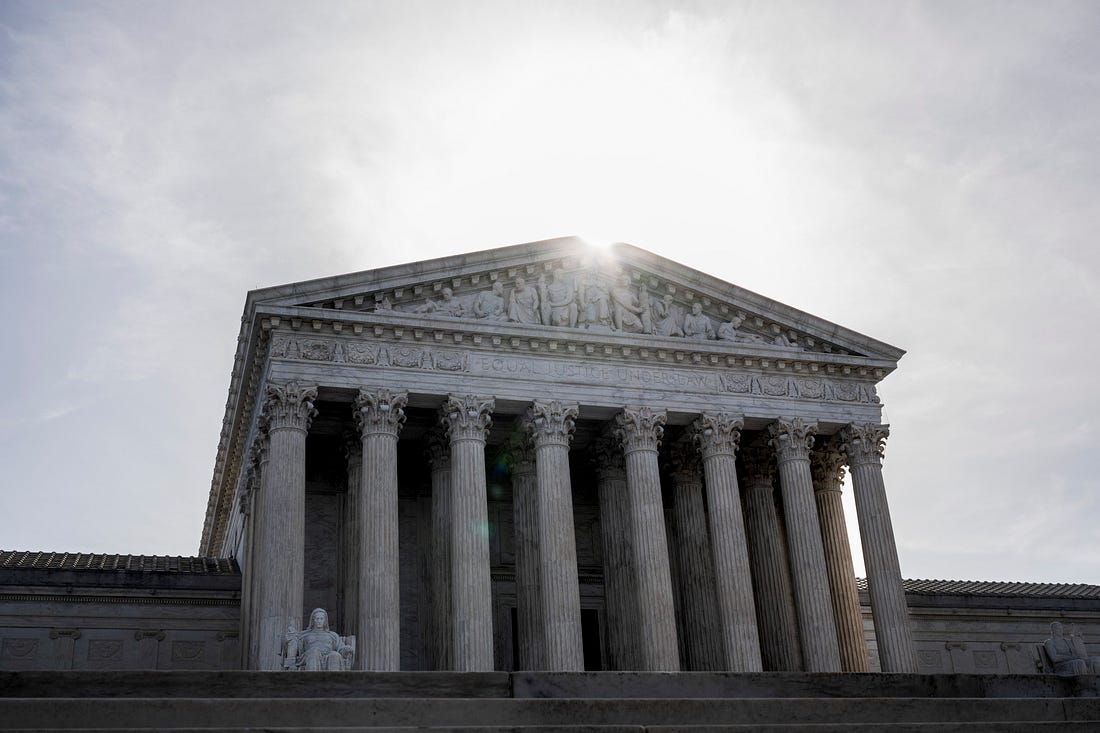
That effort runs straight through a 1982 Supreme Court case, Plyler v. Doe.
In Plyler, the Court ruled 5–4 that states cannot deny undocumented children access to free public K–12 education. The decision is grounded in the Equal Protection Clause of the Fourteenth Amendment. It recognized that education is not just another government benefit. It is foundational. Denying it would impose a lifetime of harm, not just on the child, but on society at large. It would create a permanent underclass of people who are locked out of education and therefore less able to participate in civic life, less able to support themselves, and more likely to live at the margins. Nothing about that reasoning has become less true over time. If anything, it has become more urgent.
Let’s dismiss one of the arguments against Plyler at the outset. This is not about Americans funding education for “illegal immigrants.” A recent study documented that in 2022, undocumented immigrants contributed almost $100 billion to federal, state, and local tax revenues, paying property taxes, sales taxes, and federal/state payroll taxes. The study concluded that, “Despite those payroll taxes funding Medicare, Social Security, and Unemployment Insurance, undocumented immigrants are not eligible to enroll in and receive regular benefits from these social programs.”
As for the law, it has been settled for over four decades. Schools do not ask about immigration status at enrollment. Children show up, sit in classrooms, learn to read and write and think, and become part of the civic fabric of America, ready to make their contribution to the world.
Alabama tried an end run around Plyer in 2011 when it passed HB56 and included a requirement that parents’ immigration status be revealed on a child’s school enrollment forms. In U.S. v. Alabama, the 11th Circuit confirmed that the law was designed to circumvent Plyler v. Doe, leading to a “chilling effect” on the enrollment of immigrant children, including American citizen children born to undocumented parents. The court affirmed immigrant children’s right to go to school and declined to punish their parents for exercising that constitutional right. The Supreme Court declined to rehear the case.
Now, that stability is under deliberate, strategic attack.
Since 2025, at least half a dozen states have introduced legislation designed to provoke a challenge to Plyler. Tennessee’s House has already passed a bill requiring schools to check immigration status, and there is ongoing maneuvering to make it state law as part of a school voucher measure, setting up a direct challenge to Plyler. Other states—Idaho, Ohio, Oklahoma—are moving in the same direction. The Heritage Foundation is openly advocating for states to pass laws contrary to Plyler with the explicit goal of generating a lawsuit that could reach the Supreme Court and overturn yet another longstanding, well-established precedent.
Let’s be clear about what that means: Republicans are openly arguing that children—living in this country, growing up in our communities—should be denied access to school. There is no way to soften that. It is both legally indefensible and morally reprehensible.
The legal case for preserving Plyler is straightforward. The moral case is even clearer.
An estimated 600,000 to 850,000 undocumented children are enrolled in K-12 education in the United States. They are not abstractions. They are kids sitting in classrooms next to American citizens, learning the lessons that will permit them to contribute to whatever society they are a part of as adults. Forcibly removing their access to education doesn’t just harm them individually, it leaves entire communities worse off.
We are a country that invests in the next generation without asking whether they “deserve” it based on circumstances beyond their control. Public education is one of the purest expressions of that principle. The argument against Plyler reduces children to line items on a budget, and we would do well to remember that budgets are moral documents; they reveal who we are as a society. We’ve already shut down the argument that Americans shouldn’t fund education for people here without legal status. But even if that argument held water, which it doesn’t, it misses the point.
Education is not a zero-sum game. Every time we close the door on a child, we are potentially closing the door on innovation, on creativity, on contributions we cannot yet imagine. The next scientist, teacher, entrepreneur, or writer does not come with a label indicating their immigration status at birth. When we deny education, we are not protecting America. We are diminishing it.
The challenge to Plyler is particularly dangerous given the ideological configuration of the current Supreme Court. Plyler was a 5–4 decision. That margin matters. This Court has shown a willingness to revisit—and overturn—longstanding precedents. After Dobbs, scholars across the ideological spectrum have warned that decisions like Plyler could be vulnerable.
And the groundwork is being laid intentionally. This is not an organic legal evolution. It is a coordinated strategy: pass laws that conflict with Plyler, trigger lawsuits, and present the Court with an opportunity to reconsider the case. The goal is not to refine the law. It is to dismantle it.
We have seen this playbook before.
The attack on Plyler is not really about immigration policy. Reasonable people can disagree about border enforcement, asylum systems, and pathways to citizenship. Those are complex questions. But denying children access to school is not a complex question. It is a choice, a bad one. It is a choice to embrace cruelty as a policy tool. It is a choice to ignore both constitutional principles and lived experience. It is a choice to move further away from American ideals built on the melting pot of our society.
There is a reason Plyler has endured for 44 years. It reflects a baseline commitment that most Americans, regardless of party, have historically shared: that children should not be punished for the circumstances of their birth, and that education is too important to be used as a weapon. Walking away from that commitment would not just overturn a precedent. It would mark a profound shift in who we are willing to be. Once you decide that some children do not deserve to learn, it becomes easier—far too easy—to decide that other rights, for other people, are negotiable too.
|