|
 |
Hi, y’all. Welcome back to The Opposition. Not so long ago, one of the major issues in American politics were the pro-Palestinian student protests that disrupted college campuses across the country. The images of students camping out on quads and taking over school buildings became so prominent that President Joe Biden was forced to address it in a White House speech in the spring of 2024. I’ve written before in this newsletter about how the anti-Trump 2.0 protests look different from those of Trump 1.0. But as 2026 has unfolded—from the killings of Renée Good and Alex Pretti, to the war in Iran and Trump’s threats to commit genocide—I’ve been curious about what happened to all that campus activism. That’s the subject of today’s newsletter.
If you’re not already a Bulwark+ member, please consider signing up. Not only will you get full access to all our locked content, but you’ll be joining a community that shares your concerns about the future of democracy. Give it a try:
–Lauren
The Campus Protest Culture That Targeted Biden Goes Silent for Trump
Figuring out why anti-war activism seems so subdued.
|

| ||||||||||||


|

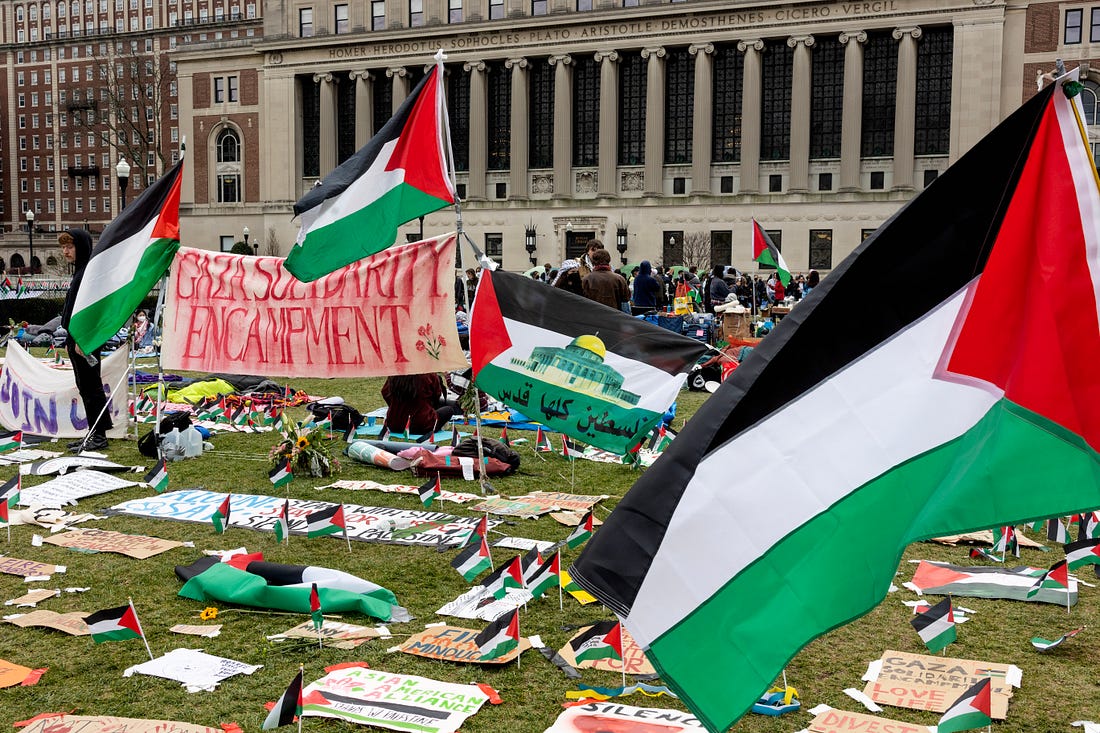 |
WHEN HAMAS ATTACKED ISRAEL on October 7, 2023, Vice President Kamala Harris was a few weeks into a tour of college campuses to promote the Biden administration’s goals and accomplishments. In the days that followed, as Israel began bombing Gaza—attacking not only targets that were obviously Hamas-related but also schools, hospitals, refugee camps, and other civilian sites—the vice president’s team became keenly aware that many young Americans were growing deeply uneasy with the White House’s support of Israel. Harris’s team even began preparing for the possibility of campus protests.
While Harris made it through that tour without any major hiccups, it wasn’t long before student protests were shutting down campuses across the nation with demands that universities divest from Israel and calls for the White House to take a different approach to the conflict. And the protest movement wasn’t confined to colleges: At stops around the country, President Joe Biden was often confronted by demonstrators calling for a ceasefire and chanting “Genocide Joe!”
“In the White House, this was certainly a communications challenge,” said Herbie Ziskend, who served as deputy communications director under Biden. “No matter where we went and whatever the topic of conversation was, protests on this conflict were ubiquitous.”
So as President Donald Trump’s unauthorized war on Iran with Israel entered into its second month, some Democratic officials were looking around and wondering: Where are the anti-war protests this time around? And why are college campuses so quiet? While President Donald Trump announced a temporary ceasefire on Tuesday evening, he did so only after threatening to eliminate a “whole civilization” and destroy bridges and power plants—which are war crimes and, by definition, genocide. Hundreds of civilians have been killed. Hospitals have been attacked. An entire elementary school was wiped out—killing more than a hundred children and dozens of adults—after the United States struck it with a Tomahawk missile.
However understandable the downward trend in campus protests might be, the dynamic has become a point of frustration for some parts of the Democratic coalition who feel that anti-war and pro-Palestinian activists are tougher on Democratic officials than on Republicans. They note that even though Harris is out of office, she still gets interrupted at public events by pro-Palestinian protesters.
“Every single speech that Kamala Harris gave in those 107 days, they found a way to protest her and call her a proponent of genocide. But they never did that throughout the campaign for Donald Trump, and then they never did it in 2025 when he was giving Benjamin Netanyahu a blank check to annihilate Gaza,” said a former Harris campaign official. “Now, when Donald Trump is threatening to do the thing that they accused Kamala Harris and Joe Biden of being complicit of, they’re silent.”
WHEN I ASKED ACTIVISTS involved in the pro-Palestinian movement about whether there had been a change in protest culture, they pushed back against the suggestion that their coalition wasn’t respo