
|
The Medium is for executives, investors and creators navigating a market where the rules for owning and monetizing AI-native IP are fragmented, incomplete and unevenly developing.
Bollywood Is Running Hollywood's Forbidden Experiment
India is building the AI-native film industry Hollywood's lawyers, unions and insurers are spending every resource to prevent—and it is working at the box office.
| |||||||||||||||


[Author’s Note: This essay is free for all subscribers.]
Google has previously estimated that there will be 1.2 billion new users who gain access to the internet between 2022 and the end of 2026. Services like SpaceX’s Starlink and Taara—an Alphabet X Moonshot company that uses beams of light to deliver high-speed data links—are expanding internet access to rural areas globally, and particularly in India and Africa.
As I wrote last August, this generation will be “the first to access the internet via AI platforms like ChatGPT and Claude, and not via start pages like Google, Yahoo or web browsers.” Reuters recently reported one impact of this new generation’s emergence in India: Bollywood studios “deploying AI at a scale unseen elsewhere” and audiences willing to pay for their AI-generated and AI-edited content. Bollywood producers are iterating and shipping AI-produced content, and audience demand is absorbing the rapidly evolving supply.
India is an emerging AI media marketplace that is unburdened by the regulatory and economic constraints of the U.S. marketplace. It is also rapidly being reshaped by growing internet access. It offers an important market test of Hollywood’s fear and AI platforms’ hopes for the future of entertainment.
The 1.2 Billion
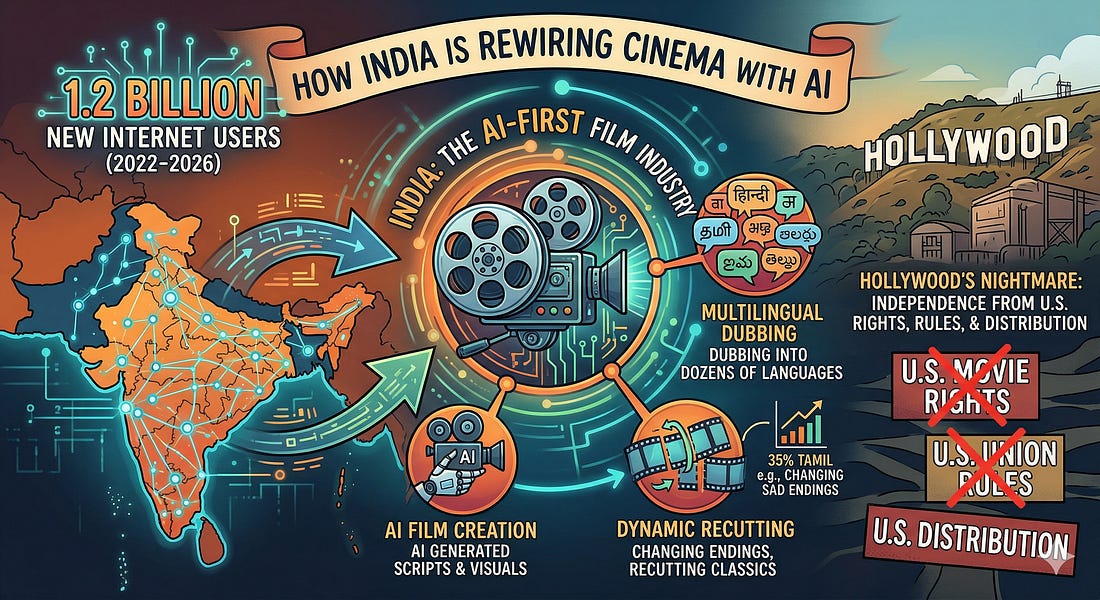 |
India now has 958 million Active Internet Users according to the Internet and Mobile Association of India (IAMAI). That reflects 8% year-over-year growth. 548 million active internet users in rural areas account for over 57% of total users. Those are growing at nearly four times the pace of urban India. 38% of India’s population—nearly 579 million people—are not yet active internet users.
Reuters depicts this emerging generation of Indian consumers as having media diets evolving away from theatrical and shifting to streaming. This has resulted in production budgets being cut. Now they consume “full-fledged AI-generated films”, movies dubbed in numerous languages using AI and older titles recut with AI to revive ticket sales at lagging theaters.
AI dubbing is particularly powerful in India, which has 22 official languages and hundreds of dialects. The technology substantially reduces the cost of serving submarkets of languages and dialects, which in turn creates new demand across those submarkets.
Aggressive Supply Side
Reuters also depicts a supply side aggressive on both costs and technology to meet this changing demand. A Bollywood director told Reuters: “In India, cinema isn’t about art. It’s purely business, so studios are going to use it to make mythologicals. Our audience is a sucker for it.”
The business logic favoring mythology has echoes in the AI-generated Revolutionary War series titled “On This Day ... 1776” from Hollywood director Darren Aronofsky and his AI-focused venture Primordial Soup—sponsored by Google, Salesforce and Time, and distributed on YouTube. On the 250th birthday of The United States of America, its founding mythology has never been more important.
They are proving there is a business in cheap AI-driven productions of American history guided by Hollywood production talent and without Hollywood acting talent (although George Washington often looks like Sean Penn). “On This Day ... 1776” is an independent venture structured to avoid paying expensive actors and production guilds, distributed on YouTube to bypass theatrical and streamer gatekeeping and sponsored to avoid relying on direct-to-consumer spending or streaming economics. It routes around Hollywood market constraints that are weaker or nonexistent in Bollywood.
Reuters noted that PVR Inox, India's largest cinema chain, is a partner in the experiment, not a casualty of it—AI recuts are being deployed to revive ticket sales at lagging theaters, inside the same window Hollywood is watching collapse (in 2025, location intelligence provider Kalibrate estimates average visit volumes declined by 15% year over year across major movie theater chains).
Technology firms are meeting the moment: Nvidia recently told an audience at India’s AI film fest that it is working to slash computing costs so that anyone can “create something substantial without putting a lot of money” into production.
This is structural alignment. Traditional storytellers are increasingly relying on AI and the technology firms are eager to deliver the infrastructure to help them. No one is waiting on anyone else to make the first move. Every constraint that paralyses the U.S. media and entertainment industry is missing in India. There is no SAG-AFTRA equivalent forcing consent for digital replicas, no copyright cases against AI platforms in a slow appeal process, no DMCA architecture to litigate around and no insurer refusing to underwrite AI risk.
The system does not need valuable IP. The myths are Indian, the audience is Indian, the distributors are Indian, and the only U.S. asset in the chain is the compute and model layer that the production companies rent by the hour.
A Hollywood Nightmare in Bollywood
India is the AI-native media marketplace Hollywood is fighting to prevent. It is evolving this fast because the 1.2 billion are not being converted from a prior media diet. The demand side is AI-native from first contact.
Their first internet experience is an AI platform, their first filmed entertainment is AI-generated mythology in their own dialect and their expectations are being set by what Bollywood ships this quarter. Supply and demand are forming together to create a new world of entertainment consumption—the only missing ingredient is Prosumer and Creator AI-generated content (see below). Google, Microsoft and Nvidia “partnering with local filmmakers” suggests that will emerge next.
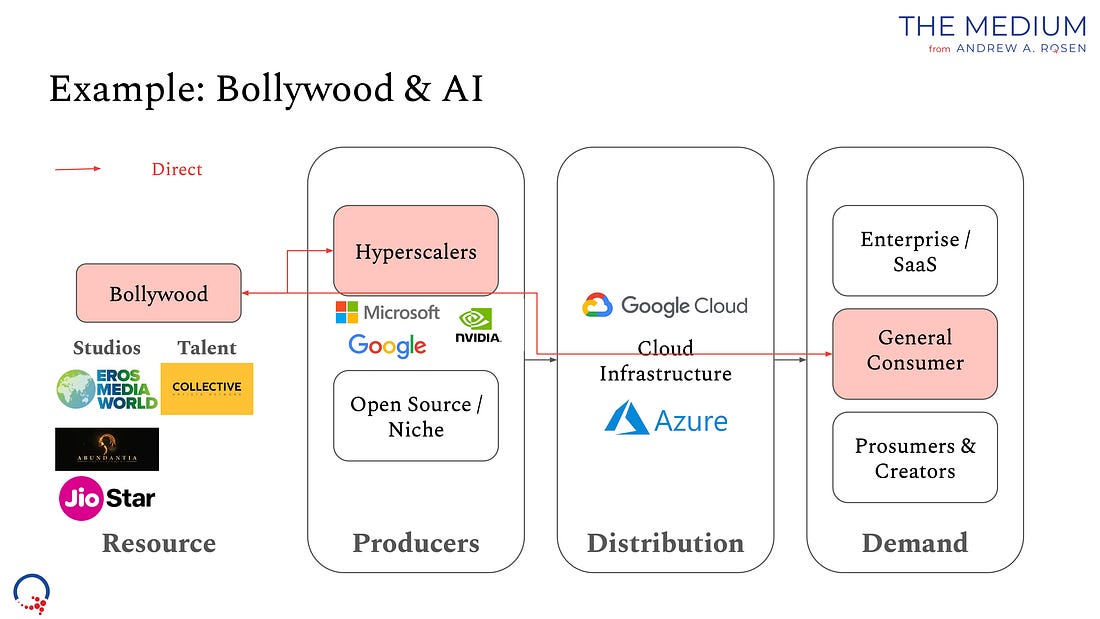 |
The Hollywood nightmare is not that audiences will embrace AI-generated content. The Indian audience already answered that. The nightmare is that India is proving that an AI-first ecosystem does not need valuable U.S. IP, does not need U.S. consent law and does not need U.S. distribution. All it needs is U.S. tech infrastructure and the storytelling takes care of itself.
Bollywood production companies are already seeing the upside at the box office. Eros Media World recut a 2013 hit movie “Raanjhanaa” over the lead actor’s public objection and sold 35% of available Tamil-language tickets in the release month. Hollywood talent agents would have killed the recut before it reached production.