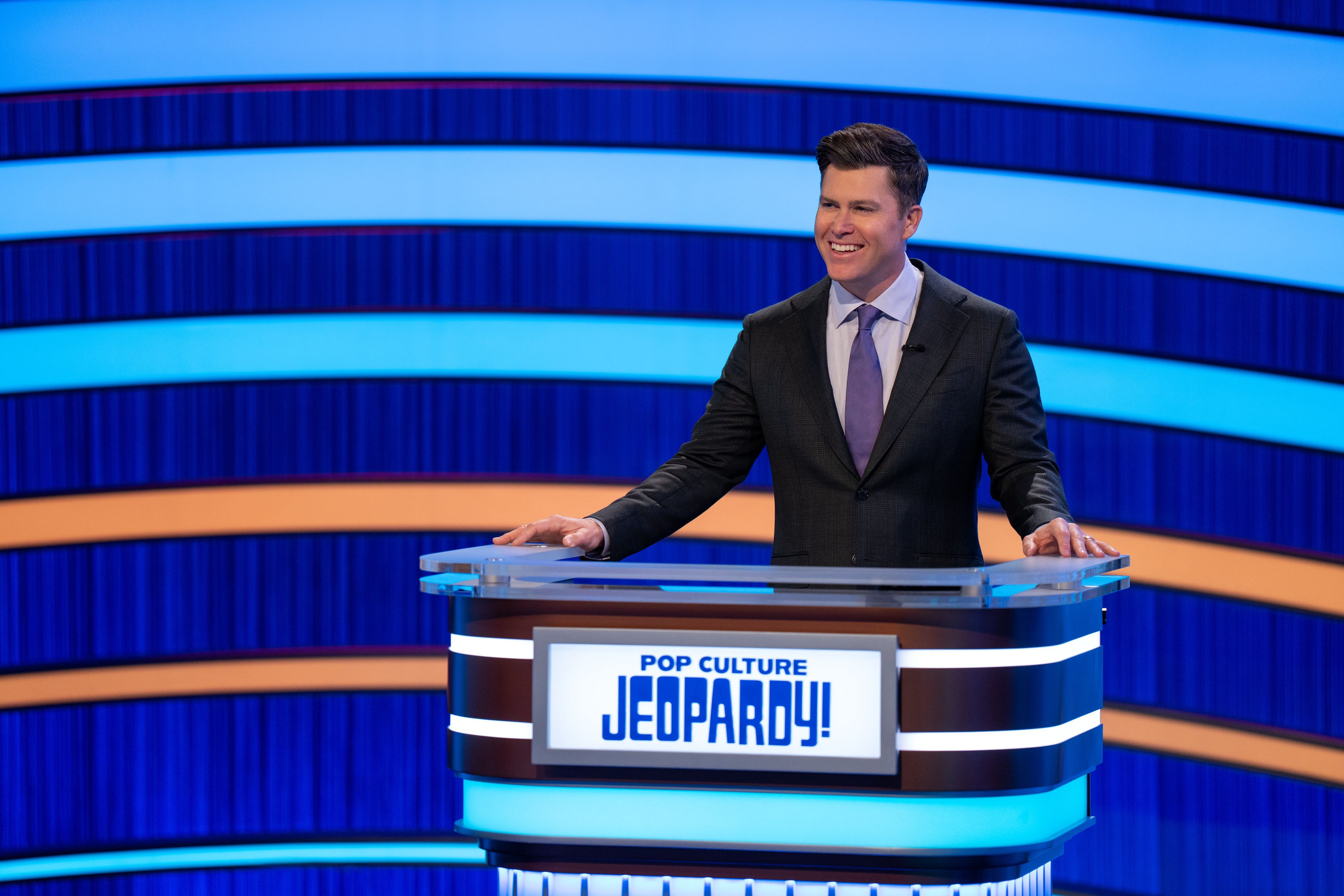
Happy Thursday, and welcome back to Buffering, where we’re dreading tonight’s second season finale of The Pitt, both because of whatever awful things the producers might have in store for Dr. Robby — and the fact it’ll be eight long months before we get a new episode of the show. This week, after some thoughts on the Disney layoffs and David Ellison in Briefering, we’ve got a look at why Netflix’s upcoming rollout of its Pop Culture Jeopardy! soft reboot is another sign of scheduling flexibility on the part of the streamer, as well as a report from Chris Lee dissecting the box office results for You, Me & Tuscany. Thanks for reading.
|
— Joe Adalian, West Coast editor
|
|
|
Subscribe now to get unlimited access to everything New York, including subscriber-only newsletters, exclusive perks, the New York app, and more. |
|
|
In this edition: Reed Hastings, Josh D’Amaro, Bob Iger, David Ellison, Colin Jost, Dan Levy, Catherine O’Hara, Laurie Metcalf, Halle Bailey, Regé-Jean Page, Christopher Nolan, Steven Spielberg, plus Pedro Pascal, Florence Pugh, Ben Stiller, Kristen Stewart, Don Cheadle, J.J. Abrams, Mark Ruffalo, Rose Byrne, Sandra Hüller, Taika Waititi, Tiffany Haddish, and everyone else who signed that letter. |
|
|
The co-founder of Netflix is leaving its board in June. The news broke right as we were about to send this newsletter. Expect deeper thoughts on what it means for the streamer (and Hollywood) next week. —Eric Vilas-Boas |
|
|
➽ Why Disney Fired 1,000 Employees This Week
|
A concept artist laid off under a mural he designed, a Marvel Comics exec let go after helping lead the company for two decades, and the unceremonious nuking of the home entertainment publicity team: These were among the thousand or so individual indignities visited upon the Walt Disney Company’s workforce this week. No layoff is easy, but new CEO Josh D’Amaro’s first bloodbath, which aims to “streamline our operations” per his leaked memo on the decision, does leave a fallout pattern that indicates the ways the winds are blowing at the company.
In cutting the home entertainment’s publicists, physical media could be an even lower priority going forward than it’s been in recent years. The move underlines D’Amaro’s emphasis on streaming, but the company has moved out of international physical media markets in recent years, killed its Disney Movie Club in 2024, and later that year announced a deal with Sony Pictures Home Entertainment to outsource disc production and distribution. Sources familiar with the layoff assure me discs will continue to be produced, but also worry that they won’t receive the kinds of promotional efforts that have made Disney’s releases successful in the past — a big loss for a company known for its beloved Vault releases and splashy steelbooks of Disney+ shows.
At Marvel, the superheroes are on the ropes, given that roughly 8 percent of the division was cut across various teams, per Deadline — a number that Disney disputes. However many were lost, the cuts reflect the precarious position the division is in right now, with the forthcoming, reportedly reshoot-laden Avengers: Doomsday due to drop (as of now) the same day as Christopher Nolan’s The Odyssey, following a string of slopfests and box-office disappointments from the studio. It’s hard to get excited for Robert Downey Jr.’s return to the franchise nearly 20 years after he was first cast for Iron Man, but Marvel, which lost employees across its comics department, film and TV production, and legal and finance, seems to need a win badly.
Other cuts include the EPK team, international publicity staff, and digital marketing staff all along the totem pole, including some key deputies to the C-suite, and the spectre of AI lingers over the entire affair, in part thanks to D’Amaro’s stated desire for a “technologically-enabled workforce” in his memo. In some ways, the re-org feels like a last gasp of the Bob Iger era; the former CEO fired over 7,000 employees after he re-took the job from Bob Chapek. But there could be another explanation. In a world where Disney must compete with the Netflixes, Googles, or Oracle-powered Warner Bros. Paramounts of the world, perhaps the Disney future that D’Amaro envisions looks more like a tech company than a family-friendly entertainment giant. It certainly fires like one. —E.V.B.
|
|
|
The Paramount and Warner Bros. merger started messy and hasn’t gotten any cleaner. More and more celebrities are signing on to an open letter that declares “unequivocal opposition” to the deal. In recent days, Pedro Pascal, Edward Norton, and Florence Pugh have all signed. They’re joined by Ben Stiller, Glenn Close, Jason Bateman, Kristen Stewart, Don Cheadle, J.J. Abrams, Mark Ruffalo, Rose Byrne, Sandra Hüller, Taika Waititi, and Tiffany Haddish. Even people who are known for work at Paramount are speaking up. South Park creator Trey Parker signed, as did Adam McKay, whose movie The Big Short was released by Paramount, and both Abbi Jacobson and Ilana Glazer, whose show Broad City aired on Comedy Central. “Our industry is already under severe strain, in large part due to prior waves of consolidation,” the letter states. —Jason P. Frank (Read the rest.)
|
|
|
➽ Could Ellison’s ‘30 Movies a Year’ Promise Even Be a ‘Minimum’?
|
That was Skydance boss David Ellison’s latest overture to the industry skeptical of his intentions at CinemaCon this week. He made a surprise appearance in Vegas and vowed that as of today, Paramount movies would get 45-day windows in theaters going forward and that there would be three-month windows for the films to be made available for purchase or rental on premium video on demand platforms. He also apologized for Flyboys. Now, as far as promotional stunts go? Not a bad one, Dave. But can Paramount actually release more than 30 movies theatrically — as in: give them a meaningful marketing push, place the right ones on Imax and other large-format screens, as well as keep them in theaters long enough for audiences to see them — in a 52-week period? Color me skeptical. —E.V.B.
|
|
|
Netflix’s Pop Culture Jeopardy! Is Going Daily |
Pop Culture Jeopardy! is moving from Prime Video to Netflix, but the spinoff of the iconic game show is not just changing platforms. When the Colin Jost–hosted series returns for its second season next month new episodes will roll out in a very un-Netflix way: daily.
The streamer that famously eschewed advertising or live sports — until it did not — has decided to drop one 25-minute episode of Pop Culture Jeopardy! every weekday for a full month, starting on Monday, May 11, and ending with the season-two finale on Friday, June 5. Per a Netflix source, this is believed to be the first time the streamer has used a daily, Monday-through-Friday cadence to release an original U.S. entertainment series. (It has come close with a couple of talk shows, including 2016’s thrice-weekly Chelsea and Everybody’s in L.A., John Mulaney’s six-episode limited series that ran for a week in 2024 as part of the platform’s semi-annual comedy festival.) Netflix announced it had picked up the rights to Pop Culture Jeopardy! this past fall.
While the idea of daily episodes is a new one for Netflix, the streamer long ago moved on from exclusively releasing all episodes of a season at once, particularly with reality shows. Love Is Blind, for example, has rolled out batches of new episodes over the course of three to four weeks, while earlier this year Star Search aired live episodes twice a week for a month. On the scripted side, Netflix now frequently splits up seasons of its biggest hits into two batches spaced a few weeks apart.
In the case of Pop Culture Jeopardy!, a source says, Netflix and producers Sony Pictures Television jointly discussed rollout options and ultimately decided that since fans of Jeopardy! are very comfortable with tuning in for daily episodes, it made sense to experiment with that sort of scheduling for season two. (For season one, Prime Video served up three episodes a week between December 2024 and March 2025.) While there is no plan to serve up more daily shows anytime soon, in success, the streamer might try it with other titles, the Netflix source said. There’s a definite upside in such a schedule: Daily shows — think Peacock’s Love Island — encourage subscribers to come back to a streaming service every day rather than just to binge specific hits. Netflix has tried to accomplish something similar with its recent expansion into podcasts, some of which drop new episodes multiple times a week.
Meanwhile, in addition to a new release pattern and platform, Pop Culture Jeopardy! is getting a slightly tweaked format in season two. The full-season bracket tournament is out; instead, the Netflix edition will feature traditional self-contained classic Jeopardy! shows for the first three weeks, during which each day’s champs will advance to the next episode, for a maximum run of five “regular season” games. Then, the top nine teams — based on total number of wins — will square off in a five-day tournament in week four to determine the grand champion.
Library episodes of Jeopardy! have been available on streamers off and on for years, but the 2024 debut of Pop Culture Jeopardy! marked the first time Sony had launched an original Jeopardy-branded series for the medium. Since then, the studio has struck a deal to stream next-day episodes of the mothership on Hulu and Peacock, while last month it debuted a special episode of the series made specifically for YouTube. As for Netflix, while it might not have tried its hand at daily episodes of a produced TV show before, it did briefly try out a daily trivia video game in 2022. That experiment, Trivia Quest, did not work out.
|
|
|
Photo: Giulia Parmigiani/Universal/Everett Collection |
The movies can be best understood as a business of hits. 2026’s reigning blockbusters Project Hail Mary and The Super Mario Galaxy Movie are doing their parts this weekend to keep multiplex turnstiles spinning while dominating box-office headlines, while financial flops (like Warner Bros.’ The Bride!) suck up the rest of Hollywood’s oxygen. More often than not, the vast middle ground of filmic offerings get overlooked en route to their final resting place on streaming. What, then, can we learn from the ramifications of a movie that does just well enough? One that does okay but not great. But not really … badly, either?
Over its opening three days in theaters, Universal’s escapist, Italy-set romcom You, Me & Tuscany became an exemplar in this category. Landing at No. 4 among new films in wide release behind Super Mario 2 ($69 million), Project Hail Mary ($24.5 million) and A24’s rage-bait-y romantic cringe comedy The Drama ($8.7 million), YM&T neither surpassed nor wildly undershot prerelease “tracking” estimates and scored a middling 70 percent on the Tomatometer. The While You Were Sleeping–inspired, Halle Bailey–Regé-Jean Page coup de foudre pulled in a thoroughly fine $8 million in North American theaters against an $18 million budget (with another $1.1 million coming in overseas). Which, in conjunction with its A- audience exit-polling score, means You, Me & Tuscany has a decent shot at hanging in over the coming weeks to turn into a sleeper hit. Or it could just as easily recede from theaters before hitting break-even, only to recoup its slim budget via PVOD fees — with no significant damage to Universal’s balance sheet in a ye |
|
|
|