| | In this edition: Nigeria’s opposition unites, South Africa’s nuclear ambitions, and the dangers of I͏ ͏ ͏ ͏ ͏ ͏ |
| |  | Africa |  |
| |
|
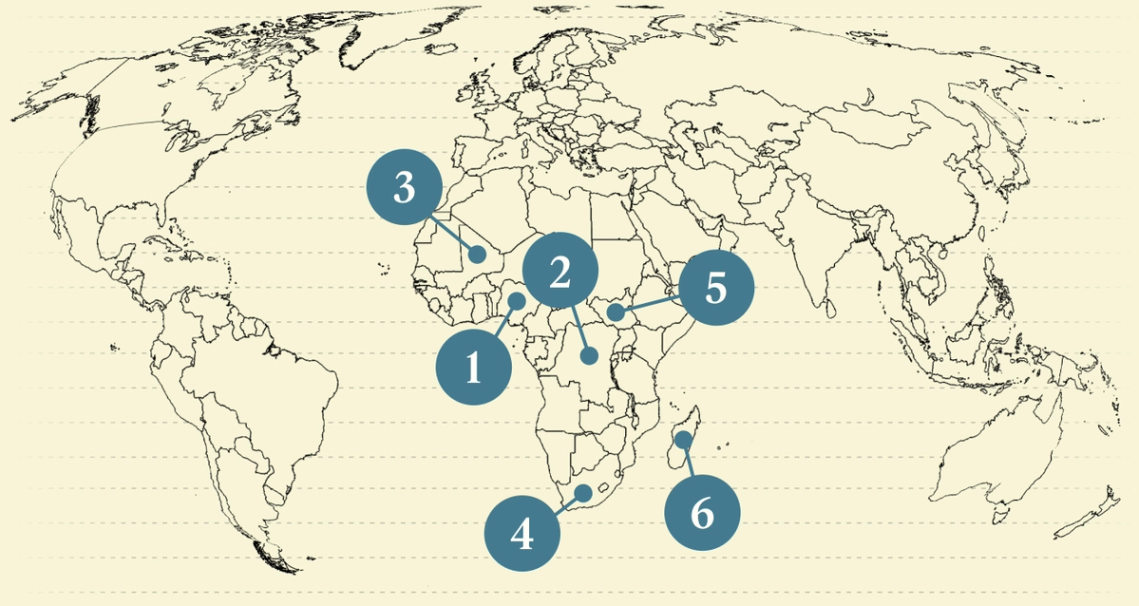 - Nigeria’s opposition unites
- Mines paramilitary unit plan
- Insecurity grows in Sahel
- S. Africa’s nuclear ambitions
- A digital wetlands atlas
- Iran war’s Africa fallout
 The Week Ahead, and a Kenyan runner makes history at the London Marathon. |
|
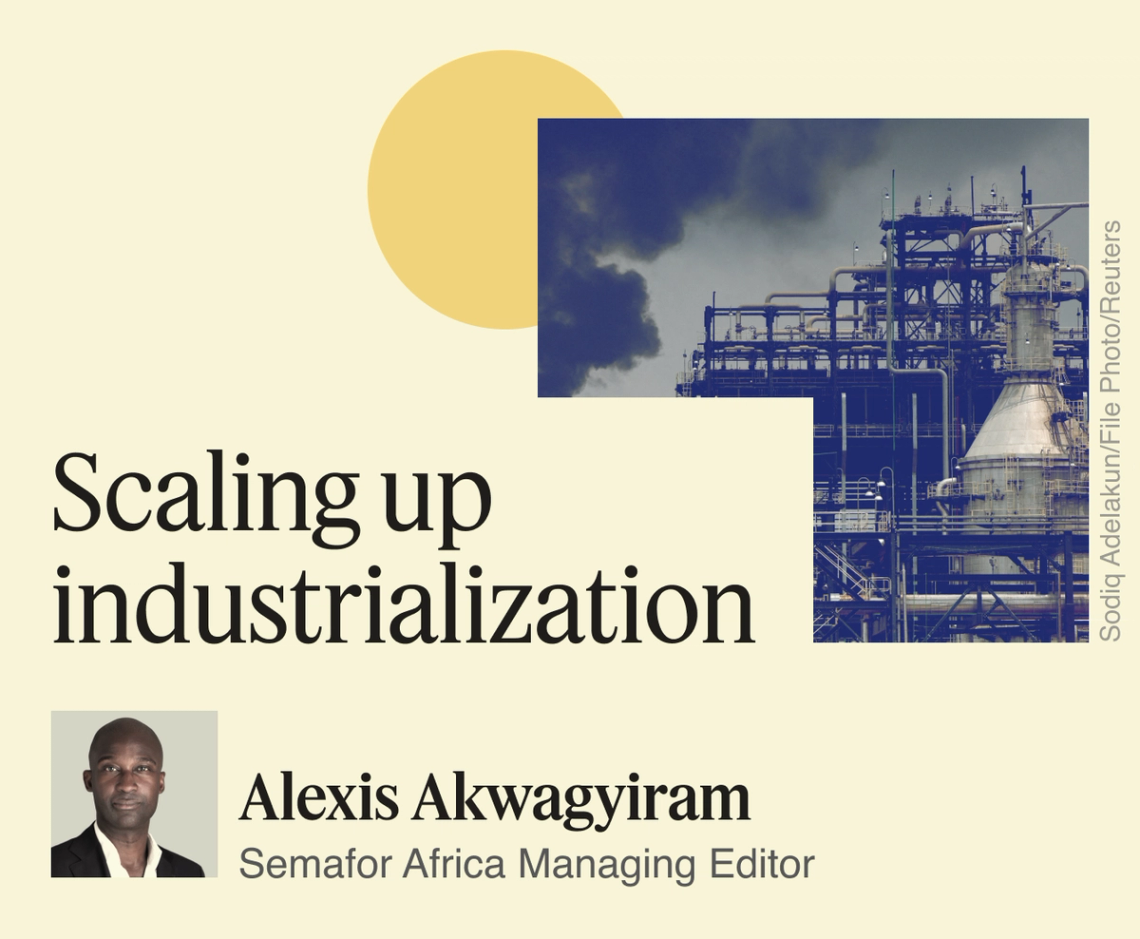 The Iran war has shown the power of industrialization — just look at the impact of Aliko Dangote’s refinery. The conflict has highlighted Africa’s reliance on fuel imports and the knock-on-effect of higher prices and currency pressure. Dangote’s plant, which has shown how local processing can reduce the impact of such global shocks, has led to him being courted by East Africa to build a similar plant in Tanzania. But the reality is that Africa’s richest man can’t single-handedly drive industrialization across the continent. A new report by the Africa Finance Corporation argues that efforts to develop infrastructure across the continent hinge on deploying existing capital to develop local processing of fuel, fertilizer, and metals, rather than raising additional funds. The multilateral lender, which hosted last week’s Nairobi event at which the plans for an East African mega refinery were announced, found capital held by African institutions rose to more than $2 trillion from over $1.6 trillion a year ago, partly driven by increased gold holdings in central bank reserves, which surged in value due to record prices. “The key issue isn’t the size of windfalls but whether they’re effectively utilized to mobilize domestic capital into infrastructural and industrial systems,” Fola Fagbule, AFC’s deputy director and head of financial advisory, told me. There are signs that governments are rolling out policies with this in mind: After it began producing oil two years ago, Senegal committed to capturing hydrocarbon revenues in sovereign wealth funds in order to develop infrastructure projects. And late last year, Kenya and DR Congo announced the creation of similar funds to capture proceeds from selling government stakes in public assets and mining revenues respectively. But the biggest bottlenecks that threaten scaling industrialization revolve around energy and political will. Stable power, which much of the continent still struggles to supply, is essential to drive industrialization. Converting economic headroom into the factories and power lines required for industrialization will also rely on governments committing to the pursuit of long-term projects with timelines that extend far beyond election cycles. Identifying Africa’s dormant capital is a great first step, but there’s a long way to go. |
|
Nigerian opposition to field joint candidate |
 Campaign posters of Atiku Abubakar and Peter Obi in 2019. Afolabi Sotunde/Reuters. Campaign posters of Atiku Abubakar and Peter Obi in 2019. Afolabi Sotunde/Reuters.Nigeria’s leading opposition politicians united in order to field one candidate to face President Bola Tinubu in January’s hotly contested general election. But, with only nine months until the poll in one of Africa’s biggest economies, it remains unclear who the main opposition candidate will be, or how and when they will be selected. Former Vice President Atiku Abubakar, who has been defeated in three elections, as well as Peter Obi, who rallied the youth vote in the most recent 2023 poll before ultimately falling short, agreed to the pact during a meeting in a town near Lagos over the weekend. The men, who came second and third in the last election and, between them, won an estimated 54% of the popular vote, are now members of the same African Democratic Congress political party, despite having run separately in the last poll. It was billed as a conference of all opposition parties but media reports suggested that Obi, who remains popular with young voters and in the southeast, could be enticed out of the pact to run on a distinct platform. — Alexander Onukwue |
|
DRC plans $100M mine security force |
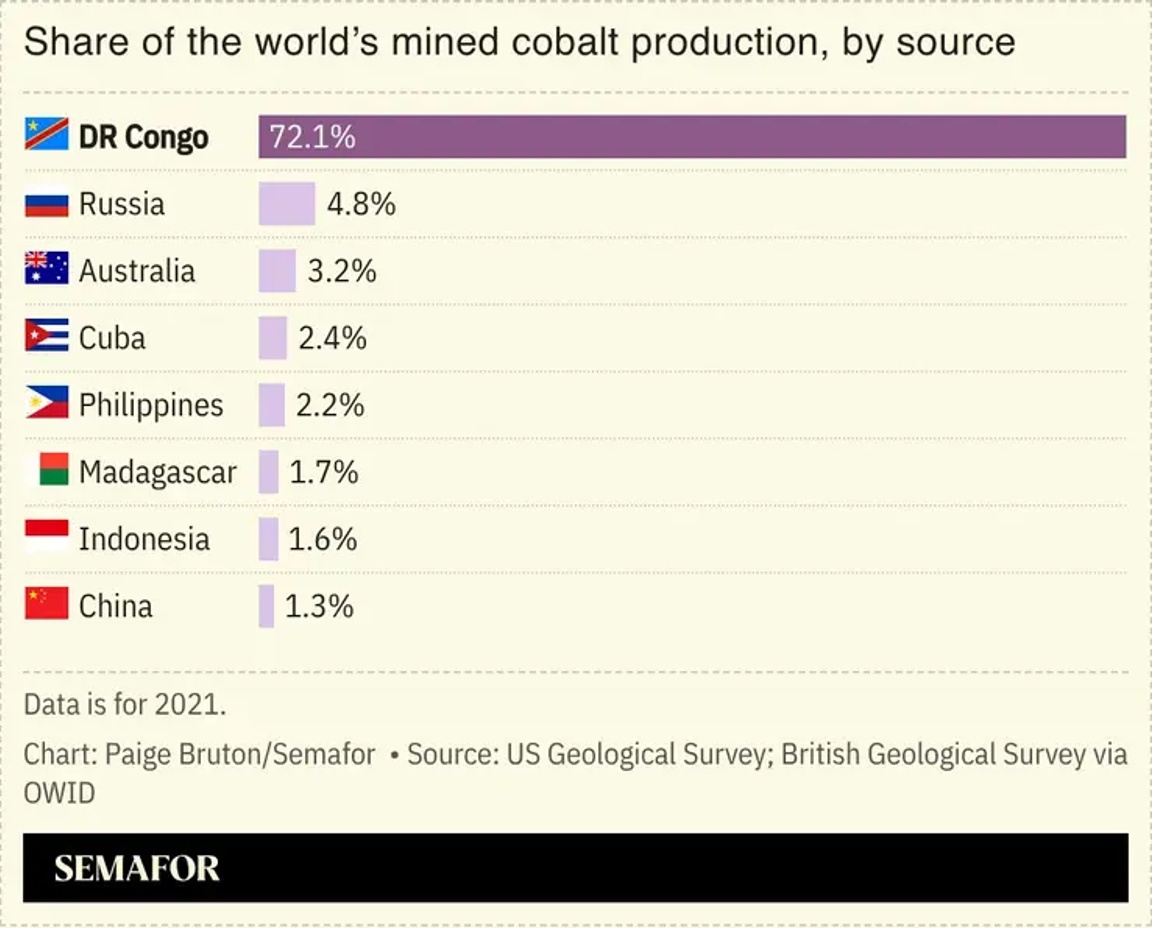 DR Congo will invest $100 million to create a paramilitary force to provide security at its mines, with funding provided by the US and United Arab Emirates. The investment will back a security drive that will see it hire 20,000 mining guards by 2028, Bloomberg reported. DR Congo, the world’s top cobalt producer and Africa’s leading copper supplier, has in recent months agreed a partnership with Washington that grants US companies preferential access to mining assets. The deal — a key plank in America’s attempt to catch up with China’s control of critical mineral supply chains — includes commitments by Kinshasa to tackle insecurity in its mining industry and improve the country’s business climate. Security is a major concern for mining companies looking to enter DR Congo and has held back the development of extractive industries in Africa’s second-largest nation by land mass, which for years has fought rebels in the east of the country. |
|
Troubles compound in Mali, Burkina Faso |
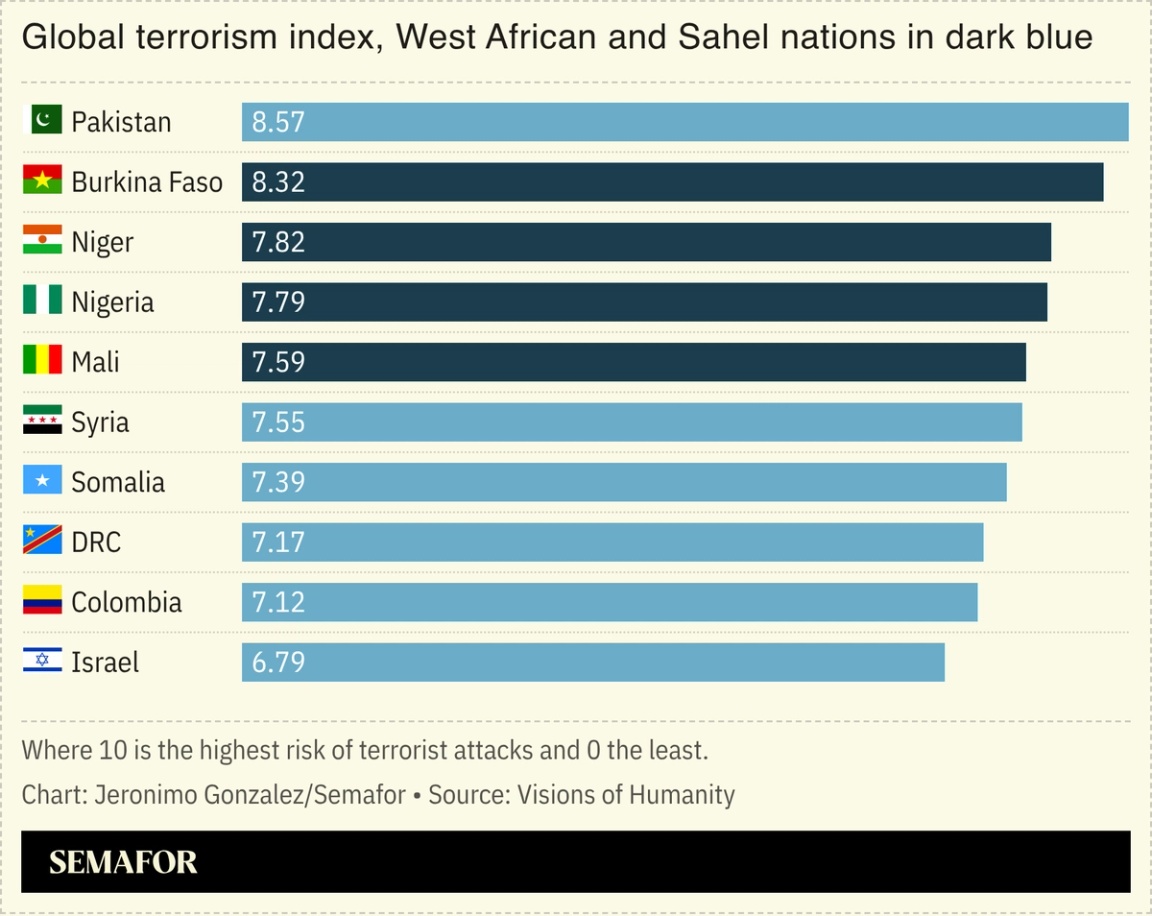 A wave of deadly attacks in Mali and Burkina Faso further destabilized the restive Sahel region. Jihadist militants launched coordinated strikes across junta-ruled Mali over the weekend, intensifying scrutiny of the country’s reliance on Russia for its counterinsurgency campaign. Mali’s defense minister was reported killed on Sunday, and Russian mercenaries were forced to withdraw from key positions in one of the biggest insurgent attacks since 2012. Moscow has a “heavy military hand without a political strategy to address the root causes of violence” in Mali, the Carnegie Endowment wrote. In neighboring Burkina Faso, at least 28 people were killed in an attack on a military base after an uptick in incursions by armed men, RFI reported. The Council on Foreign Relations recently noted that a collapse of international counterterrorism support and weakening regional leadership had “created a vacuum in which violent extremism can expand.” |
|
South Africa’s nuclear ambitions |
| |  | Tiisetso Motsoeneng |
| |
 Koeberg Nuclear Power Station in Cape Town. Esa Alexander/Reuters. Koeberg Nuclear Power Station in Cape Town. Esa Alexander/Reuters.South Africa is hoping to lure back engineers working abroad as part of a recruitment drive to ramp up nuclear power capacity and ultimately supply about a tenth of the nation’s electricity, the country’s most ambitious energy project in decades. The plan aims to attract skilled migrants and South African expatriates, especially those working in the United Arab Emirates, which hired large numbers of local engineers during the build-out of its Barakah Nuclear Plant over the last decade. It forms part of a $120 billion-plus energy roadmap aimed at stabilizing South Africa’s electricity grid and transitioning away from the nation’s longstanding reliance on coal. The nuclear component, targeting 5,200 MW of new generation capacity by 2039, is the most contested pillar of a strategy that includes a major expansion in solar, wind, and gas to power infrastructure. Critics argue the expansion will be expensive and raise the risk of corruption. |
|
A new atlas sheds light on wetlands |
 Eldson Chagara/Reuters Eldson Chagara/ReutersA new digital atlas has collated crucial data on Africa’s wetlands, including their climate change mitigation potential, in a bid to protect one of the world’s most vulnerable ecosystems. Since the 1970s more than a third of the world’s wetlands have disappeared, largely due to climate change and urbanization, at a rate that is three times faster than forest loss. In Africa’s Sahel region, wetlands only make up 10% of the total area, but are home to 75% of the region’s population and support more than 85% of its GDP, Wetlands International, which developed the atlas, told conservation news site Mongabay. They also act as important carbon sinks and help to protect areas from flooding. The atlas is expected to plug a crucial information gap about wetlands in the Sahel and Horn of Africa. |
|
View: Risk of Iran war assumptions |
 Sodiq Adelakun/Reuters Sodiq Adelakun/ReutersMost African governments are betting that the Iran shock will be short-lived, a shaky assumption that could prove “very costly,” two regional experts argued in a Semafor column. Judd Devermont, who led the White House’s African affairs under President Joe Biden, and Jerry Laurienti, a former US senior intelligence service officer, developed a bespoke AI model to run a key assumptions check, with the results revealing a significant vulnerability to a prolonged shock. Nearly half of the continent’s countries have assumed the crisis will fade, they found, and have either limited themselves to symbolic measures or stayed on the sidelines. All African governments need to prepare for a long shock, the authors argued, saying that this was “the moment to pursue greater regional integration and diversification, as well as supply-chain resilience through local refineries and production.” |
|
 - April 27: Zimbabwe announces its ZiG inflation data for April.
- April 27-30: The 15th annual Connected Africa Summit, focusing on digital inclusion and innovation, gathers in Nairobi.
- April 27-May 3: AfrikaBurn, a regional Burning Man festival event, takes place in South Africa’s Tankwa Karoo National Park.
- April 29-30: The Africa Blockchain DeFi & Web3 Summit meets in Lagos.
- April 30: Antler East Africa hosts a Founders Live event in Nairobi, an in-person pitching competition for entrepreneurs.
- April 30: Kenya, Uganda, and Zambia announce their inflation data for April.
|
|
|