| | In today’s edition: Why JD Vance is still Trump’s most likely successor, and House Republicans’ grow͏ ͏ ͏ ͏ ͏ ͏ |
| |  | Washington, DC |  |
| |
|
 - Vance 2028?
- Ballroom fight
- House GOP divisions
- Energy cost worries
- Iran fractures alliances
- Florida’s new map
- Politico staff letter
PDB: DHS intensifies scrutiny of green card applicants  King Charles III addresses Congress … California gubernatorial candidates debate … Oil soars to $111 a barrel on Iran standoff |
|
View / Why it’s still JD Vance |
| |  | Ben Smith |
| |
 Illustration: Joey Pfeifer/Semafor; Photo: Anna Rose Layden/Reuters Illustration: Joey Pfeifer/Semafor; Photo: Anna Rose Layden/ReutersVice President JD Vance overwhelmingly remains the likely Republican nominee in 2028, despite Washington conventional wisdom holding that the prize is slipping a bit from his grasp. Polymarket has his odds of winning the nomination below 40%, down from a November high near 60%, former Obama aide Dan Pfeiffer says his confidence in a Vance nomination has “waned,” and Washington insiders would really love to return to the relative normalcy suggested by a Marco Rubio presidency. But after a round of conversations this past week with Vance’s circle and people close to his putative rivals alike, I emerged surprised that his given odds aren’t higher. Much of this is just the obvious political reality of President Donald Trump’s Republican Party. But he’s also been a bestselling author and an effective political performer who has managed the Republican coalition more deftly than his critics imagine. |
|
Congress unlikely to fast-track ballroom |
 Kylie Cooper/Reuters Kylie Cooper/ReutersSenate Republicans are releasing a flurry of proposals to finish Trump’s ballroom, with the latest arriving overnight. Montana GOP Sen. Tim Sheehy’s bill, shared first with Semafor this morning, would authorize the project without using taxpayer money — a contrast to one from Sen. Lindsey Graham, R-S.C., which would divert $400 million to the ballroom. Sen. Rand Paul, R-Ky., also released a bill Monday with an expedited review process for White House projects. Meanwhile, Rep. Ralph Norman, R-S.C., told reporters on Monday that “you don’t need Congress” to approve the ballroom — so quick action on any of these ideas seems unlikely. Most Democrats oppose passing funding for the ballroom and don’t see a connection between the space and Saturday’s attack directed at Trump. And GOP leaders are reluctant to tack the project on to their party-line immigration enforcement funding plan. — Burgess Everett and Nicholas Wu |
|
House GOP divisions flare |
 Annabelle Gordon/Reuters Annabelle Gordon/ReutersHouse GOP leaders are running headlong into resistance from the conference’s right flank. Leadership urged lawmakers during a conference meeting last night to pass their major agenda items this week without making changes. That includes the renewal of warrantless surveillance powers, the farm bill, and a budget blueprint for funding ICE and CBP. But House conservatives aren’t convinced and still want to amend many of those items. They’re threatening to vote down the rule setting up a final vote on the FISA legislation, too. “Heck no. They need to gut FISA and come back with a different product,” said Rep. Tim Burchett, R-Tenn., while Rep. Chip Roy, R-Texas, said he still wants “improvements” to the DHS bill. House Speaker Mike Johnson has floated passing the budget blueprint and also sending a new bill to reopen DHS to the Senate. — Nicholas Wu |
|
War heightens fears over energy costs |
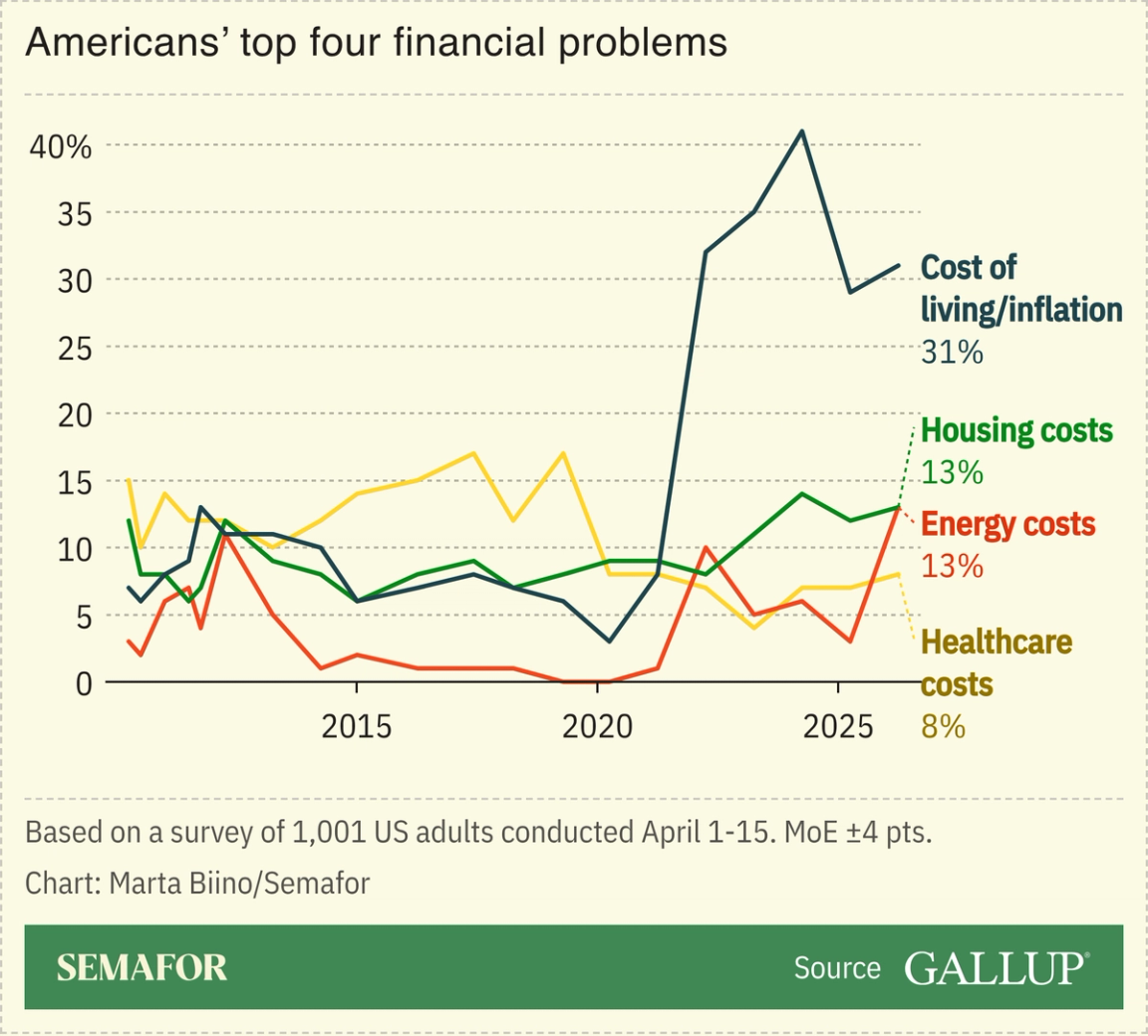 The number of Americans who are singling out energy costs as their most important financial problem — 13%, according to new Gallup polling — is the highest it’s been in nearly two decades, as the Iran war drives up prices. That’s an increase of 10 percentage points from last year and is the biggest share recorded since 2008. Nearly a third of Americans, meanwhile, pointed to the high cost of living overall as their most pressing financial concern — suggesting affordability remains a top voting issue. The poll also points to broader economic malaise; 55% of Americans say recent price increases have led to financial hardship, and the same number say their financial situation is deteriorating. Against that backdrop, the Federal Reserve meets today; the central bank is widely expected to keep interest rates steady. |
|
Europe pressures Trump over Iran |
 As Trump weighs a new proposal to end the Iran war, he faces more pointed criticism from traditional allies over the eight-week conflict. The US is “being humiliated” by Iran, German Chancellor Friedrich Merz said yesterday, adding that the Trump administration “quite obviously went into this war without any strategy” and has “no truly convincing strategy in the negotiations either.” European leaders are facing growing political pressure as the war drives up energy costs. The conflict has led to a fracture between Trump and British Prime Minister Keir Starmer — one that King Charles III is on a mission to mend this week on his swing through DC. The Trump administration is keeping up pressure on Tehran amid talks of a potential deal; Treasury Secretary Scott Bessent threatened sanctions on any companies working with Iranian airlines as they look to resume flights. |
|
Florida legislature set to approve new map |
 Evelyn Hockstein/Reuters Evelyn Hockstein/ReutersThe Florida legislature is poised to approve a new, gerrymandered congressional map as it gathers for a special session today. Gov. Ron DeSantis unveiled the new map just yesterday, telling state legislators that the Supreme Court will likely wipe out constitutional requirements for majority-minority districts. The new map would replace four Democratic-leaning seats with Republican seats, contradicting the state’s prohibition on partisan redistricting. House Democratic Leader Hakeem Jeffries said that the “DeSantis dummymander” would “go nowhere,” but Republicans believe that it can pass fast enough to dodge legal jeopardy in the state supreme court, where conservatives have a supermajority. In a legal memo, the governor’s office argued that the Voting Rights Act’s racial components would likely be struck down soon, that the state’s own voter-passed gerrymandering ban was likely invalid, and that population growth since 2020 rendered current lines outdated. — David Weigel |
|
Politico staff raise concerns about CEO |
 Mathias Döpfner. Kevin Dietsch/Getty Images. Mathias Döpfner. Kevin Dietsch/Getty Images.Executives at Politico and its parent company, Axel Springer, held a meeting yesterday with its journalists that touched on a recent letter from staffers who raised concerns about whether its CEO’s political views interfered with Politico’s journalism, Semafor’s Max Tani scoops. On Friday, Politico employees — including some in Europe and some members of its US unionized staff — sent a letter to Jonathan Greenberger, Politico’s new editor-in-chief, warning that Axel Springer CEO Mathias Döpfner’s “repeated use of POLITICO to promote his political agenda” risked “taking on the appearance of editorial slant.” Staffers pointed to two recent op-eds written by Döpfner, including one calling on Europe to support the US and Israel in their war with Iran. During yesterday’s meeting, which was convened to discuss Greenberger’s editorial vision, he and Döpfner reiterated Axel Springer’s commitment to Politico’s independence and tried to reassure staff. |
|
Blindspot: Weapons and AI |
 Stories that are being largely ignored by either left-leaning or right-leaning outlets, curated with help from our partners at Ground News. 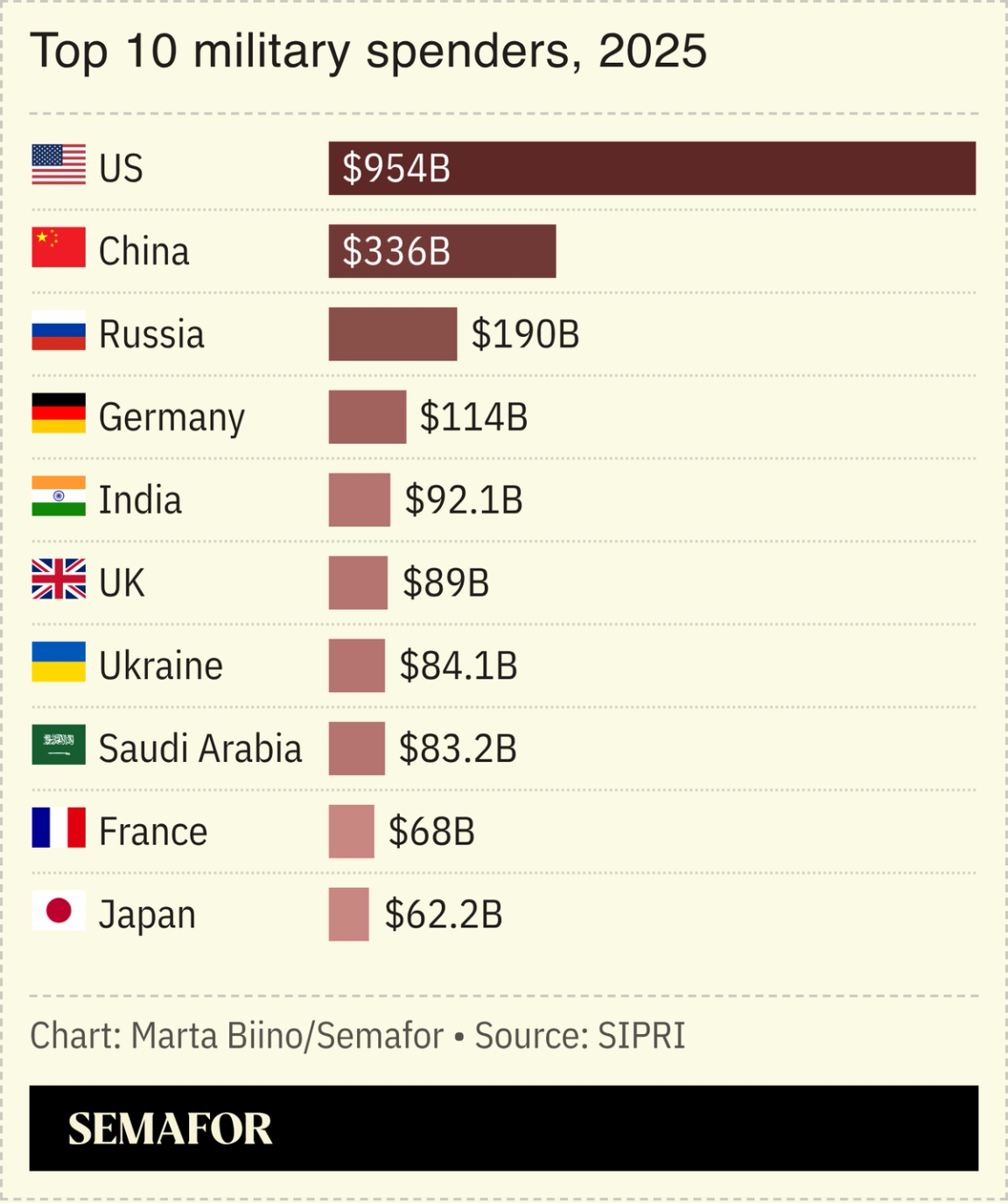 What the Left isn’t reading: Global military spending hit a record high last year. What the Right isn’t reading: More than 600 Google employees signed a letter urging CEO Sundar Pichai to prevent the Pentagon from using its AI models for classified work. |
|
 Can Mark Cuban solve soaring healthcare costs? On this week’s episode of Compound Interest, presented by Amazon Business, Mark joins Liz and Rohan to discuss his approach with Cost Plus Drugs, which aims to disrupt the little-known middlemen driving up prescription drug prices. He also discussed soaring valuations in sports, his regrets around the Dallas Mavericks sale, and offered a surprising assessment of TrumpRx. |
|
 Beltway NewslettersPunchbowl News: “They’re clearly not talking to their members,” Rep. Jim McGovern, D-Mass., the top Democrat on the House Rules Committee, said of Republicans’ failure to pass a rule to extend warrantless government surveillance powers. “They have no clue on strategy or how to move anything across the finish line, and it’s just frustrating as hell.” Playbook: The White House is holding a meeting with tech and cyber firms today on the cybersecurity implications arising from Anthropic’s powerful Mythos model. Axios: The Iran stalemate risks drawing America into a Cold War-like frozen conflict with no fighting and no deal, several US officials said, with one saying this scenario would be “the worst thing for Trump politically and economically.” White House- Vice President JD Vance has questioned the accuracy of the Pentagon’s information about the Iran war. — The Atlantic
|
|
|


