
|
 |



Tell me who you think wrote this:
“‘The National Trust for Historic Preservation’ is a beautiful name, but even their name is FAKE because when they add the words ‘in the United States’ to the National Trust for Historic Preservation, it makes it sound like a Governmental Agency, which it is not. In fact, the United States refused to continue funding it in 2005 because they strongly disagreed with their mission and objectives. They are very bad for our Country.”
I know who it sounds like in my head. I can hear Donald Trump’s voice.
But in fact, it’s the lead paragraph in a motion filed by the Justice Department Tuesday morning, in the lawsuit over Trump’s unauthorized demolition of the White House’s East Wing so he could build his ballroom. The lawsuit alleges violations of environmental and historic preservation laws, seeking to stop construction. We’ve been discussing it as it progresses.
 |
But in the wake of Saturday night’s incident at the White House Correspondents’ Dinner, DOJ filed a remarkable statement of position in the case this morning, without a request from the judge. It was filed over the acting Attorney General’s name and signed by the Associate Attorney General (who, while the acting AG is seeking the nomination for the permanent position, is reportedly fighting for his job).
The pleading, which is titled “DEFENDANTS’ RULE 62.1 MOTION FOR AN INDICATIVE RULING DISSOLVING THE COURT’S INJUNCTION”—a request that the court tip its hand on how it will rule in the future—goes on to explain that despite being asked by the military not to sue because of the “Top Secret nature of the important facility being built,” the plaintiffs went ahead. Why would they do such a thing? The motion explains: “This did not deter them because they suffer from Trump Derangement Syndrome, commonly referred to as TDS, as noted by Democrat Senator John Fetterman, of Pennsylvania, and are represented by the lawyer for Barack Hussein Obama, Gregory Craig.”
The upper echelons of the Justice Department have truly become the president’s law firm.
You know what’s coming next. The motion delivers it: “With such a facility, it would have been impossible for an attack like that which took place last Saturday evening in D.C.” It continues, “The Secret Service fortunately neutralized the assassin before he could reach the ballroom. However, Saturday’s narrow miss—which marks the third assassination attempt on President Trump since 2024—confirms what should have already been obvious: Presidents need a secure space for large events, that currently does not exist in Washington, D.C., and this Court’s injunction stalling this Project cannot defensibly continue, for the sake of the safety of President Trump, future Presidents, and their families, Cabinets, and staff.” That might work—if presidents never traveled out of the ballroom. The motion maintains that “This Project will ensure that events like the horrific attack on Saturday night do not happen again.” Perhaps the president should consider reforming gun laws if he hopes for that outcome, because building a ballroom isn’t going to get him there.
The motion continues, replete with excessive capitalization, and tells the court that “this weekend makes clear why this Court’s injunction must be dissolved ‘immediately.’” The injunction that partially stops work on the project is on appeal, which halts the court’s jurisdiction, which is why the White House is asking for an “indicative” ruling. But instead of making legal arguments, they resort to insulting the court’s prior ruling, writing, “This Court should never have enjoined this Project, but now, after the Saturday night attempted assassination, which could have never taken place in the new facility, reasonable minds can no longer differ — The injunction must be dissolved. This Court should immediately issue an indicative ruling that it will dissolve the injunction, and put an end to this frivolous lawsuit, which greatly endangers the lives of all Presidents, current and future.” This president, who seeks the power of a unitary executive, a king in everything but name, wants to simply tell a federal judge what to do and make it so, using Saturday night as a convenient hook. And tellingly, no one at the Justice Department told him no. No one stood up for principle or the rule of law.
I had expected to devote the entirety of this post to the motion, but it was not to be due to other developments. You can read the motion in full here, but read on first, because there is other news.
In what has to be the ultimate small world story, former FBI Director Jim Comey’s daughter, Maurene, was the federal prosecutor who handled the Epstein case and obtained the conviction of Ghislaine Maxwell. Her performance as a prosecutor was “exemplary” until she was fired, according to the judge who is handling her lawsuit challenging her removal. Maurene Comey sued, arguing that she was improperly removed “solely or substantially because her father is former FBI Director James B. Comey, or because of her perceived political affiliation and beliefs, or both.”
The Trump administration wanted the case dismissed, maintaining she couldn’t bring suit in federal court, but today, federal District Judge Jesse M. Furman in the Southern District of New York held that she could proceed. That decision may spill over and encourage other fired federal employees, because her case will be heard by a federal judge, not an administrative agency, the Merit Systems Protection Board, which itself has been impacted by Trump firings.
But, of course, Maurene wasn’t the only Comey in the news today, because her father was indicted—for the second time—by the Justice Department, this time in a case that skates on even thinner ice than the one that was dismissed late last year.
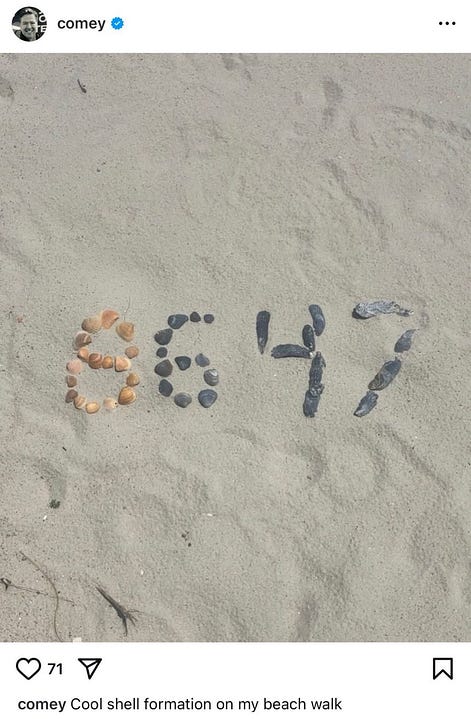
The indictment is about this now-deleted Instagram post. That’s alleged to be a criminal act, a threat of physical violence to the president of the United States. It sure looks like First Amendment-protected political speech, though.
 |
This case against Comey is precisely the sort of political weaponization of the criminal justice system that this administration baselessly accuses the Biden administration of. The indictment alleges that the post is a threat against the president, and charges Comey with two crimes:
18 USC 871(a), which makes it a crime to knowingly and willfully make any threat to take the life of, kidnap, or inflict bodily harm upon the President of the United States; and
18 USC 875(c), which makes it a crime to make a threat to injure a person.
The charges make about as much sense as the theory that because the Southern Poverty Law Center was paying informants to provide information about hate groups, it was somehow supporting those groups. Here, the government will have to prove, beyond a reasonable doubt, that “86 47” conveys a physical threat against Trump, when anyone who has ever worked in a restaurant will tell you it means remove, as in to remove a sold-out item from the menu, or in this case, remove Donald Trump from office.
Comey promptly apologized and removed his post when it was suggested that it might be construed as encouraging violence. Was it a smart post? I’ll leave that up to you. Was it criminal? That’s up to the courts, and perhaps ultimately, to a jury.
In 2022, in Counterman v. Colorado, a 7-2 Supreme Court explained the “true threat” doctrine, which is the dividing line between pure political speech, an expression of dissatisfaction or even dislike of the current president that is protected by the First Amendment, and a true threat that is not, and can give rise to prosecution. Justice Kagan wrote the majority opinion. She was joined by the Chief Justice, as well as Justices Alito, Kavanaugh, and Jackson. Justice Sotomayor concurred in the judgment and was joined in parts by Justice Gorsuch. Justices Thomas and Barrett