|
|
|
|
Good morning. Canada’s economy remains under strain, but new signs suggest the country is weathering the storms of war and trade tensions better than some had feared. That’s in focus today – along with a look at how drug deaths in Canada and the United States are declining overall, but unevenly at the local level. |
|
|
|
|
|
|
|
|
|
|
|
|
|
|
|
|
Energy: Negotiations between Alberta and Ottawa that could pave the way for a new oil pipeline have been stymied by disagreements over carbon pricing and a CO2-capture project in the oil sands. |
|
|
|
|
|
|
|
|
|
|
|
|
|
|
|
|
|
|
|
|
|
|
|
|
|
|
|
Shipping containers in the Port of Montreal. Christopher Katsarov/The Canadian Press
|
|
|
|
|
|
|
|
|
|
|
How Canada is staying afloat |
|
|
|
|
While yesterday’s Statistics Canada report
didn’t exactly set hearts aflutter – at least, mine didn’t noticeably flit, but that could be because I’m trying to drink less coffee – it did point to how the country is coping with slow growth and pressures from the Iran war. There are downsides almost everywhere you look, but also signs that the country, at least through a wide-angled lens, is more resilient than expected. |
|
|
|
|
Trade: Canada’s merchandise trade balance swung to a surplus of $1.8-billion in March compared with a deficit of $5.1-billion in February. |
|
|
|
|
|
|
|
|
That surplus was driven by higher oil prices and a burst of gold exports – not exactly the kind of foundation an economy can count on for sustained growth. Strip those out, and exports fell at a 2.4-per-cent annualized pace in the first quarter. |
|
|
|
|
Tariff‑exposed exports continue to struggle: Steel was down about 50 per cent from a year earlier; lumber about 22 per cent. |
|
|
|
|
But motor vehicle exports continued a steady drive up from earlier production disruptions, and overall export volumes were higher year-over-year for the first time since last March. |
|
|
|
|
Energy: Higher oil prices have been a clear financial boon for Canada’s energy sector. Crude oil exports jumped nearly 19 per cent in March from February, when oil prices surged following the U.S.-Israeli attack on Iran. |
|
|
|
|
The price shock is funnelling significantly more revenue into Canada’s oil-producing regions, quickly boosting export values even without a corresponding rise in volumes. |
|
|
|
|
That’s why the head of the International Energy Agency is calling on Canada to accelerate energy infrastructure projects. Fatih
Birol is in Ottawa this week to meet with federal cabinet ministers about the energy crisis, which is hobbling global markets. Given the high price of oil, the country has a “once-in-a-generation opportunity” to become a major exporting player, he said. |
|
|
|
|
But talking about major infrastructure in Canada is a whole lot harder than building major infrastructure in Canada. As Emma Graney and Stephanie Levitz report, early negotiations between Alberta and Ottawa on making way for a new oil pipeline are already mired in muskeg. |
|
|
|
|
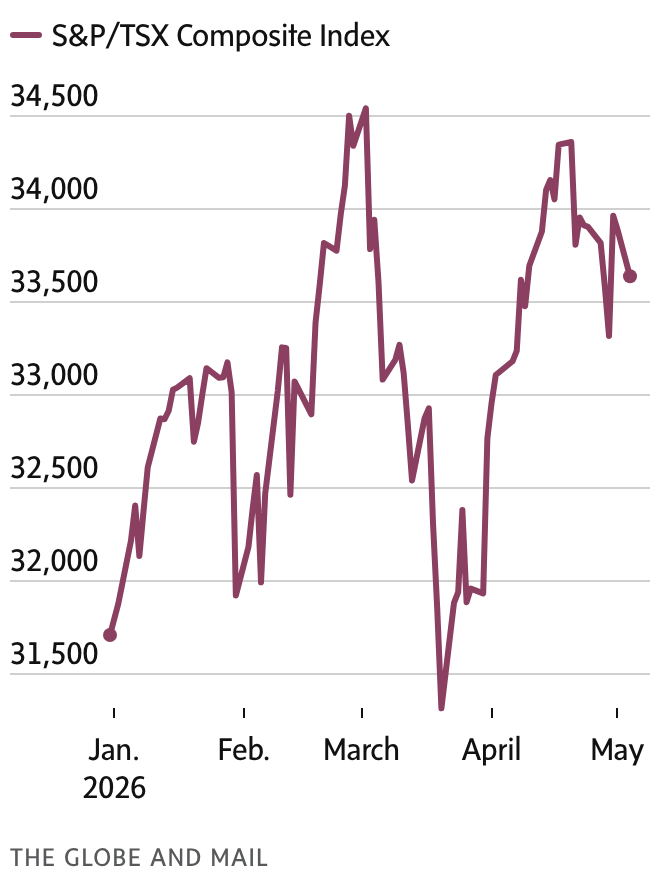
Earnings: Investor behaviour suggests markets don’t believe wider geopolitical shocks will weigh on the earnings of Canada’s major oil producers, which account for roughly 15 per cent of the S&P/TSX Composite. The index gained nearly 8 per cent in the first five months of the year after rising almost 32 per cent in 2025. |
|
|
|
|
|
|
At least for now. As this (↑) chart shows, that confidence wobbled in mid‑March when signs emerged that the Iran conflict might cool, pulling down oil and gold prices – and with them, a Canadian market that had been buoyed by both. |
|
|
|
|
Consumers: As anyone who eats food or uses fuel knows, higher oil prices come with a downside. Even after Prime Minister Mark Carney suspended the federal government’s tax on gas, prices at the pump are well above their prewar prices. |
|
|
|
|
While high fuel prices sting, Rob Carrick writes, they could fall if a resolution is reached in the Iran war. The larger issue is food. “There’s nil chance of food prices declining from current levels in a broad and noticeable way.” |
|
|
|
|
Food inflation is above the rate of wage increases, and food is what matters to most Canadians, Carrick told me. Wage increases have tracked above inflation – but that’s only on average, “which means plenty of people are getting nothing or close to it while others are doing well.” |
|
|
|
|
Canadian economy: Higher
imports from earlier in the year could weigh heavily on economic growth in the first quarter, economists at RBC wrote in a note to clients yesterday. But it’s a drag on paper that hints at strength: Gains in industrial equipment imports point to sustained business investment. That hasn’t exactly been a strong point for Canada in recent years, and represents one of Carney’s biggest challenges. |
|
|
|
|
(Relatively) comforting thoughts: A combination of higher energy revenues, the lagging effects of earlier interest-rate cuts and increased government spending will support further improvement in Canadians’ standard of living in the year ahead, the economists wrote. |
|
|
|
|
There’s still the matter of trade negotiations with the U.S. But there’s room for mild optimism there, too, according to David Doyle, head of economics at Macquarie Group. In a market strategy note last night, he outlined an expectation that the United States Mexico Canada free-trade agreement “will continue in force,” although a finalized deal to renew it, including any changes, does not appear likely before July. |
|
|
|
|
|
|
|
|
|
|
|
|
|
|
|
|
|
|