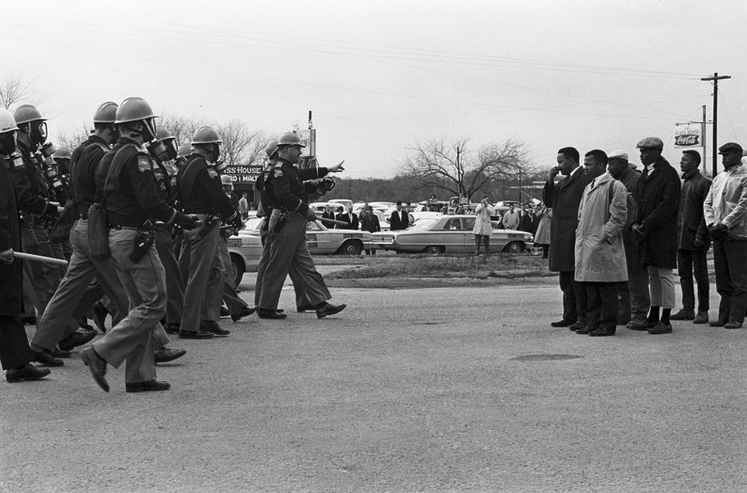
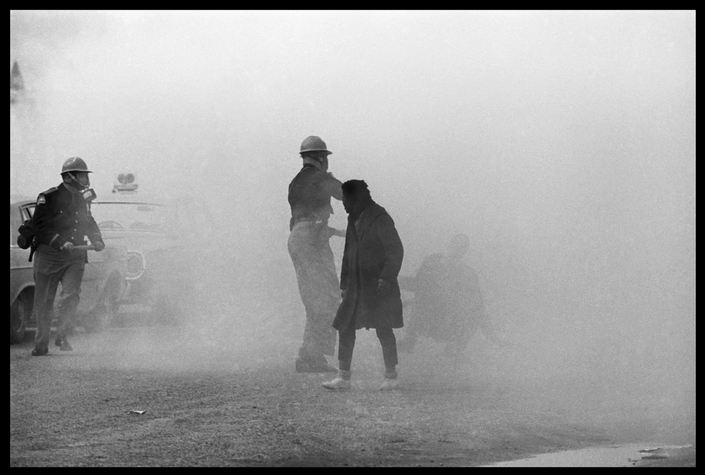
Top: Police advance on the demonstrators. Mauldin is second from the right. Bottom: Tear gas fired by police wafts through the air on “Bloody Sunday.” (Spider Martin/The Spider Martin Civil Rights Collection)
As police began beating people around him, Mauldin said, he remembers Lewis being struck over the head with a club.
“I’ll never forget the sound of his head being cracked,” he recalled.
Then, troopers turned to tear gas.
“What tear gas does, it makes your skin burn, it forces you to run away from it — it makes your lungs seem to implode,” Mauldin continued.
He got as low to the ground as possible. Then, he said, he and others ran to the river and eventually made their way back to the Brown Chapel A.M.E. Church.
There was “nothing to do unless you can escape it,” Mauldin said. “It’s a pretty harrowing experience, especially for kids.”
In the years after Mauldin was tear gassed, he was diagnosed with asthma. There’s no research that shows tear gas as the cause of an asthma diagnosis, but it’s technically possible since the chemicals can cause lung injury, Sven Jordt, a professor at Duke University School of Medicine who’s an expert on tear gas, told ProPublica. In one of the court declarations we read as part of our reporting, the mother of the 12-year-old who broke out in hives said her son also developed “chronic respiratory issues” and now needed an inhaler after months of breathing in tear gas that seeped into their home. The family lives near an ICE facility in Portland, Oregon, where federal officers routinely shot chemical munitions at protesters.
Another parent living near an ICE facility in Broadview, Illinois, told us she’s taken her 7-year-old daughter to urgent care about five times since last fall, when officers repeatedly used tear gas against protesters. “She’s been complaining about her throat,” the mother said of her daughter. “It gets to the point she can’t breathe.”
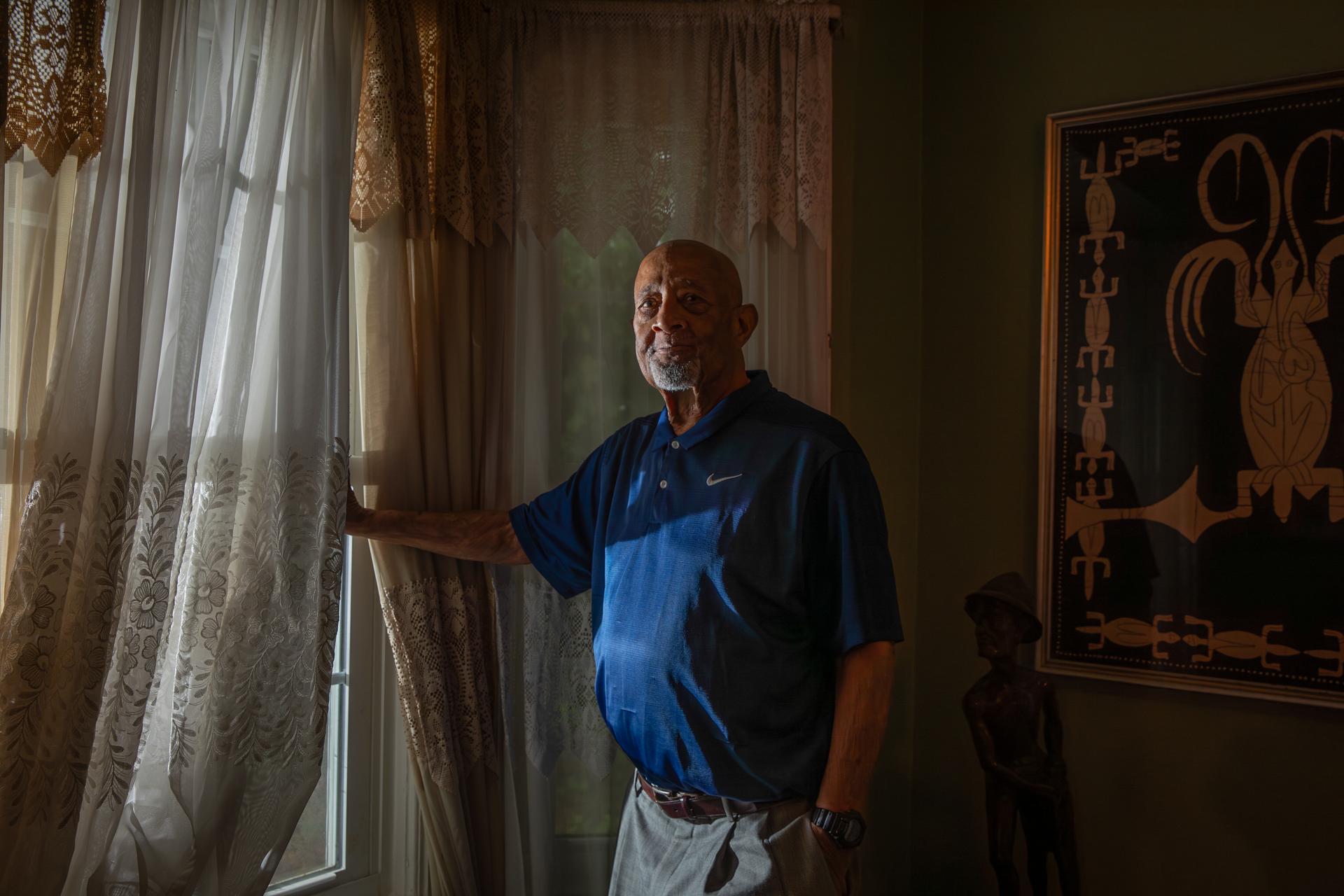
For Mauldin, who said he is the last living person from the front of the line on that Sunday in 1965, being tear-gassed at a young age left an emotional toll — one he said he is still coming to terms with.
Experts we spoke with emphasized how important it is for children who were recently tear-gassed or pepper-sprayed to seek help for their mental health. That includes children who were not only directly harmed by these chemicals but also those who saw other people hurt by law enforcement, said Dr. Sarita Chung of Boston Children’s Hospital, who studies pediatric disaster preparedness and response. “Without support, this could be a lifelong burden.”
At first, children may struggle to sleep or eat, or have difficulty concentrating after experiencing a traumatic event, said Dr. Andrew Racine, president of the American Academy of Pediatrics. That’s especially true for younger children who can’t grasp what’s happening, he said. These reactions may dissipate over time, but the core event may stick with a child for much longer: “Some of them will remember this for a very, very, very long time.”
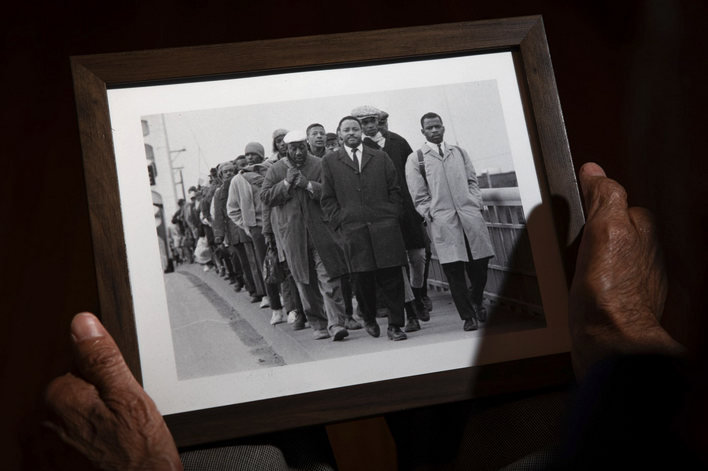
Mauldin only recently began sharing his experience about what happened at the Edmund Pettus Bridge, an event of police brutality that became known as “Bloody Sunday.” Processing that trauma began after visiting the bridge some years ago with historians, who Mauldin said helped get him to open up memories and emotions he had suppressed.
“If you don’t realize it, and you don’t get help with it … it’ll limit your experience to grow and be the best that you can be,” Mauldin said. “You have to be able to kill a part of yourself to be able to sustain that trauma.”