Donald Trump is headed to China with a whole bunch of top U.S. CEOs in tow to talk about trade. There is probably a post to be written here about how Trump is creating a new kind of “America, Inc.” centered around his own person, using a combination of tariffs, export controls, federal government equity stakes, and personal bullying. But this is not that post. Instead, this is a post about decoupling. Trump was elected in 2016, and again in 2024, on promises to reduce American economic dependence on China. How well has he succeeded?
First, some background. In the mid-2010s, when Trump came to power, the U.S. and China had a pretty well-understood economic relationship. America did R&D and designed products, then shipped the designs to China where they were manufactured — often using components from Japan/Korea/Taiwan, but sometimes using Chinese components. China would then ship the products back to America, where they were marketed and sold and serviced by the American companies.
Both countries chafed at this arrangement. Americans complained that the relocation of labor-intensive assembly to China put American factory workers out of a job (which was true) and worried that outsourcing assembly would eventually lead to the outsourcing of more valuable activities (which was probably true), while Chinese leaders were annoyed at being stuck in the low-value-added middle of the production chain. So both countries implemented policies to break up this arrangement and create a new trading system.
China used industrial policy to onshore high-value component manufacturing and create its own “national champion” brands, while U.S. Presidents Trump and Biden strove to reduce U.S. trade dependence on China. I wrote about this breakup in 2022:
Everyone agrees that China has succeeded in its half of the decoupling — far more Chinese-made goods are now made with Chinese components. The country has climbed up the value chain, and developed top brands like BYD, Huawei, Xiaomi, DJI, CATL, and so on.
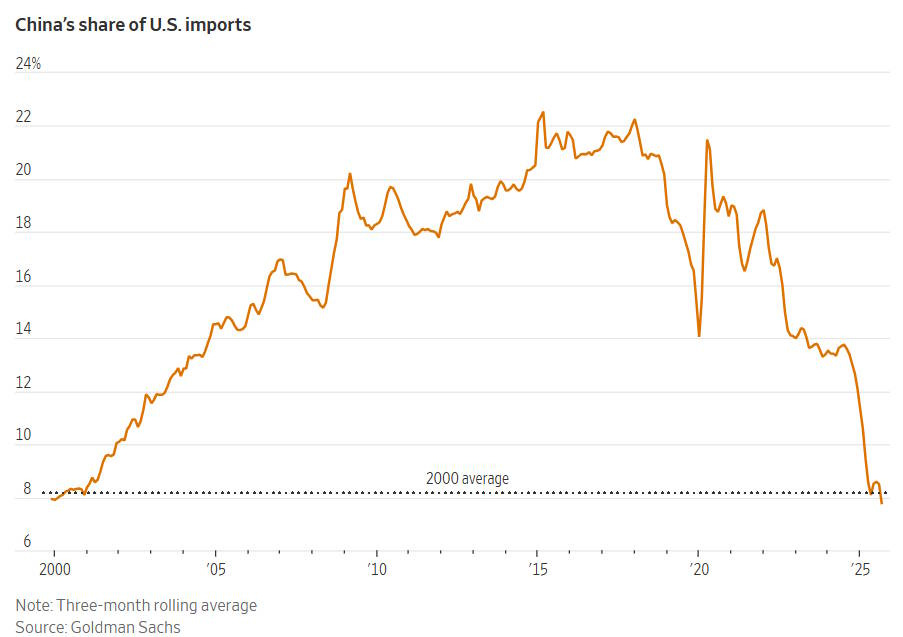
Whether the U.S. has succeeded in reducing its dependence on Chinese manufacturing, however, has been a subject of hot debate. On one hand, the percentage of America’s imports that it gets from China has plummeted:
That’s from a WSJ story in February of this year, entitled “The American and Chinese Economies Are Hurtling Toward a Messy Divorce”. A few more details:
Some businesses have moved production from China to the U.S. to avoid tariffs, but the flow is still modest. Mexico and Southeast Asian nations are more common destinations for manufacturers leaving China…About 9% of Ohio manufacturers in a recent survey said they had reshored some production to the U.S. in 2025, up from 4% in 2021. About 60% of the reshoring in 2025 relocated from China[.]
It’s clear that tariffs have had an effect on the shifting of U.S. imports away from China. Even Trump’s far weaker tariffs in his first term showed results — America started buying tariffed goods from countries other than China, even as it kept buying non-tariffed goods from China: